New Thinking Allowed Interviews: Sanskrit the Language of Yoga (2012)

“The Language of the Gods” or Sanskrit the Language of Yoga

A 3-part interview plus an interview on the History of Yoga as part of Jeffrey Mishlove’s New Thinking Allowed program


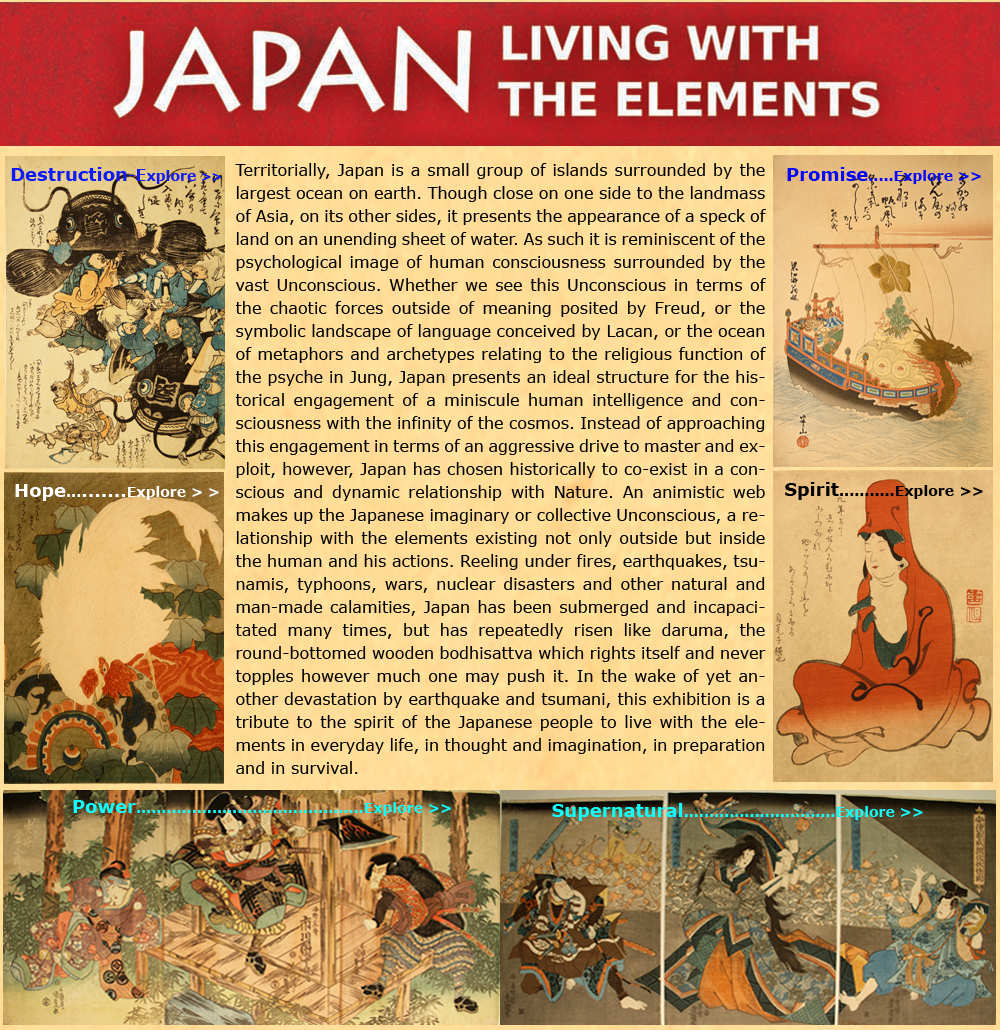
Japan: Living with the Elements

This exhibition was held at the Philosophical Research Society, Los Angeles, from July 23 – September 25, 2011. Responsding to the disastrous earthquakes of 2011 in North Honshu, the exhibition, showcasing Manly P. Hall’s collection of surimono, ukiyo-e, Japanese photographs and books, was designed as a fundraiser for the victims of the earthquake. It celebrated the spirit of the Japanese people and their shinto and Buddhist roots, bringing them into intimate relationship with the elemental forces of nature.

Sapta Chatusthaya Intensives

May 2009 – (Introduction to Siddhi Chatusthaya – chapters 1-4 of The Yoga of Self-Perfection)

Day 1
Introduction & Session 1 Part 1
Introduction & Session 1 Part 2
Session 2
Session 3
Session 4
Day 2
Introduction & Session 5 Part 1
Introduction & Session 5 Part 2
Session 6
Session 7 Part 1
Session 7 Part 2

July 2009 – (Siddhi Chatusthaya, Shuddhi – chapters 5-7 of The Yoga of Self-Perfection)

Day 1
Introduction & Session 1 Part 1
Session 2
Session 3 Part 1
Session 3 Part 2
Session 4 Part 1
Session 4 Part 2
Day 2
Session 5
Session 6
Session 7

October 2009 – (Siddhi Chatusthaya, Shuddhi and Mukti – chapters 7-9 of The Yoga of Self-Perfection)

Day 1 (Shuddhi: Completion of Chapter 7)
Session 1
Session 2
Day 1 (Mukti: Chapter 8)
Session 3
Session 4
Day 2
Session 1
Session 2
Session 3

March 2010 – (Samata Chatusthaya – chapters 11-13 of The Yoga of Self-Perfection)

Day 1
Session 1
Session 2 & 3
Session 3 (Alternate w/ overlap)
Session 4
Session 4 (Alternate w/ overlap)
Session 5
Day 2
Session 6
Session 7
Session 7 (Alternate w/ overlap)
Session 8
Session 8 (Alternate w/ overlap)
Session 9

May 2010 – (Chapters 14 and Chapter 15 of The Yoga of Self Perfection)

Day 1
Session 1
Session 2
Session 3
Day 2
Session 1
Session 2
Session 3
Session 4

July 2010 – (Chapters 16 and Chapter 17 of The Yoga of Self Perfection)

Day 1
Session 1
Session 2
Session 3
Session 4
Session 5
Session 6
Session 7
Day 2
Session 1
Session 2
Session 3
Session 4

Nov 2010

Day 1
Session 1 Part 1
Session 1 Part 2
Session 2 Part 1
Session 2 Part 2
Session 2 Part 3
Session 3 Part 1
Session 3 Part 2
Day 2
Session 1 Part 1
Session 2 Part 1
Session 2 Part 2
Session 3 Part 1
Session 3 Part 2

The Life Divine Studies On Skype – Recordings Book-II-Part-2-Chapter-15-28

Chapter 15 – Reality and the Integral Knowledge
03/22/2007 – Part-I
03/22/2007 Part-II
03/29/2007
04/05/2007
04/12/2007
04/19/2007 -I
04/19/2007 – II
04/26/2007
05/03/2007
05/10/2007
Chapter 16 – The Integral Knowledge and the Aim of Life; Four Theories of Existence
05/17/2007
05/24/2007
05/31/2007
06/07/2007
06/14/2007
06/21/2007
06/28/2007
>07/05/2007
07/12/2007
07/19/2007
07/26/2007
08/02/2007
Chapter 17 – The Progress to Knowledge – God, Man and Nature
08/30/2007
09/06/2007
09/13/2007
09/20/2007
09/27/2007
Chapter 18 – The Evolutionary Process – Ascent and Integration
11/01/2007
11/08/2007
11/22/2007
11/29/2007
12/06/2007
12/13/2007
01/10/2008
01/17/2008
Chapter 19 – Out of the Sevenfold Ignorance towards the Sevenfold Knowledge
02/21/2008
02/28/2008
03/06/2008
03/13/2008
03/20/2008
04/10/2008
Chapter 20 – The Philosophy of Rebirth
04/17/2008
05/01/2008
05/08/2008
05/22/2008
05/29/2008
06/05/2008
06/12/2008
07/10/2008
07/17/2008
07/31/2008
08/28/2008
09/03/2008
09/10/2008
Chapter 21 – The Order of the Worlds
09/17/2008
09/26/2008
10/01/2008
10/08/2008
10/15/2008
10/22/2008
10/29/2008
11/05/2008
11/12/2008
11/19/2008
11/26/2008
Chapter 22 – Rebirth and Other Worlds; Karma, the Soul and Immortality
12/03/2008
12/10/2008
01/14/2009
01/22/2009
01/28/2009
02/05/2009 Part I
02/05/2009 Part II
No class 02/12/2009
02/19/2009
02/26/2009
03/05/2009
03/12/2009
03/19/2009
03/26/2009
04/02/2009
Chapter 23 – Man and the Evolution
04/02/2009
04/09/2009
04/16/2009
04/23/2009
04/30/2009
05/07/2009
05/14/2009
05/21/2009
05/28/2009
06/04/2009
06/11/2009
Chapter 24 – The Evolution of the Spiritual Man
06/25/2009
07/02/2009
07/09/2009
07/16/2009-No-Class-Discussion-on-Synthesis-of-Yoga-Book-IV
07/23/2009
08/06/2009
08/13/2009
08/20/2009
08/27/2009
09/03/2009
No class 09/10/2009
09/17/2009
09/24/2009
10/01/2009
Chapter 25 – The Triple Transformation
10/08/2009
10/15/2009
10/22/2009
10/29/2009
11/05/2009
11/12/2009
12/03/2009
12/10/2009
12/17/2009
Chapter 26 – The Ascent to the Supermind
02/11/2010
02/18/2010
02/25/2010
03/04/2010
03/11/2010
03/18/2010
03/25/2010
04/01/2010
04/08/2010
04/15/2010
04/22/2010
Chapter 27 – The Gnostic Being
04/29/2010
05/06/2010
05/13/2010
06/03/2010
06/10/2010
06/26/2010
07/22/2010
Chapter 28 – The Divine Life
12/02/2010

Techno-Capitalism and Posthuman Destinies I

I
Arthur Kroker, contemporary Canadian critical theorist and editor of ctheory.net, has written a provocative reassessment of techno-utopian futurist Marshall McLuhan, in which he ends with the words: “McLuhan was fated to be trapped in the deterministic world of technology, indeed to become one of the intellectual servomechanisms of the machine-world, because his Catholicism failed to provide him with an adequate cultural theory by which to escape the hegemony of the abstract media systems that he had sought to explore. …. His discourse could provide a brilliant understanding of the inner functioning of the technological media; but no illumination concerning how “creative freedom” might be won through in the “age of anxiety, and dread.” In the same e-journal, Kroker reproduces a chapter “The New Protestant Ethic” from his book Born Again Ideology . In both these articles, in his analysis of McLuhan/Teilhard de Chardin as also in his demonstration of the close braiding of Puritanism and the Enlightenment imperative in the American ethos, Kroker introduces the idea that the Enlightenment is a metaphysically transposed theology, the grand onto-theology, to which there is certainly more than a grain of truth. The 19th c. German metaphysician G.W.F. Hegel can indeed be read in this vein, as the grandest theorist of this white mythology of the Logos, the Word of God made flesh resurrecting itself into Universal Rationality as the end of History. Hence, to understand this, the essence of technology and the essence of the human need to be considered in their relation at this, the eschatological cusp of their mutual destinies.

But to complicate matters, there is also capitalism, which neither Hegel, nor Teilhard or McLuhan have given much thought to in its intimate intermiscience with Technology and the Enlightenment teleology, though Hegel has been adapted into the Materialism of Marx in trying to make some sense of this and its overcoming. So perhaps we need to turn to Marx as well in our exploration.

Technology as the advance of human ability to “grasp” his world and “shape” it for his “use” – survival, utility, comfort, enjoyment, possession in that order of increasing aggression, has of course been with us since language, or the beginning of the human. But archaic cultures and civilizations have built their social worlds from another essence, not the essence of technology. This we can see quite clearly when we consider China, which invented paper, printing, the maritime compass and gunpowder, all indispensable foundations of the modern technological regime. Europe has used these technologies as the foundations of the Enlightenment – universal literacy and universal/targeted advertizing/propaganda; the voyages of discovery, the “final frontiers” and colonialism, the harvest of non-white peoples; the taming and mining of the earth and worldwide genocide. It took the “modern” combination of capitalism and the Enlightenment ideal to achieve this, China could not and did not manage it. Mao Tze Dong wreaked his own version of it on his own people after learning of it from the west (and its critique, both at once, second – or third – hand) in a bid to disinfect the capitalism and retain the Enlightenment but produced only a bloodless population hungering to get back with a vengeance onto the desiring machine of techno-capitalism. But China of the archaic civilizational eras, those bygone impossible-to-recover times, now the rubbish of history, every day an aeon further in forgetting as our hyper-modern temporality with its flattening insistence on the surface of the present distances itself ever more completely from other temporalities (except to salvage their products as abstract aesthetic capital), China produced its technologies as part of a differently balanced habitus, where conveniences and extensions came in the stride of a manifesting consciousness to which they were not primary.

To understand the difference which modernity introduces then, let us turn to the Marxist critique of modernity as the techno-capitalistic desiring machine. Recent readings of the later Marx by Moishe Postone view the root of his insight as a fundamental shift from a society which produced primarily for its own consumption to a society which produced primarily for exchange with a view to negotiating competitive advantage. The self-orientation within a community embeds its products within its habitus and its internal discourse, and makes these products subservient to this social discourse and its interests and thus does not ascribe abstract use values to these products. Accordingly, it does not believe either in the production of surplus (except limited surpluses for emergency storage or barter/exchange with products not available to it but part of its discursive need). The shift occurs however when production of all products is primarily for exchange, detaching products from their habitus, ascribing abstract value to them and giving them the desirable potential of unbounded surplus production, corresponding to competitive advantage or accumulation of capital. Postone’s sophisticated expansion of this theme is too elaborate for me to present here beyond this nutshell, but I would recommend his Time, Labor and Social Domination. The bottom-line (for my purpose here) is that this ideological shift, arising out of a divorce between production and habitus, ends up in transforming habitus itself into a progressively abstract and universalizing derivative of its own products and their means of production – a habitus that is made to sink into the forgetfulness of all else and tailor its consciousness after the unbounded mechanical drive for the production of surplus and of markets to consume the surplus products. This endemically alienated habitus-production system is the condition we experience as modernity – not a static condition (though certainly static in the sense of its being a structure within which all its tremendous movement is trapped) but an ever-accelerating machine of increased production of products, of the means of production(production of technology), of consumers for the products (production of desire), of skill, knowledge, creativity and labor for the production of products, of the means of production and of the consumers of production (production of knowledge-workers and cultural capital). Like the Brahman in the verse from the Gita, which is said to be the sacrifice, the giver of the sacrifice, the enjoyer of the sacrifice and the goal of the sacrifice , Technology here is the primary product, the means of production of the product, the means of production of the consumer, and increasingly, the consumer him/herself and the knowledge-worker, reduced to a discursive punctuation mark, or binary fluctuation, Derrida’s “repeated violent insertions in the arithmetical machine.”

So, is there a way out? Is it going to be the Marxist revolution, the class war, do we need to begin worrying about which class we belong to or our neighbor or relatives? According to Postone, who is looking at the late writings of Marx, Marx himself did not see the solution coming from a division of society into bourgeouis and proletariat since he did not see the problem any more in subject/victim terms. The abstract alienated structure gathers a life of its own and makes all of us into its perpetrators and its victims. We internalize it through our habitus into our conscience, we are made into specific kinds of subjects by it. So if there is to be a revolution, Postone says, it must be an immanent revolutuon of human consciousness (yes, human, a post-humanity that needs to recover its humanity before exceeding itself if it is to “save itself” and not turn into a bioplasmic appendage of universal technology) within the episteme of techno-capitalism.

What does this mean in practical terms? What do we need to do? And are there any uses to technology if this happens? What about the universalization of Logos, Hegelian/Teilhardian/McLuhanian Noosphere/Universal Rationality/Sensory Omniscience? Where does it leave us? As wielders of pure consciousness or of new technologies? These and further questions are left for our continued reflection.

Techno-Capitalism and Posthuman Destinies II

Let us dwell for a moment also on the “traditional” understanding of Marx, one which Postone is at pains to distinguish himself from, since this version also meshes in its own way with the goals of the Enlightenment and may debatably show itself to be be identical with the techno-utopia of Hegel/Teilhard/McLuhan, and pushing in its own ingenuity, the self-same mythology with the same structural order of frozen time (teleology).

Among Marx’s own internal narratives, this could very well be one of his spectral alternates, since Hegel was more than an influence in his thinking. The “traditional” version then is that products are produced by concrete labor and “originally” for their concrete and (subjectively) specific use-value(s) in the self-consumptions of communities. But the process of marketization is one of the necessary birth of history, of the journey of capital as abstract use value of commodity translating labor now also abstracted for the universalization/globalization of human exchange. This process of the materialization and terrestrialization of human labor is mediated for competitive self-advantage by a “middle” class, the bourgeois, a mediation that accumulates capital privately and fuels the processes of the production and consumption of unbounded increasing surplus – the exploitation of labor and of nature, the production of technology, the production of knowledge and the production of desire. But the internal contradiction in this system between the use and abstract value of the product and the subjective concreteness and objectified abstraction of labor (these two sets of contradictions mapping into one another as necessary translations, since it is labor which translates into the value of product) drives the dialectic of inexorable necessity towards the “justice” of pure unmediated translations, a global order which achieves the end of history in the completed identity of abstract/concrete exchange/use producer/consumer as the self-representation of collective humanity in the form of the international union of labor through the political organ of the World State.

The traditional view of Marxist revolution is that of human intervention in accelerating the inherent rationalization of this process by the overcoming of the mediation of the bourgeois and his competitive privatization of capital through a collective organization of the proletariat and its direct ownership of the means of production and the products and control over their consumption, distribution and exchange through nation-states and eventually, the world-state. The mythology of this narrative should not be lost on us. This is the Sacrifice of the originary Unified Body of collective Man in the Symbol, pure communities of the Symbolic Age of humanity, Satya Yuga, consuming their own production, but now driven to the reconstitution of the dis-membered body through acts of exchange, leading logically (since the hidden Subject of this leading is the Logos, who makes Himself visible only through His adjectival quality, logic) to the terrestrialization of Universal Value (which is Universal Justice) in the reintegrated Body-Politic of International Labor as the unmediated self-determining producers/consumers of their own labor/produce of use/exchange (each of these opposition-pairs being now realized identities in consciousness). Marxists, of course, will shudder at this mythologization, since they will say it is exactly the Geist, Spirit of Hegel which Marx rejected in materializing his dialectic in the collective human body and its material processes of production and consumption, with the proletariat as its real Subject. But be that as it may, why the process of history should take this logical form, of a loss of “innocence” through private selfishness and the transformation of individual selfishness to universal justice and finally of the revelation in universal justice of Universal Love, were it not for the
immanence of the Logos, the Word of God made flesh hidden in the heart of human history, whatever may be its manifest actors and their motivated/material acts, is difficult to comprehend. The subsumption of the Christian mythos in the Hegelian vision of the Enlightenment undergoes a second level of secularization in the “traditional” narrative of Marx, but cannot divorce itself from the source of its necessity in its Origin.

Where Postone questions this version is in the centrality of its “original sin,” since this will determine also the totality of its apotheosis in the “end of history.” According to Postone, for the later Marx this is not an act of selfishness but one of self-alienation. The decision to produce not for self-consumption but for exchange produces not merely the mediation of economic and more fundamentally, social relations (the transformation of the habitus) by the layer of the “middle class” but by another layer of immanent mediation, which becomes more and more manifest through the historic process as the
“true subject” and beneficiary of this history – the layer of alienation itself materializing and universalizing itself as Technology – Technology as Logos or Logos as Technology, which no revolution of the proletariat or overcoming of the bourgeois can displace, produced out of the dismembered body of the sacrifice of collective Unity in the Symbolic Age of Innocence, the shining Bio-Robotic Cow of Universal Plenty, its mechanical udders vibrating with the fatal fascination of alterity, cannibalizing its producers into its own alienated Substance. Marx’s mature view of the “end of history” then for Postone is not the apotheosis of labor and the utopia of Universal Love but the totalitarianism of Technology as the regime of alienation, his revolution not a revolution of the proletariat against the bourgeois but an immanent revolution of human production and consumption against technicity, the technologized consciousness-structures of the alienated social habitus, of commodified social relations. In this version, Marx visioned Hegelian Universal Enlightenment as a mistake and his own narrative is a historical explanation and critique of Hegel. In this view, Hegel mistook a non-human Universal Spirit (Geist) as the progressively materializing and rationalizing Subject of History
because he himself was embedded within the structural temporality of modernity, which was already marked by its endemic alienation. This ojectified alienation, rationalizing itself materially as Technology is what Hegel mistook as Spirit.

But granted that this is a possibility, can Hegel/Teilhard/McLuhan be dismissed so easily? Can the Enlightenment and the fascination of its mythos be negativized unequivocally? After all, the Aurobindonian narrative sounds surprisingly similar to some ears as the Hegelian one; many there are who read the regime of globalization as the materialization of the Brahman, even of that specially mystifying Aurobindonian term, the Supermind. And Postone’s Marx and his attribution of self-alienation at the “origin” of modern history – how does this history realize itself universally – I mean how did it even get this far, what processes of chance or necessity or combination of the two took local phenomena of exchange and turned it into the globalizing world-market, whose ontology (hauntology, as Derrida will tell us in his Specters of Marx) is technicity? Was it perhaps the Hegelian Zeitgeist, Time-Spirit, the Heideggerean disclosure of Being in the horizon of modern Time, the Foucauldian inexplicable epistemic change ? And what does it portend for the future destiny of the human at the end of its history? Or can its history be aborted and transformed through immanent revolution, as Postone suggests (but never makes practically concrete) in his text?

What are the dimensions of the Enlightenment narrative and where does Sri Aurobindo fit into it or where does it fit into Sri Aurobindo, if we are to be more audacious or is there a radical misfit between the two? Where is the inadequacy in “Catholicism” which Arthur Kroker invokes to explain McLuhan’s failure or is it some other kind of inadequacy, in the heart of the Enlightenment ideal and that of its proponents who see subsumed and hidden in it the track or trace, footsteps of the Holy Spirit of archaic ages?

What indeed, is the Enlightenment ideal and where do we stand in its realization today? Put simply, the onto-theological ideal of the Enlightenment is the universalization of Divine Reason, the Rationality or Intelligence of the Universe as the common property of Humanity on earth – not the property of any one person but of Humanity as a whole, for its access and use. Enlightenment brings liberation, this was the belief, and a universalized Enlightenment will bring universal liberation through the terrestrialization of the properties of Divinity (or as Divine Reason equated with Divinity) being accessible to all humans. The prime properties of such a realized divinity would be the Omnisicience, Omnipotence and Omnipresence of the Divine Reason within unversal access. Today, the virtual universalization of satellite technology, telecommunications and intercontinental travel have effectively non-localized our experience of the world, we can almost be “present” at any point on the earth at any time. Is this not Omnipresence? The proliferation of electronic archives and incredible information density of storage systems are making all the history of textual and multimedia expression and discursivity of the earth available to the access of all human beings at the push of a button. Is this not Omniscience? And Technology today makes it possible to give life and take life universally – we are on the verge of being able to overcome every natural deterrent to food production and to regenerate human organs and we can blow out the world at the push of a button. Is this not Omnipotence? So where did we go wrong or did we? And is there anything else that Sri Aurobindo can give us here – or is this indeed also the Aurobindonian mythos, the terrestrialization and universalization of Supermind as the Vedic Cow of Human Plenty?

These are questions worth reflecting on and bringing into alignment with the Neo-Vedantic teleology (if it can be called that) of Sri Aurobindo.

Techno-Capitalism and Posthuman Destinies III

To ask ourselves the question where we are headed in these civilizational end-times, this eschatological hour of the realized hubris of techno-capitalism and to pose the question in terms of godhood – omniscience, omnipotence, omnipresence – is to foreground the issue of post-human destinies. Are we to remain what we are or is something else taking shape in us, an alien life-form being born imperceptibly in the spectral interstices of our already blurred humanity? And what is the nature of this life-form – is it Heidegger’s “god (who will) save us,” Derrida’s unnamable l’avenir, Nietzsche’s superman or Sri Aurobindo’s ? Or is it Kafka’s metamorphosed cockroach or William Burrough’s ventriloquist whose anal speech-trick ran uncontrollably out of hand and took over his body and brain ?

Let us consider the godhood of our contemporary post-Enlightenment hour of global power and control. What kind of omnipresence, omniscience, omnipotence do we have here? Techno-capitalism is a regime of international globalized flows leveling all differences into universal exchangeable measures – a flow of technology as capital and of capital as technology – the two imperceptibly intertwined like Mercurius’ caduceus or the Ida and Pingala occult streams of internal circulation. But that does not mean they are one – their sources of origin are separate and though they work as one within the universal body of the psycho-sphere, it may be possible to unbraid them if we know the why and how.

What then is our present Omniscience and Omnipresence? Our omniscience and Omnipresence are those of anonymous instrumentation and its master, anonymous Rationality, of the extension and refinement of sense organs turned upon the material world and probing it for its universal secrets, and ultimately for its intrinsic singular rationality, for this is how the Enlightenment has defined “the human” to itself – the
secret possessor of the Logos of God who by collective effort of/as history will distil and release this objectified universal Logos, the Immortal Static Infinite Intelligent Word of God which is the hidden operative rationality of Matter and Life and the conscious instrumental rationality of the human. But whereas individual human beings are finite and mortal, the “human race” is potentially immortal (for such is the rationality of Nature) and its collective historical reach is infinite. This is how its effort can produce an Age of Universal Enlightenment which belongs to no single person but is made available for the use of humanity as a whole. But this statement has to be understood in its fullness – not merely in the utopic ring of its idealism. For if it cannot belong to any single person, this is not because no single person can come into control and possession of it, but because no single person can be equal to it in consciousness. This is one of the two fundamental dualities of the regime of instrumentation as technology – that it produces a globalized objectified Rationality as instrumentation, which is far beyond the capacity of any individual to equal, which therefore dwarfs and obliterates that same individuality which it produces as the subject of its own production, splitting the individual from all past and present systems of identity/belonging, producing in him the conscience of prized individuality and anonymizing him. This individual anonymous “member of the human race”, producer of the universal rationality of the age of enlightenment objectified as the regime of globalized instrumentation must then perforce become a continuing producer, user and consumer of its Omniscience and Omnipresence through the mediation of technological instrumentation. And this mediation determines through its totalitarian McLuhanesque extra-human far-from-neutral neurality the conditioned responses of human agents, responses more proper to a silicon-based life-form, which reduces the human to a ticking (pun intended) part of its machinery.

Which leads to the second duality at the heart of this Omniscience/Omnipresence – that between the essence of technology and the essence of the human. For Technology as the product of the Enlightenment remains objectified Rationality but humanity if reduced to the rational, loses its essence as an undefinable life-form in transition, seeking to create in itself its own godhood. This second duality is a realized godhood as human creation which slays the essence of the godhood of human creativity, its own sources of self-transcendence. This then is the Omniscience and Omnipresence beckoning us as the fulfilled end of Technology, an end which is largely unquestioned and avalanches towards its fulfillment, taking “the human race” to its own post-human destiny as cannibalized machinery.

And what of Omnipotence, the secret urge behind every seeking for Omniscience, the human dream of making a better world than that which God has made, a world more suited to its needs and desires? Here is where Technology and Capitalism become separable, for if global Technology anonymyzes and dwarfs us as individuals and splices us into the nano-genetics of its non-dual world reality as Instrument, this same inequality between the finite mortal individual and the Infinite Immortal objectified Reason as Knowledge spawns a different valence for Power – one of the huge individual hunger to become the possessor of such a Dream Machine – a possessor not in/for consciousness but as property for enjoyment. This is the urge of global capitalism, which produces the regime of Technology as an increasingly accelerating desiring machine, machine of the production and consumption of human beings as desiring subject/objects and of universal capital as impersonal exchange property of property exchange driving the hunger and thirst of infinite possession known as the world market.

The operating logic of such a regime is that of the ecology of speed and the mythology of rupture. A mythos of perpetual progress flattens Time towards pure spatiality, where the Here is the Now, distancing itself ever more radically from “the past” through the production of History and projecting itself ever more thoroughly into “the future” through its ceaseless reinvention, a double fetish of willed obsolescence assimilated ever more rapidly into the world museum of ruins and a compulsive turnover of fleeting novelty as its “other,” two specifically modern forms of sensational pleasure. But is this mythos of “rupture” from the past the same as the discontinuity of the messianic Return, is this pure spatiality of Time the diaphaneity of the fourth dimension , is this eschatological moment the inauguration of a new time-structure of perpetual rebirth, the Aurobindonian condition for the physical immortality of one kind of post-human future?

Hardly so. This spurious supermanhood at the end of Hegelian/Enlightenment History does not yield the phenomenology of the diaphanous fourth dimension but the commodification of Subjectivity which amounts to the oblivion of memory and the erasure of Being. Its Omnipresence is not an omnitemporality which redeems or fulfills the past but betrays it by tearing from it the historicity of its presence and packaging it as alienated product of consumption or collection. Its Omnipotence does not grasp the plenitude of infinite Being as a non-dual self-possession, but marks its object with the unfulfillment, dis-ease and boredom of its own wanting finitude. Its Omniscience is not a
penetration of or identification with the Intelligence of God in all things but a voluntary abdication of creative consciousness in favor of a conditioned instrumentality yielding a piecemeal fragmentary knowledge at best simulating the integral. What it is most useful for is not the global reproduction of democratic godhood but the global surveillance of the Unitary Panopticon , invisibly and anonymously mapping every point in space and moment in time for the control of whatever power or principle may manage to lay hold of its machinery. But effective though this may be in subjecting human bodies to its disciplinary regime, human consciousness persists in its incalculable presentation of something beyond instrumentation and discreteness, something which no calculus of limits or nano-resolution of binarity can capture, something which is reality itself as integral Idea, Real-Idea, escaping its hold, though deferred or pre-empted from its own post-humanity. The Godhead we have collectively produced, by forced conscription of all the energisms of the human race over 500 years of labor, toil and blood-sacrifice in the yajna of the Enlightenment is simply the hugely magnified and universalized double Ego of Mental-Vital Man, objectified as global machinery and desiring Will, Technology and the World-Market.

And today, it is not a matter of choice, not the lure of the god of the Enlightenment which attracts the adherence of our will but the avalanche of its momentum which sweeps inexorably towards the end of its projected temporality, its time-structure as world history. Does Heidegger’s alternate god, the “god [that] can save us” hide its footsteps behind the mask of this mental-vital fraud? We cannot say. For Sri Aurobindo and the Mother, the answer is “yes,” though what is uncertain there is if we will have any part of it. The Aurobindonian superman does not need our assistance or midwifery to make its appearance. For Heidegger or Derrida, the answer is unimportant, our propriety as beings at the end of “human history” one of knowing how to awaken the sleep of unsuspecting travelers, how to indicate the margins of human possibility and how to wait. Is that all? And what are the margins of human possibility? What post-human forms loom in those margins? And what futures await us at the culmination of Enlightenment history? And is there a history beyond?

I have spoken of two dualities dividing the human individual from the God of the Enlightenment. One of these is the division between the finitude of the individual and the infinity of God. The other is the division between the essence of the human and the essence of Technology. It is both these dualities that Arthur Kroker is invoking when he refers to the lack in McLuhan’s (following Chardin’s) theological metaphysics to bring into awareness or overcome the irreducible alienation of an Enlightenment godhood. Western metaphysics as western theology (displacements of each other) and the two together as onto-theology are premised on these dualities. The essence of the
human individual there is a finitude faced with an infinite God or Universe and a struggling irrationality faced with a rational God or Universe. This is the human structure or onto-theology from which it knows no escape.

The only apotheosis of the human individual here at the end of the cycle of objectified and universalized Rationality is its disappearance into Machinery. This is a post-human future which looms large as a possibility at the nearing margins of the impending end of human history – maybe first the surreptitious disappearance of man in the Machine, an embodied instrument in the world wide web of impersonal Techno-Capitalism, then an increasing nano-bionic mutation of physical substance going hand in hand with an increasing miniaturization and de-materialization of machinery and ending with the extinction of the human – the consciousness of universal human history and experience ceding its temporality and mortality to the continuance of a memory bank in astral cyberspace pulsing out its permutated algorithms of post-human desire in cyber-sensory worlds without limit.

Or may we dare to question the lack at the heart of Christian/western onto-theological duality and posit a radical post-structuralism on the one hand as the essence of the human – not a finitude but an ever creative infinity, and on the other, as the essence of God or Universe – not a rationality but a post-rational integrality? May the universalization and objectification of Rationality and Instrumentation as the end of Enlightenment history be an intermediate invitation to a non-duality where a supra-rational subjective power of consciousness in the individual measures, equates and overpasses itself? The practical
phenomenology of Vedanta would seem to indicate such a possibility, not as an astrologism, but as a necessarily participative process, a process termed yoga. It is this possibility that Sri Aurobindo holds out as the post-human future of choice which can activate an evolutionary transcendence. Can the objectification of universal Rationality as non-local Instrumentation be mirrored in identical structures of subjective consciousness? May, indeed, such an objectification facilitate such a realized equivalence of subjective consciousness, make it easier for the individual to realize its operational non-locality and universality in consciousness, so even as to eventually make the objectified machinery unnecessary and obsolete? And if such a possibility may be imagined, under what individual and social conditions could it be realized?

Sri Aurobindo has a provocative statement about the Enlightenment drive for Godhood and the end of Machinery ending the chapter on “The Materialist Denial” in The Life Divine. He says:

“Science itself begins to dream of the physical conquest of death, expresses an insatiable thirst for knowledge, is working out something like a terrestrial omnipotence for humanity. Space and Time are contracting to the vanishing-point in its works, and it strives in a hundred ways to make man the master of circumstance and so lighten the fetters of causality. The idea of limit, of the impossible begins to grow a little shadowy and it appears instead that whatever man constantly wills, he must in the end be able to do; for the consciousness in the race eventually finds the means. It is not in the individual that this omnipotence expresses itself, but the collective Will of mankind that works out with the individual as a means. And yet when we look more deeply, it is not any conscious Will of the collectivity, but a superconscious Might that uses the individual as a centre and means, the collectivity as a condition and field. What is this but the God in man, the infinite Identity, the multitudinous Unity, the Omniscient, the Omnipotent, who having made man in His own image, with the ego as a centre of working, with the race, the collective Narayana, the visvamanava as the mould and circumscription, seeks to express in them some image of the unity, omniscience, omnipotence which are the self-conception of the Divine? “That which is immortal in mortals is a God and established inwardly as an energy working out in our divine powers.” It is this vast cosmic impulse which the modern world, without quite knowing its own aim, yet serves in all its activities and labours subconsciously to fulfil.

But there is always a limit and an encumbrance,—the limit of the material field in the Knowledge, the encumbrance of the material machinery in the Power. But here also the latest trend is highly significant of a freer future. As the outposts of scientific Knowledge come more and more to be set on the borders that divide the material from the immaterial, so also the highest achievements of practical Science are those which tend to simplify and reduce to the vanishing-point the machinery by which the greatest effects are produced. Wireless telegraphy is Nature’s exterior sign and pretext for a new orientation. The sensible physical means for the intermediate transmission of the physical force is removed; it is only preserved at the points of impulsion and reception. Eventually even these must disappear; for when the laws and forces of the supraphysical are studied with the right starting-point, the means will infallibly be found for Mind directly to seize on the physical energy and speed it accurately upon its errand. There, once we bring ourselves to recognize it, lie the gates that open upon the enormous vistas of the future.

Yet even if we had full knowledge and control of the worlds immediately above Matter, there would still be a limitation and still a beyond. The last knot of our bondage is at that point where the external draws into oneness with the internal, the machinery of ego itself becomes subtilised to the vanishing-point and the law of our action is at last unity embracing and possessing multiplicity and no longer, as now, multiplicity struggling towards some figure of unity. There is the central throne of cosmic Knowledge looking out on her widest dominion; there the empire of oneself with the empire of one’s world; there the life in the eternally consummate Being and the realisation of His divine nature in our human existence.”

This Neo-Vedantic appropriation and supercession of the Enlightenment furthers an alternate teleology of the Subjective which travels to a non-dual post-human future prioritizing Consciousness. It also indicates an alternate Science of the Subjective, a collective phenomenology of experience and the development of subjective technologies of consciousness. Are we up to such developments? Are we permitted the time within the hyper-temporality of Techno-Capitalism’s ecology of rupture and insistent objectification of commodified space-time? Are we permitted the choice within the totalitarian globalized regime of the ever-tightening ubiquity of the world wide web, the economic barbarism of its tinsel-town neo-liberal techno-optimism, its Panopticon of terrestrial surveillance?

Without the growth of collective awareness in the imperative of this alternative, its teleology, even if admitted, may well bypass the human. But to awaken to a more than personal responsibility does not come easy to humankind. This too is an ironical aspect of the dwarfing of human consciousness in the regime of Techno-Capitalism, where the individual is expected to be global but all this amounts to in terms of responsibility is an uniformitarian adherence to multinational consumption. Apathy is the badge of its regime, aspiration merely its lip service to an ideal for which it seeks deified substitutes for its own insufficiency. And yet, without the growing awareness in humanity of the urgent need for a change in direction, the hope in a “God [that] can save us” will remain an impotent and impractical faith, the prospect of the God who came and went and remained unrecognized, an eventuality far more pathetic than that of the God who earned men’s hate and martyrdom. Intentional groups which can make the collective choice to refuse the imperative of global capitalism and persist in economies and ecologies determined by the alternate imperative of developing the accumulated phenomenologies of the Subjective and technologies of Consciousness in engagement with the regime of
post-Enlightenment Modernity may alone have a chance at this transition. Every attempted experiment in this direction is a possible evolutionary bifurcation, a possibility of socio-personal mutation whose success or failure or dimensions are completely unknown at this time, but which urgently demands our participation. What is primary for this initiation is individual awakening to the images of the post-human futures driving the present, the trajectories of Techno-Capitalism and their power, the urgent imperative for alternate post-human futures which lead to non-dual identities of Consciousness in being and power and a heroic aspiration and global responsibility flaming up within as a result of these contemplations. Without these understandings, these contemplations and these aspirations one is not ready for the transition, either as an individual or a collective, and social experiments even based on teachings such as those of Sri Aurobindo and the Mother, are blighted from the outset. With these requirements, do we have a better chance? And can the experiments of miniscule collectives, even if lucky enough to survive, mean anything to globalized humanity? Without the attempt we will never know. A post-human future of non-dual consciousness which glorifies and transcends the human is least likely to arrive without human participation. And perhaps if we can overcome the pressure of inertia and apathy endemic to the regime of Techno-Capitalism and wake to the necessary post-human aspiration, the Mother’s message may become meaningful in a new and active way: “Blessed are those who take a leap towards the future.”


The Return of The Veda

Contact Talk Radio Interviews with George Quant in 2009

6/2/09: The Return of the Veda
Click Here To Download
The non-dual knowledge that initiates time returns in new names and forms through the Ages
6/9/09: Soul and Nature
Click Here To Download
The self-presentation of Being and the representation of Being as Soul and Nature in their various ramifications
6/16/09: The Illuminating Mind-Tree of the Veda
Click Here To Download
How Vedic knowledge entered the maintream of Indian society through the many arts and sciences. The by-ways of connecting Purusha and Prakrit, when translated into culture, can define an Age. How can we bring about a similar cultural revolution of Purusha in contemporary society?
6/30/09: Time and the Cycles
Click Here To Download
The meaning of Time, the relationship of eternity to time, the cyclic or spiral nature of Time in the Vedas and whether we are returning to a new Golden Age as promised by many of the world’s ancient wisdom traditions.
7/28/09: The Physics of Satchidananda – an Interview with Ulrich Mohrhoff
Click Here To Download
Ulrich Mohrhoff, theoretical physicist teaching and working out of the Sri Aurobindo Ashram in Pondicherry discusses quantum physics as a probability formalism for describing and predicting the nanoscopic world; and the importance of metaphysical frameworks to provide the matrix of questions and to interpret the results by.

This is a profound insight which is quite assumed in the cultural ontology of a milieu – eg. here, the global milieu of the 21st c. where we take a materialist metaphysics as a framework. In instead we took a consciousness metaphysics as a framework, then we could explain it in what Ulrich calls a top-down epistemology, and in what I call the epistemology of a transcendental empiricism where the transcendence is absolute immanence.

What kind of self-relations will be entered into by the One – the self-relations of space and substance. Or looked at from the Vedantic viewpoint, the self-relations of Delight using the play of Being and Consciousness as shaped by Ideation. This Ideation is not mental ideation, not even Ideation of cosmic Mind, it is the Ideation of Freedom and the radical freedom of Ideation.

One of the Real-Ideas of Ideation would be to enter into a self-relation of Involution-Evolution or to structure infnity with a zero so as to structure two mirrorred infinities, a positive infinity and its inverse, subject and object, spirit and matter, soul and ignorance along one axis of quality; and along another axis, the divine and the undivine, devas and asuras, the climb of the athelete will up the strenuous world axis; the meaning of Time, measured in spoonfulls.

The spatial and temporal distribution of the play of this Real-Idea, its field, would produce an infinite discrete disembodied subtance-forms of life-quality and mind-quality looking for a process to involve themselves in an exclusive concentration down to an inverse infinity, the conditions of Immanence within the cosmic Idea evolving through Matter.

The self-relations will go all the way down to the predictability conditions of the quantum formalism and the quantum formalism is found to behave in consonance with the predictability conditions. This is what makes Ulrich say that even from a purely metaphysical point of view, the framework of brahman-satchidananda-vijnana and the idea of evolution of the avidya-maya is a framework which gives meaning to the probability formalism of quantum physics.