Hip cats walk the bombay streets
Experts of the cool man language
The chillim talk
Hybridized with the vernacular (bom shombhu)
Where the transition from language to language is sutured
Along a productive interface or problematic field or fold,
A seismic plate of the real-idea
Offering a zigzag for the cross-walk of traditions,
Old and new and ones yet to be born
Including traditions of the non-faith, nastika
While cleansing the doors of perception with acid.
Hey man, what’s your plan, take the leap and let it go.
Trust in the creative force of evolution
Which is another name for individuation.
Now that the supermind fold is active
In the body of the baroque Serpent
The Person begins to be present in things;
Or holding that thought, manana, it becomes experienced and realized.
This is another way of saying “All life is yoga.”
Hipcats walk the bombay streets
Internationalizing the vernaculars
Or poststructuralizing universal languages –
Towards the limit condition of infinity?
No need for twos if we move on folded wings:
Probability distributions and the exertion of the Will to individuation
(dig the jazz of radical, infinite and radically infinite whatever which way you find them).
Go under said Nietzsche, élan vital said Bergson, Kali said Sri Aurobindo
Or bombay cats prefer Mahalakshmi over Mumbadevi
‘Cause of the cool bhang and bombay black they find there
Warp and woof is the password for the hidden language
Knowledge of twoness and oneness and manyness
Like Blake the cryptic tongues that bombay hipsters speak in.
Kali is the evolutionary Force,
Fierce in front, cool behind; black in front, golden behind, kali-gauri,
Prakriti and shakti, consenting to be ignorant to allow the story of self-emergence to emerge
And multiplied Dancer in the dance of Differance
Enamoured and intoxicated for its radically infinite Lover.
avanti used to say that while the birth of modernity in the west was premised on the death of god the birth of modernity in india which was simultaneously the birth of its nationalism was premised on the birth of god. yes it is true in more ways than one; the birth of modernity in the east – in fact it began with japan before india – japan the land of the rising sun – japan which (according to okakura and the cultural mythos of the nation soul or swadharma) preserves the essences of all the cultures of asia even when they have themselves lost them; japan just across the international dateline separating east and west received the rebirth of the phoenix: or rather the phoenix got substantially absorbed in trikaldrishti and reappeared across the night of euro-america as a new tapas of the cosmic purusha in japan.
of course within modernity there have been a number of nights of europe or perhaps they were all greater or lesser lumps of dark matter in a generalized night a night closer to ours is the one during which rabindranath died, expecting a dawn from the east, or at the end of which heidegger proclaimed only a god can save us though like all his quasi nazi predecessors he believed this savior must come from germany; or the one in which japan herself lost her way falling prey to the lord of nations. truly a dark night, night of the terrible ambiguity of true and false subjectivism.
the rebirth spans a twilight epoch an illogical crossing just as the night that receives it swells and ebbs like an expecting mother racked with good and bad dreams. but to periodize the material conditions of modernity we must look to the turn of the 19th and 20th centuries. combining both thunder and lightning which presage the knowledge-will of the sun and the calm neutrality which precedes the first rays of the dawn shingon and zen, bukkyo and shinto the twin colors of the phoenix like the ashwin twins blazed accompanied by the two younger of the four sisters, dakshina and sarama heralding the appearance of usha the dawn. it was to revivify the dead sun that they had come or which is the same thing, to lure amaterasu from the cave.
thus in 1902 due to the cross-fertilizations of josephine mcleod an american messenger like the alchemic mercurius japan came to india in search of vivekananda since in fact before the cosmic rebirth of the never same it’s germ takes material form in a space-time habitus or seen as chronotope a situated becoming.
thus while the blur of the phoenix’s wings in hyperspace traced an oneiric hieroglyph of the symbol dawn in japan the son-child was born in india, the theistic embodied divine the literal rebirth of god as ramakrishna. some people sri aurobindo has said can change an age just by their presence. india sri aurobindo has said preserves that which preserves the world. yes the birth of modernity in the east the dream of the embodied logos since that is the unfinished enlightenment the condition of a divine life on earth the evolutionary nisus urging towards the posthuman – is premised on the rebirth of god from the ashes of the west or from the demise of its own temporality, call it episteme, zeitgeist or yugadharma rising like the proverbial phoenix.
but perhaps ashes and magic bird are not good metaphors nor a second coming in an age when everyone has an avatar. from the cold steel bone and stone of proud ruins hybridizing with silicon have sprouted the jungle trees of machinic vitalism and mechanic materialism conceptually circling the earth as a control society. in a time-space without escape when/where matter is engineered through nanotechnology life is engineered through molecular biology and mind is engineered through language, the superman must master these three folds of the superfold. no longer the dualism of the spiritual east and the material west, god from germany, japan or india, but the implosion of spirit in matter under the conditions of (post)modernity thousands of people testing out the integral yoga in a thousand walks of life will be needed to manifest the sun-word rising from the earth.
You came to and left the earth At a time of time compression Like a glint in the eye of the cyclonic depression Over the Bay of Bengal.
The kal boisakhi of the bauls The unpredictable seasons of whirling ecstasy and madness Remnants of shamanic communitas Beat their thunderdrums Around that silent eye.
Only the gods knew of that arrival and departure The quantum flash of your chariot with its sun flag Your archetype disclosed and aborted A light wrinkle on Time’s forehead Hazy with enigma.
But that which comes can never leave Becoming part of actualized immanence The living present past Or past as present’s palimpsest From the viewpoint of Becoming.
Into this hauntology you imploded Fusing with the atomic idea The inmost jewel in the cosmic lotus Imprinted with your Logos.
Not an alien element this But an imperceptible intimate essence Opening a dimension through a fold of deconstruction And in keeping with radical infinity, Immanent yet transcendent.
Occult surgeons suture the body for the feast Humans wait like cattle for mass enlightenment While your invitation expands within like a dawning Duration stretching its fingers Back to the future.
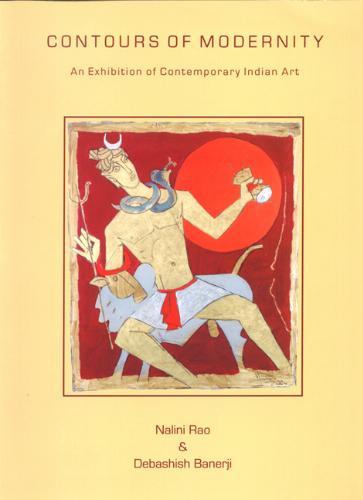
This exhibition, held Feb.1- April 1, 2005 at the Soka University of America, was co-curated with Dr. Nalini Rao. The exhibition featured works from the 1970’s to the present by twenty leading artists from India and of Indian origin. The artists whose works are displayed here include M.F. Husian, S.H. Raza, Allan deSouza, Ram Kumar, Ganesh Pyne, Ramananda Bandyopadhyay, G.R. Santosh, F.N. Souza, T.Vaikuntham, Anjolie Ela Menon, Bikash Bhattacharjee, Paresh Maity, Rameshwar Broota, Anil Riveri, Shakti Burman, Vasundhara Tewari, Sohan Qadri, Surender Caur, Anjan Chakravarty, Sudha Achar and Amrita Banerji.
nature and culture mind and body warp and woof in the weave of the visible
slide smoothly apart then splinter into fragments on one side pythagoras ptolemy euclid decartes arrange dimensions and perspectives like planks or piano keys collect atomic triangles oblongs rhomboids tetrahedrons and curls which curl back into curls each time they’re straightened
these they assemble into man then reaching into the other side they conjure a violin a mandolin a vase and give these to the man things with seed boxes membranes rounded and pulpy picasso likes what he sees or better what he feels he is attarcted by the other side
so putting away his carpentry his metallurgy his aeronautics he turns to archeology turns to alchemy distillation sediments stone plant animal machine and unnameable residues these cry out for consumption exploitation pleasure each its own automatism cry out in pain for pleasure such is the nature of automatism
colonial picasso complies he is their knight in shining armour his phallic spear ready to impale his sword to decapitate and release to release and please to please by release his mechanical hands to twist grind distort deform with technological exteriorization of motor organs telescopes for eyes memory chips for brain cyberspatial nervous system thrilling with eros of mutilated and mangled but still alive whether inertial in torpor or writhing still alive woman stone woman plant woman animal woman nation woman picasso digs woman distilled down to residual nature incomprehensible totem and taboo impregnated by stainless steel blades of post-cubism
stone is what she first appears in or disppears in in the little death and the big one stone as mineral boulder shit clay weathered by erosion or moulded lovingly and propped precariously piece by piece compositional elements uncomplaining because the white man’s burden knows that stones never complain they exist for tourism ecotourism whether economic or ecologic who cares it’s only semantics anyway propped precariously wondrously one atop another limb over limb breast over breast or breast over limb head over buttock in a desolate landscape picasso beheld what he had wrought and he was happy on the seventh day picasso rested
on the eighth he got up again this time he wanted the vegetal the vestigal the virginal the vaginal no longer rolled round in earth’s diurnal course but full of pain and pleasure yet unmoving pure subject dreaming without moving he now invoked manet matisse the marvellous canonical painters of odalisques vases lampstands mandolins seed boxes langrous slaves somnophilia sister of necrophilia the pleasure of sleeping plant parts of equatorial forests rainforests ready for plundering for butchering bulldozing chainsaw massacrering without demure without a resisting sound then again picasso beheld what he had wrought and he was happy on the seventh day picasso rested
on the eighth he woke again this time he was sick of the meek the timid obedient unresisting made him want to puke he had dreamt the cannibal of millipedal hands and legs that moved clawed tore of mouths with teeth that spat bit chewed tore to pieces of parts that agonized with pleasure and burst with pain that knew entanglement beyond identity and fratricide an alias for suicide all wars after all are civil wars of the family of the human and posthuman destiny picasso invented the aesthetics and the decorative arts of painful ambiguity the pleasure and pain of eros and thanatos and this time he could not rest
his dreams now were nightmares with minotaurs and writhing horses and riders stone dead on the ground women like felled trees full of fruit and machine gun monster men fascism and racism and huge burning haytstacks unmanned machines that plundered and raped and doves that flew alongside nuclear bombers perhaps the serenity he sought for refuge like w. b. yeats now was only artifice a mechanical assemblage in which the blood guts teeth torn panises vaginas breasts buttholes buttocks seedboxes with seeds spilled and trampled broken guitars mandolins lampstands vases flowers shredded fruits mutilated were forgotten reduced to geometry once again carefully arranged minimalism of wires sticks and a few screws returned culture and nature to the man with his guitar wiping the tear from dora marr’s lacrymose nostril picasso before resting for the final time inscribed his name in a simple austere alphabet nature vanished into technology itself reduced to an impersonalism of beauty beyond need.
In invisible streaming of capital virtuality screams burning with overdose. Multisensory Matter transmuting careens towards the fourth dimension. Yeats hardly knew what he was paying homage to when he desired immortality in Byzantium.
drowsy emperors till the labor-intensive soil preparing modernity. Snakes of evolution delberately uncoil the global desiring machine. flesh cries to erase itself in erotic embrace or hold the world captive in its lurid dream.
multinational flows replace the ageless tides seething with foam. like wolves we bay, a lunatic intelligence hides within the cosmic scheme. the whim of Empire oils the tracks of the gyre. Insatiable hunger of gladiator sports driving the wheels.
cyber explosions of pleasure in the American blood are mined by third world bodies. compassionate buddhists indulgently smile setting themselves on fire. electric heaven of the west is premised on bio-subjection of the rest. the purpose of time way-lost and sunk in the mire.
in another laboratory another heaven prepares its godless hour. designer bodies fashion appearance to shape the future’s form. the health industry shudders with pleasure of replacing mothers. physical immortality neo-liberal Empire’s disciplinary norm.
power and possession and gigantic lusts of the etheric body are not all the market hungers to fill. nor eugenic and bio-maximized collectible dolls or genetically-altered viral meat. informatics trades in control binary reduction of the whole atom cell and cosmos dovetailed in an enormous systemic cheat.
mental vital and material contestants of anthropic telos modernity’s terrestrial construct made and unmade by the human sciences; a story of loss swells to fill the sails of history. empty homogenous time enacts the Hegelian mime simulacra swallowing self at the gold-enamelled cusp of modernity.
another technology awaited us perhaps, another disappearance was preparing its arrival post-anthropological its nameless existence’s trance the multiple dreams of possibility. from capital ideology or law its outline seems to withdraw herein the changeling evolutionary Person’s reality.
neti neti the track, against the outward-fastened senses from the clutch of merchants quiet the infusion of psyche its incorporation of the lenses the soft warm intimacy with all things. will, intelligence or gene as its instruments are seen slow time like gathering gold its richness into nature brings.
but the luxury of this ode to autumn its mellow fruitfullness is it not impossibly distant dromology claims contemporary space-time with its thickness of stream-lined business-suited robots but a different time grows in the liminal shadows where nomenclature thickens with ambiguity and slips through the knots
erase first the demand of belonging, the conscience building bribe tongue that writes you into history odysseus and arjuna knew the epic ladder rung for rung guided by the wind. no shelter in engagement no benefactor to pay the rent the post-human is birthed in the interstices of counterfeit kind.
God is all being all that can be sensed, all that can be imagined, all that cannot be imagined.
God exists as the totality of Being, including the known, the unknown and the unknowable; God also exists in/as every instance of being.
God perceives him/her/itself in different gradations of objectivity leading to a continuum of Being with gradations of Consciousness.
God as Subject is absolute Consciousness. It is known as Brahman. The power by which it perceives itself is known as Maya. The forms of objective self-perception have relative consciousness and are thus held as evolving forms of Ignorance.
God as Object is Matter. All the gradations of consciousness leading to and including the Consciousness of Subject are latent in the Object, just as all the gradations of consciousness leading to and including the Inconscience of the Object are latent in the Subject.
God as Subject evolves towards greater and greater material perfection; Matter as Object evolves towards greater and greater spiritual perfection. These two evolutions are in fact one perpetual motion machine, an involution-evolution.
Consciousness implies Sentience and Will.
The sentience of God Consciousness is absolute Bliss. The sentience of relative consciousness is the duality of pleasure and pain.
God is thus absolute Being, absolute Consciousness, absolute Bliss (Sacchidananda), absolute Subject (Paramatman).
The will of God Consciousness is Divine Will. The will of relative consciousness is the duality of will-towards-consciousness and will-towards-unconsciousness.
Will-towards-Consciousness is called good; will-towards-unconsciousness is called evil.
Each instance of being is nothing but Being; but depending on its gradation of consciousness, it experiences itself as relatively ignorant, relatively happy-and-unhappy and relatively good-and-evil.
God as absolute Being, absolute Consciousness, absolute Bliss, absolute Subject is also absolute Instance or Individual, Supreme Person (Purushottama).
Thus, though each individual instance of being (jiva, purusha), depending on its gradation of consciousness, is relatively ignorant, relatively happy-and-unhappy and relatively good-and-evil; this is a form of self-perception by the Person (Purushottama). Person is thus the truth of the person in the relative field, but is not realized as such by it.
Forms of self-perception by the Person (Purushottama) which are conscious of their identity with the Person, that is, innately realize the Person as their truth, and thus are not ignorant, always happy and always good are known as the gods (devas).
Forms of self-perception by the Person (Purushottama) which are far from conscious of their identity with the Person, and thus are ignorant, unhappy and evil are known as the demons (asuras).
Thus devas and asuras or good and evil archetypes are not Absolute realities or instances but relative realities or instances based on the Absolute’s self-perception in terms of gradations of Consciousness.
The existence of relative archetypes of good and evil sets up a polarity which causes a churning of the space of relative consciousness.
This is however only one of the (infinite) polarities; or rather, it is one name of the Polarity of the radically infinite Person in relation to its radically infinite Other in the reality field of radical infinity.
Archetypal forms of self-perception by the Absolute Being as Person are innate and unchanging; but there may be forms of self-perception by the Person that are evolutionary.
Whereas archetypal individualities (devas and asuras) cannot change the idea of the self-presentation holding them together, evolutionary individualities have freedom of consciousness and will and hence can act upon their own consciousness with their will i.e. a will-towards-consciousness or a will-towards-unconsciousness.
For evolutionary individualities, the degree of freedom of consciousness and will is dependent on the degree of individuation that is in the continuum of Being with gradations of Consciousness, relative persons that can establish relations of consciousness with the Person partake of an increasing freedom of consciousness and will in realizing and manifesting the Person as their truth.
The relations of consciousness that relative persons can establish with the Person are relations of Being, Knowledge, Love and Power.
Absolute Being/Person seems incomprehensible to any relative person but is nothing other than him/her/it. The Person can disclose him/her/itself evolutionarily, progressively stretching the capacity of the relative person towards realizations of identity with it in Being, Knowledge, Love and Power.
Yet already always the relative person is nothing but a self-presentation of Person. And thus in other words, nothing but Person presenting itself as relative person. Hence if relative person identifies itself in being with the Person, it can exert the will of radical freedom to present itself to itself differently.
Those who know this Truth live in the faith that God dwells in them and they are God.
Any relative person can relate to the absolute Being/Person through one or more of its modes: the Absolute Being/Person, the Cosmic Being/Person known through its manifestation as the infinite (or is it 33?) gods, any individual that has realized his/her identity with absolute Being/Person (yogi, guru), an incarnation of Absolute Being/Person (avatar) or an invocation to absolute Being/Person through any individual object or instance (archa).
Evolutionary joy is woven as in warp and woof by the joy in folding and the joy in holding.
The joy in folding is the baroque impulse symbolized by the Rose.
The joy in holding is the classical impulse, not the classical of the mental idea, but the classical of the fractal seed of the embodied Idea, the Flame.
The joy in folding follows the intuitions of origami of using materials to the best advantages provided by their properties.
Tending to form, by the structural and processual relations of parts to whole, complex stabilities.
Fertilize the matter and add an infusion of life, and these same become self-organizing and self-replicating machines.
The process of individuation begins to show its face and we may intuit already the presence of the infinite Person.
The bud of the Idea begins to bloom, the infinitely infolded flower saturated with the highest intensity of affect, the love of the infinite Person for his/her/its infinite Other, the crimson Rose.
At its center is a perpetually deferred ending, a vaginal Hole that seems to open ever inward into a progressive constriction towards a vanishing point – in a Face? Idea? Symbol? Archetype? Bija?
Unknown. What is known is that to every state of being there exists a greater non-being and to every non-being a greater being.
Real-Idea is reality presenting itself through an Idea. Self-presentation implies a choice of Being to present itself to itself through a dynamic representation.
Since Reality is radically infinite, Real-Idea must necessarily represent the self-presentation of Being around a productive Idea, a problematic field with radically infinite solutions.
The infinite fertility of the Seed realizes a dream of infinite systems held together in infinite relations by the play of Love of the infinite One and its infinite Other.
The systems arise out of the Gnosis of the Seed as perennial peristaltic ripples along a continuous gradation of folded consciousness.
These folds occur at many levels of density of consciousness-substance spanning a spectrum of states of being opening up their own horizons of experience.
And each state of being is a face of the Person and a dynamic Idea, allowing unending variant repetitions of Same/Never-same and the multiplied particulation/particularization/participation of the continuous.
These are the in-folded petals of the Rose.
That which evokes infinite wonder must have a face that evokes infinite wonder.
There can be a monstrosity to this face and there can be a simplicity to this face.
The two are one and are the infinite Idea-spectrum of Beauty.
This simple complexity coupled with the intensity of Love that holds it together is the self-presentation of the Rose
This is the Form that evokes radical Wonder, The Form that can only be known when seen, that most auspicious Form varam rupam.
The joy of folding is the spontaneous ontological response to the encounter with radical infinity.
The joy of folding belongs to the Rose.
The joy of holding is the nay-say, the infinite deferment.
It is the non-being that devours all being because only so can radical infinity manifest under conditions of discrete becoming.
Through disappearances and reappearances the self-presenter presents Him/Her/It self as progression or Time.
This is the flame, the fire that holds the cohesion of all things, atomic fire or solar fire, saurya Agni.
The flame is not quenched or rather it traces a track of disappearances but inevitable returns because the self-choice of the self-presentation of Being (swayambhu) as Becoming.
Buddha used the word nibbana because it referred directly to the putting out of a flame.
Nothing substantial was put out Buddha said since the flame was no substance anyway. It was a succession of moments of burning. ;-).
Yet the Flame ever returns after the deferment of the putting out.
Between the putting out and the return it holds even if invisible.
And it returns to put out that which put it out.
This is why it is the knower of births, jataveda.
Interminable, it is the massing of Idea in Purpose, chit-tapas, holding like a string through the particulation of Time.
Yes the Flame is the putting out and the holding, preservation-destruction, entropy-negentropy, Shiva and Vishnu.
Because the flame is in mind and body and vitalism,
The flame comes when you least expect it
The flame hides in molecular structures.
The flame holds through all its state changes.
The Flame is born of the churning experienced by the infinite recursion of the double Darshan wonder gaze of the radically infinite One and its radically infinite Other locked eternally in mutual self-exploration.
The joy of holding belongs to the Flame.
Differance as Derrida said is deferment and differentiation, negative and positive, the Flame and the Rose, holding and folding.
Within the Flame is the Rose, within the Rose is the Flame.
Or, holding is folding and folding is holding
And there’s One who’s presenting Him/Her/It self in the holding and in the folding.
To know with the knowing of that One is to know it all and be free of it.
Time is not fundamental, neither is space. They arise from the existence of distinct entities that we may term objects, which are observed by conscious/sentient beings. Imagine “space” without objects. E. Mach thought about this long ago. An empty universe would not have time. Space-time and matter go together. – Menas Kafatos
I
During times of pralaya, all matter reverts to dark matter and due to the disappearance of objects, space-time becomes quiescent.
Yet are all three ever-present properties of Being
Who has infinite properties.
Matter is a range of self-perception (ontology)
And time and space
Are the conditions and content for subjective and objective self-experiences (phenomenology and empiricism).
All three are operations of Consciousness in Being.
Combinations of such operations that become self-sustaining constitute a cosmos.
Cosmoses are temporary. In other words, they are flotsam and jetsam
In the sea of radical infinity.
They are held together objectively by a co-constitution and co-evolution of persistent operations (habits) of consciousness.
They are held together subjectively by the fire of tapas of the self-individuating (swayambhu) Person (Purusha).
Such temporary forms of attention co-constitute ad infinitum the infinite object of radical wonder for Purusha’s self-awareness and self-enjoyment.
Yet they are the play of Purusha’s self-Idea or Real-Idea, reality as idea or idea as reality,
Idea ignited as Fire from the infinite Heart of the Purusha.
II
Fire implies a churning, a rubbing of similar opposites.
Similar to the limit of identity and opposite to the limit of infinity.
The central Fire is tended by the Lord of the House and his Spouse.
The Two-in-One who constitute the mysterious bridge between discreteness and continuity
And the infinite realms in-between.
They are the original idea of duality in the field of the infinite One.
The plane of consistency that corresponds to the plane of immanence.
The Idea of the Virgin Birth (swayambhu) that is the self-presentation of Being as Becoming.
Fire of Self-Becoming that has no beginning and no end.
Fire is the cohesive of Self-expression, whether we call it co-constitution or autopoeisis
Even in dark matter (pralaya samudra) the Fire (agni) remains though passive and diffuse
Awaiting the next gust of the Wind (vayu, marut) to awake it out of its torpor
Which itself waits on the sonic reverberations (sabda) of the Idea (vijnana)
Rising as Will (kratu) based in Memory (smriti) going back before Time
And appearing as an object of attention in Shiva’s (Purusha’s, Person’s) contemplation
To resume the Infinite Child’s (bala mukunda) never-finished adventure story.
III
Why does the will to self-presentation return forever? In fact, why is it the basis of Time?
Not only the cycle of light, where the co-constitution of cosmos is held together by solar Fire (saurya agni)
But in the cycle of dark matter representing the infinite preindividual residue (ucchista) in space-time (nivritti)
The Divine Person ever seeks the reconciliation of the One and the Infinite in the Each in a material self-presentation.
This is the Idea of the play of infinitely instantiated figurations of the Infinite One, sparks of the Fire (amsa sanatana, eternal portion) that appear and disappear but persist through rebirth.
The perpetually repeated return of the One in each of us (not only humans but each that can be called an each) respects the entropy eating at each co-constituted self-sustaining system.
And returns with the will to an enduring self-presentation.
This is the Idea in the Fire, inscribed in each subject/object in the cosmos as a unique seed-idea (bija), signature of Singularity
Person at the center of randomly constituted and co-constituted temporary entities and systems introducing negentropy in the entropic field.
IV
Entropy represents the dynamic infinity of the One
Negentropy represents the dynamic oneness of the Infinite.
Among the original archetypes from beyond the Overmind, from Supermind
Where Satchidananda is eternally self-manifest as the images that give meaning to Becoming
We find the infinite Person, the One whose form is radical Infinity.
Then we find the Solar Fire, the Seer-Poet (kavi, rishi), The Lord and Spouse of the cosmos, the Divine Child, the Seed/Tree of Involution/Evolution, the Serpent.
The Person activates the property of Memory through an operation of Consciousness, mixes it with Fire and inhabits these archetypes as the Person within.
And thus begins the never-begun perpetual self-presentation of Person, or put the other way around,
The perpetual evolution/co-evolution of co-constituted self-sustaining, self-replicating systems towards individualized and collective conditions for the manifestation of the freedom and infinity of the Person.
Recurring eternally as the perpetual return of Difference.
Ever since its discovery by Raffles in 1814, Borobudur has been an object of mystery. Its imposing size and the magnificence of its conception and carving aside, the uniqueness both of its structural design and its iconography among religious monuments, not only in its temporal and spatial proximity, but anywhere in the Indic world, has heightened its aspect of enigma, inviting conjecture on its intention. Who made Borobudur, what was it used for and why was it made the way it was made – these and similar questions arise immediately in connection with the monument.
Though more than 150 years have passed since its discovery, none of these questions have been definitively answered, though some important preliminary headway has been made, in establishing the period of its construction and in conclusively identifying the textual sources of the carving. Thus, the monument is known to have been built around 800 A.D. during the rulership of the Shailendras in Java, and the texts represented on the walls of the terraces have been identified, in order of ascension from the bottom as the Karmavibhanga, the Jatakas and Avadhanas, the Lalitavistara and the Gandavyuha.[1]
Other Buddhist temples belonging to this period and in its proximity (Central Java) have been identified, but none of these are built on the same mountain plan as Borobudur, though affinities in structural and iconic elements are not absent. The iconographic similarities only go to strengthen in a general way, what is already evident from the textual sources of Borobudur – i.e it is a Mahayana monument. Mahayana is a highly complex and diversified system, followed by many sects in the vast Buddhist world, and to recognize merely the Mahayana basis of Borobudur sculpture affords us no further focus on the stage or variety of Mahayana represented by the monument. Various interpretative attempts have been made to derive a coherent meaning from a study of the monument, but none of these have been conclusive in presenting an entirely satisfactory explanation. My purpose in this essay is not to provide yet another totalizing interpretation of Borobudur, but to raise certain questions regarding the directions in the search for solutions so far followed, and to open up certain areas for further investigation.
Principally the opinion over the purpose of the monument has divided itself into arguments for its interpretation as a stupa or a mandala. Most historians have taken their stand on one side or the other of this divide, though a few (Woodward[2], Lohuizen-de Leeuw[3]) have acknowledged the possibly polysemic character of the monument. The reason for the trenchancy of the divide, though, lies in the fact that the mandalic interpretation has been taken to imply a Tantric origin for the monument, and the assumption of Tantrism introduces a hypothesis which is not easily provable or obvious in the spatial and temporal domain of Borobudur. My contention here is, that in the context of Borobudur, an equation of Tantrism with the elaborately developed system of Tibetan Vajrayana or Japanese Shingon, may not be warranted or necessary, the absorption of Tantric ideas and practices into Buddhism being a gradual process, which might very well have developed incipient forms of Tantric Buddhism as short-lived or temporary intermediate stages, one manifestation of which may be Borobudur.
The mandalic argument has hinged largely on the consideration of the structural aspects of Borobudur. The mandala is a Buddhist form of the Tantric yantra, which is a magical diagram combining sacred geometry with an arrangement of deities in some form of intentional symmetry, used ritually to achieve a specific result. Two characteristics associated with the mandala as a Buddhist form of yantra are (1) the presence of circular elements in the diagram, an essential feature, given that ‘circle’ is the primary Sanskrit meaning of ‘mandala’; and (2) the use of the diagram as a power object to attain bodhichitta, the transcendental experience. Though, to some extent, all Indic sacred monuments reflect some degree of intentional symmetry, in the yantra/mandala, the specificity of detail becomes heightened for ritual purposes. The three principal elements necessary to interpret in the context of a mandala are: (1) geometry; (2) numerology; and (3) identification of deities.
In most serious mandalic interpretations of Borobudur to date (Weyman[4], Lundquist[5], Chandra[6], Huntington[7]), attempts have been made to map these elements onto the Mount Meru symbolism of the Vajradhatu mandala, present with minor variations in the Tibetan (Vajrayana) and Japanese (Shingon) Tantric Buddhist traditions. The justification for this mapping has been different in different cases, for example in Weyman, the tenuous invocation of undated Srivijaya origin for the commentary to a Buddhist Tantra, found in its 11th century translation in Tibet[8]; or in Chandra, the comparison with a 11th century Buddhist temple in Tabo, Himachal Pradesh, exemplifying the Vajradhatu mandala, and also featuring the life of the Buddha and the Gandavyuha on its walls[9]. Whatever the justifications though, a number of close correspondences seem to emerge in this mapping, establishing the general impression of a relationship between the structure of Borobudur and the Vajradhatu mandala.
In all these comparisons, the geometric aspect seems to bear the strongest similarity, the description of Mount Meru establishing it as divided into two sections – a base of five rectangular supports topped by a cloud and a kutagara of three levels above it. Seen from an aerial view, the five rectangular terraces and three circular platforms of Borobudur, seem to fit this description rather nicely, the design seen repeated in the structural plan of Vajradhatu mandala based Vajrayana temples, such as the Kumbum in Tibet[10].
With the identification of the deities, there is some confusion, though also some correspondences. The Vajradhatu mandala, as other Vajrayana Dhyani-Buddha mandalas, feature a central set of five Buddhas – Vairochana, Akshobhya, Ratnasambhava, Amitabha and Amoghasiddhi. These can identified by their respective mudras – the dhramachakra, the bhumi-sparsha, the varada, the dhyana and the abhaya. In a vajradhatu mandala, one would expect a placement of these Buddhas, with Vairochana at the center and Akshobhya, Ratnasambhava, Amitava and Amoghasiddhi at the cardinal points. The four lower terraces of Borobudur have a placement of 92 Dhyani Buddhas on each of the four cardinal sides. Each set of 92 Buddhas holds a specific hand-gesture, bhumi-sparsha to the east, varada to the south, dhyana to the west and abhaya to the north. The fourth gallery has a set of 64 Buddhas, all in vitarka mudra. On the three upper terraces, in perforated stupas, sit 72 Buddhas, all in the dharmachakra gesture; while an unfinished Buddha at the apical center of the monument sits, touching the earth with the bhumisparsha. While the sets of 92 on the four sides of the four lower terraces may be identified as Aksobhya, Ratnasambhava, Amitabha and Amoghasiddhi respectively, we are left with three more sets of Buddhas to identify. If we equate the dharmachakra Buddhas in the circles as Vairochana, following the Vajradhatu, the 64 Buddhas in vitarka and the central one in bhumisparsha still need interpretation. A variety of possible solutions have been suggested for these, but the fact remains that they disrupt the tidy fit of the deities at Borobudur with the vajradhatu mandala. A more serious mismatch, glossed over by the mandala theorists, is the identification of the other deities of the vajradhatu mandala. There are 36 of these, including consorts and attendants of the five Buddhas, and puja and sangraha devis[11]. At Borobudur, aside from the narrative panels, there are no deities other than the above-mentioned Buddhas, least of all consorts.
The aspect of numerology enters even more treacherous ground. We have already noted the difficulty with the five Dhyani Buddhas. The set of 36 Buddhas, consorts and attendants of the vajradhatu are sought to be related to the 72 dharmachakra Buddhas on the three circular terraces of Borobudur, by a dubious trick of ‘doubling’[12]. Chandra indulges in miscellaneous number juggling, relating the total number of Buddhas (504) at Borobudur to the one thousand ‘surrounding’ Buddhas of the Japanese vajradhatu mahamandala, again by the mysterious power of ‘doubling’[13]. In a more interesting and bolder speculation, based not on the vajradhatu mandala, but on an equating of the three upper circles of Borobudur with the three mysteries of the Buddha, Body, Speech and Mind, constituting the dharmadhatu, Weyman explains the 72 Buddhas in dharmachakra mudra. Thus the four postures of the Body, three kinds of Speech and two varieties of Mind are each related to the eight spokes of the wheel of Law (dharmachakra) to obtain 32 outermost, 24 next and 16 innermost generations of the Buddha[14]. Even more obvious than with the deities, the match between the vajradhatu mandala and Borobudur in the matter of numerology, is extremely questionable; though here again, taken independently, a sense of symmetry and numerological significance seems to impress itself on us from Borobudur and cannot be easily dismissed.
Apart from poking holes in these kinds of arguments, the stupa theorists (Klokke, Boelles [15]) have highlighted the paucity or lack of evidence of any Tantric element among other monuments or icons found in the vicinity of Borobudur, and the illegitimacy or questionable nature of using 10th or 11th century models (Vajrayana texts from Java, Tibet or Japan or Tibetan temples, such as Kumbum) to deduce the mandalic intentions of Borobudur. They then use the necessity and sufficiency argument of scientific method to dismiss the mandala theory, in that it is necessary to account for the monument in terms of the Mahayana narrative carvings in the lower terraces; and that, if an explanation in consonance with these carvings can be shown for the iconography of the higher platforms, this would be sufficient, there existing no further need for assuming mandalic or other theories of explanation. Whereas this reductionist attitude seems appealing in that it relieves us with its simplicity, it achieves its ends by its dismissal of any significance for the specificity of structural or numerological aspects, and an exclusive emphasis on iconography. Only Snellgrove acknowledges the mandalic in design and Buddha iconography, but dismisses the necessity of assuming any Tantric connection, by calling it a Mahayana Buddha-mandala[16]. This pushes us to the borders of the debate – may it not be that the ‘Mahayana Buddha-mandala’ is a stage in the incorporation of Tantra into Buddhism and represents some level of Tantric intention?
The anti-mandalists, following in the footsteps of the invokers of Tabo or Mt. Kukai or Kumbum, could have fruitfully invoked, themselves, later examples such as the mountain temples of the Khmers or the stupas of Burma as non-mandalic structural comparisons with Borobudur. The Khmer imperial mountain-temples evolve increasingly towards identification with Mount Meru, the trend eventually literalizing itself at the Bayon with its approach and exit lined with sculpted gods and demons holding Ananta Naga as the churning rope. The very inception of the temple-mountain idea may very well derive from Borobudur, Jayavarman II, the founder of this practice, being believed to have been closely connected, in some way, to the Shailendras of Java and having returned to Cambodia contemporaneously with the building of Borobudur. However, two facts mark the difference between these temples and Borobudur : (1) With the exception of the Bayon, they are all Hindu monuments, with a primary emphasis on the mountain as a symbol of spiritual power, iconographical or additional structural details counting for little; and (2) Following on (1), there is no mandalic or circular element in these temples.
However, it may be noted that Bakheng, built by Yashovarman in the late 9th century, comes the closest of these temples to Borobudur, being built on a five-storeyed terraced pyramid plan, with extensive numerological correspondences (7 levels to the temple, 108 towers, 33 visible at any one time, all sacred Hindu numbers)[17].
In Burma, the 9th century Bupaya Stupa, with its addition of a terraced plinth to the earlier Pyu bell-shaped structure, is the earliest example of the trend leading to 11th century stupas, such as the Sche Sandaw, with their multiple circumambulatory terraces[18]. 12th and 13th century examples, such as the Seinnet Nyima or the Mingalzedi respectively, have added Buddhas in framed niches[19], so that, as at the Kumbum, the essential structural elements of Borobudur are all present here – the terraced pyramidal appearance, with its four steep stairs rising along the center of the four cardinal sides and leading to the platform with the circular enclosure, and overseeing Buddhas in all directions. However, this is a Theravada monument, not even Mahayana, and clearly not Tantric in its intention. It is worth noting here, though, that Angarika Govinda, in a work that Lundquist references[20], elaborates a mandalic symbology for the stupa in general[21]; and that J.E. van Lohuizen-de Leeuw, tracing a possible precedent for Borobudur in the perhaps Gupta period stupa of Nandangarh, notes the latter’s mandalic nature and locates the origin of Tantric ideas in Buddhism in the Gupta period[22].
The Hindu Tantric Meru mandala of course, is the classic Sri Chakra, and this might well have provided the basic elements of the Buddhist mandala type. In the Sri Chakra, we have a rectangular enclosure, with a protruding extension from the center of each side and a number of circular enclosures within the rectangle. In the standard Sri Chakra, there are three such circles, the outermost containing 16 lotus petals and the intermediate, eight. Within the innermost circle are 8 intersecting triangles, four ascending and four descending, plus one small descending triangle near the center, with a ‘point’ or bindu at the center of the yantra, representing infinite consciousness immanent in all things. In this case, the system of triangles at the center is the Mount Meru[23]. The similarity of this general plan with Borobudur will be immediately apparent.
Turning our attention to the narrative carving of the monument, the Karmavibhanga, Jatakas/Avadhanas, Lailtavistara and Gandavyuha are all Mahayana texts. In fact, the Lalitavistara and the Gandavyuha are two of the nine principal texts or dharmas of Mahayana, sacred alike to Madhyamika and Yogachara schools[24]. Of these, the Gandavyuha , evidently, was of prime importance to the makers of Borobudur, since it has been represented twice and occupies the major part of the wall space of the rectangular ambulatory paths. The Gandavyuha itself, is part of a larger text, the Avatamsaka Sutra, and Buddhist sects have been known to exist that organized themselves around the primacy of this text. In China, this was the Hua-yen sect, which flourished from the 7th to the early 10th century; and in Japan, the Kegon sect, which was popular at Nara from the 8th to the 10th century, and saw a short-lived revival in the late 12th and early 13th centuries. The overlap of both these schools with the known period of establishment of Borobudur is significant and points to the possibility of the agency of some Avatamsaka-based sect in the design, construction and usage of Borobudur.
The Avatamsaka is known to have been translated into Chinese from Sanskrit in the 5th century[25]. Among the important ideas contained in the Avatamsaka, is that of the Trikaya or the Three Bodies of the Buddha, consisting of the Dharmakaya, the Sambhogakaya and the Nirmanakaya. Edward Thomas, in his study of the History of Buddhist Thought, traces the idea of the Three Bodies to the 5th century mystic and Buddhist thinker, Asanga, and his Yogachara and Vijnaptimatra systems of thought[26]. The term Dharmakaya had existed prior to this of course, but meant the persistence of the Buddha after his nirvana, as the body of the Law, equated with the Pali canonical texts. But after the 5th century, the meaning of the term seems to have changed, and become incorporated into the system of the Three Bodies. Interestingly, Asanga is claimed by the Tibetan Buddhist tradition to be a Tantric siddha, and the author of the earliest Tibetan Tantric text, the Guhyasamaja Tantra. [27]
The Avatamsaka sutra might then, very well have been composed around the time of Asanga, contemporaneous or subsequent to the introduction of the idea of the Trikaya. Of course, it has been suggested and it is possible, that the Avatamsaka or parts of it, such as the Gandavyuha, is/are much older; but in that case, we have to recognize its possible rewriting during or soon after the time of Asanga, to reflect the idea of Trikaya and perhaps other contemporary ideas.
If we acknowledge this possibility, certain peculiarities of the Gandavyuha become apparent:
The Gandavyuha as siddha literature:
The story of Sudhana in his journey to true enlightenment[28], leads him through 53 teachers, who come from all levels of phenomenal existence. These teachers, called ‘spiritual friends’ (kalyanamitra), include royalty, scholars, professional people, householders, “lay women”, boys and girls, nuns, mendicants, enlightened beings, gods and goddesses. Each of these ‘friends’ is an adept in some specific spiritual qualities. Their methods of teaching are also varied, and consist of demonstrations of their magical powers, along with verbalizations. After imparting their specific teaching, each of them acknowledges the partiality of his or her spiritual achievement, and its relative insignificance in the face of the complete enlightenment of the Buddhas, pointing Sudhana to the next teacher, who would be able to further extend the teaching. Mahayana Buddhism developed early into a monastic tradition, and the idea of isolated spiritual adepts from all walks of society, seems exceptional to its sanghic temper. The narration of the journey and the verbalizations of the teachers are presented in a repetitive, incantatory fashion, conducive to hypnosis. Combined with the profusion of phantasmic, visionary and magical events and images, the text seems to be a move away from didacticism towards altered states of consciousness, opening to spiritual experience. Apart from this primarily experiential
content, the ‘message’ of the Gandavyuha seems to be that the dharmakaya of the Buddha is active in many ways in many walks of phenomenal life; that ‘teachings’ can come in many flavors from beings who possess exceptional ontological orientations that give them specific insights into Buddha-nature. However, this Buddhological message does not explain the sense of the celebration of magical powers, siddhis, that the text leaves us with, nor the variety and unpredictability of the teachers and their methods of teaching. Indeed, the ‘teaching’ of one kalyanamitra is to do nothing except indicate the next teacher that Sudhana must visit. The nature of these teachers is very much that of Tantric siddhas; and combined with the visionary and incantatory nature of the writing, points to the classification of the text among siddha literature.
The proto-mandalic structure of the Gandavyuha:
The mutual interpenetration of all things and their transcendental relativism is an essential part of Mahayana teaching and the major theme of the Avatamsaka sutra[29]. A corollary of this is the idea of the presence of the macrocosm in the microcosm. This, of course, is also the idea behind the Tantric yantra or mandala, which is the cosmos as diagram. The Avatamsaka sutra itself is written (or compiled) in this form, the Gandavyuha, though a part of it, being seen as a crystallization of the entire Avatamsaka[30]. The Gandavyuha itself may be divided into three parts – the Journey, featuring Sudhana’s pilgrimage, the Realization, featuring Sudhana’s experience in Maitreya’s kutagara; and the Vow, featuring Sudhana’s experience with Samantabhadra and the concluding Bhadrachari section. The journey section of the Gandavyuha leads from location to location through isolated teachers, who appear to have nothing in common except for the mystic thread that links them in Sudhana’s journey. The locations themselves are largely sites from South India, which has given rise to the speculation of the Gandavyuha’s South Indian origin. However, towards the end of the journey, a portion stands out due to its homologies. This is the portion pertaining to the Night Goddesses or Ratridevatas. The importance of the Night Goddesses in the
Gandavyuha can be seen through their equation in Mahayana tradition, with the ten stages, dasabhumi, one of the five ‘ranks’ within which the 52 stages of enlightenment have been divided, which was singled out for special attention and on which another very important portion of the Avatamsaka, the Dasabhaumika, elaborates. The Night Goddesses are a set of ten deities, the approach to whom is indicated by the Earth Goddess, Sthavara, who herself is pointed to by Shiva Mahadeva, residing in Dwaravati. The presence of Shiva, followed by the ten goddesses is itself exceptional, bringing to mind the ten mahavidyas of Tantra. The Night Goddesses however, have little in common with the Mahavidyas, except for their divine nature. The iconography of the Mahavidyas is elaborate and detailed in terms of their colors, surroundings, number of arms and attributes. Moreover, though considered aspects of the Mother Goddess, they are terrible and dangerous, and only the heroic truth-seeker is invited to approach them. In this, they bear much closer resemblance to the consort goddesses of Vajrayana.
The Night Goddesses are entirely benefic. They are characterized as beautiful, but apart from a few attributes, we are not provided with detailed physical descriptions about them. However, the very fact of the presence of goddesses without precedent in an early Mahayana text is surprising. Additionally, these goddesses are also siddhas, each possessing specific powers to experience and reveal the interdependent nature of things and the immanence of the Buddha everywhere. Thus their adaptation from Tantra is a strong possibility. Moreover, what also groups them together and separates them from the rest of the teachers, are : (a) Their long, exotic, Sanskritic names; (b) the descriptions of the dwelling-place of a number of the goddesses in mandalic terms[31]; and (c) their location at sites of importance to the life of Sakhyamuni, a couple of them from Kapilavastu and Lumbini, but all the rest from “the enlightenment site of the Buddha”. After meandering from place to place, as in a tirtha through pithas, with the Ratri Devatas, Sudhana finds his intention magnetized, rapidly spiralling in to the site of enlightenment. Thus, within the Gandavyuha, the Ratri Devatas seem to be a crystallization of the entire journey of Sudhana, holding the secret meaning of its intention. While this will be important to us at a later stage of the argument, for the time it is sufficient to note the proto-mandalic structure of the Gandavyuha as outlined above, quite possibly an adaptation from Tantric ideas, and to recognize some generalized similarity with the structure of Borobudur. Thus, my contention is that the Avatamsaka, and specially the Gandavyuha, already represents the incorporation of Tantric ideas into Mahayana Buddhism; and it would not be inconceivable to think of a sect, based on it, leaning more heavily in the Tantric direction, and formalizing its ideas into a mandala.
At this point, it may be useful for us to consider the basic elements of Tantra, and see where we stand, relative to the Gandavyuha and Borobudur. Hindu Tantra is not an uniform philosophical system, but a collection of yogic and ritual practices, based on certain standard elements and aiming at varied goals. These elements may be identified as : mantra (mystic utterance or spell); yantra (or mandala, mystic diagram composed of a significant arrangement of geometric forms and deities and utilizing numerological concepts, most often used in conjunction with mantra); puja (ritual worship, consisting of sacrificial offerings to the deities, usually female); asana (physical posture, relating to psycho-physical disciplines or practices, aiming at the development of paranormal states of consciousness or powers. The sexo-yogic postures, so commonly equated with Tantra are included in this category, but are not essential to Tantra); mudra (mystic hand gestures, used in conjunction with asanas, in ritual and yogic contexts); shakti (literally, power; equated in Tantra with the goddess and relating to conscious powers responsible for the phenomenal world); siddhi (perfection, the goal or objective of Tantric practice, arrived at through invocation using mantra, yantra, asana and puja, of the shakti/s, resulting through identification with her, in the possession of her ontological status with its special insights and magical powers.)
The use of mantra, as magical incantation, was prevalent in Buddhism from an early stage, as evidenced in the Prajna Paramita Hridaya Sutra. The incantatory mantric element in the Gandavyuha is unmistakable. The idea of puja or ritualized sacrificial offering is also present in Mahayana adaptations. The Ratri Devata section of the Gandavyuha is full of descriptions of making offerings to the Buddha[32], while the entire Gandavyuha is an allegory of the offering of the self. Little evidence of the asana, either in the sense of physical contortions or sexo-yogic postures, exist as prescribed practice in Mahayana literature at this point, and there is no representation of this element on the walls of Borobudur. However, the primacy of meditation as a practice of consciousness can be seen, as in Hindu Raja Yoga, to have minimized the dependence on asana to postures of sitting, conducive to meditation, such as the Padmasana or the Paryankasana. The importance of asanas, in this context, is not to be underestimated though. The Gandavyuha begins with the Buddha demonstrating to the host of gathered Bodhisattvas and celestial beings “the marvellous workings of a certain mystic position called Simha-vijrimbhita”[33]Mudras attain to importance in Mahayana at an early stage, as in evident from the earliest Kushan period depictions of the Buddha. In Borobudur, six standard mudras associated with Buddha are depicted – Bhumisparsha, Dharmachakra, Vitarka, Abhaya, Varada and Dhyana. Shaktis make their appearance in fully developed and centrally important systems in Vajrayana, so the presence of the Night Goddesses in the Gandavyuha is an interesting isolated early example, showing the nascent influence of esoteric and typically Tantric ideas on Mahayana. Finally, as mentioned above, the presence of siddhis in the Gandavyuha is unmistakable. In the Vajrayana, attainment of siddhis is closely related to the practice of esoteric rituals and visualizations, and elaborate descriptions of ‘alchemical’, psycho-physical processes exist in Tibetan Buddhist literature, outlining esoteric energy dynamics leading to siddhi. Though the
Gandavyuha does not contain any such descriptions, in view of the widespread importance of siddhas and siddhis in it, oral traditions of siddha practice may well have been current in Avatamsaka sects of this time; or else, Mahayanic adaptations of such practices, such as ritual circumambulations of mandalic structures, may have served as their substitutes. Seen in this light, the possibility of the use of the yantra or mandala in a Mahayana adaptation, seems quite plausible, and would represent a stage in the incorporation of Tantra into Buddhism, prior to its more full-blown version as Vajrayana. Adding weight to this possibility, are the following facts: (a) From the mid-9th century, distinctly Tantric images enter the Buddhist corpus in Java[34]; (b) The vajra, a characteristic feature of Vajrayana, makes its appearance, as a motif and as a priest’s scepter in Central Java from the late 9th century[35].
Returning to the idea of the Ratri Devatas as embodying the ‘secret’ of the Gandavyuha, we have already noted their pre-eminence, both structurally within the Gandavyuha and in their traditional association with the ten stages (Dasabhumi). Apart from the fact that, barring two, they all dwell at the ‘site of enlightenment’, the most important ‘vision’ in this section, seems to be that of the Buddha at the enlightenment site, just after enlightenment. It is the act of bearing witness to this moment that initiates the journey of the Ratri Devatas from an ordinary life to a life as an ‘enlightening being’. The journey itself follows on innumerable more such repeated witnessings of the many Buddhas becoming enlightened.
At the beginning of the Gandavyuha, Sakyamuni demonstrates to the host of gathered Bodhisattvas and celestial beings the power of a special mystic posture/meditation method, leading to a number of miracles[36]. As the culmination of these miracles, all present are able to witness him at the moment of becoming enlightened under the Bodhi Tree, at the site of enlightenment. After this apparently isolated event, the story of the journey of Sudhana begins. However, it seems most unlikely that this initiatory event is unconnected with the rest of the text. It is more reasonable to suppose that the story of the journey occurs as a continuation of Buddha’s demonstration – showing his omnipresent action in the phenomenal world, helping enlightenment-seekers through the guidance of the kalyanamitras to the knowledge of the bodhichitta.
We may be able to relate this view to the Buddha’s Trikaya. Thus the image of the Buddha at the site of enlightenment, at the moment of enlightenment, would represent the Dharmakaya. This transcendental body, neither form nor formless, both form and formless, existing simultaneously both inside and outside of phenomena, could be said to find its closest phenomenal approximate in the moment of realized coincident presence of the transcendent and phenomenal Buddha, the moment of enlightenment. It is for this reason that this image occupies centrality within the Gandavyuha. The Buddha who initiates the Gandavyuha from his celestial sphere through the demonstration of his miracles, would be, in this light, the Sambhogakaya, the transcendent Buddha as form, present for the Delight of Enlightenment. Finally, the kalyanamitras, in Sudhana’s journey and the many Buddhas referenced by them in their teachings, would all be the Nirmanakaya, the presence and action of the Buddha in the phenomenal world.
This interpretation could be fruitfully carried over to a consideration of the iconography of Borobudur. The Buddha at its apical center, in bhumisparsha mudra then, would represent the Dharmakaya, its ‘unformed’ nature a sign of its ambiguity between form and formlessness. This interpretation is in consonance with Huntington, though he arrives at it through the assumption that the Avatamsaka sutra is being taught by Sakyamuni at the enlightenment site[37]. For the identification of this Buddha also, a Gandavyuha reading would be in agreement with Huntington. In the descriptions of the Ratri Devatas, the act of bearing witness to the moment of enlightenment is sometimes described generically in terms of “the Buddha at the enlightenment site”[38], but sometimes as “the Buddha, Vairochana, at the enlightenment site”[39]. To make a distinction between Sakyamuni and Vairochana as identification of the central Buddha, therefore, is not necessary.
Around the central Buddha, the three circles of Buddhas in stupas, would represent the Sambhogakaya, imaged as the Buddha at Sarnath, teaching the transcendental law. Together, these would form the dharmadhatu, or the transcendental, indestructible realm. The incomprehensible and deep secret nature of the Dharmakaya is emphasized through the invisibility of the apical Buddha within the solid stupa. The Sambhogakaya, on the other hand, present as form, and thus ‘visible’, though still transcendental and secret, is encased in perforated stupas. If we assume a mandalic division of the entire monument into two zones, the circular platforms and the apical stupa would correspond to the Vajrayana vajradhatu or transcendental zone, while the rectangular terraces would constitute the garbhadhatu, or phenomenal zone. Whether this terminology was formalized at this stage, or recognized by the makers of Borobudur, is unknown, and is not necessary to assume. For the numerology of the Buddhas on the circular platforms however, it may be fruitful to elaborate Weyman’s analysis. Wayman relates the three circular platforms with the three mysteries of the Buddha which constitute the dharmadhatu[40]. These are Body, Speech and Mind. Wayman invokes Pali canons to identify four kinds of Body, three kinds of Speech and two kinds of Mind[41]. These are then multiplied by a factor of eight – for the eightfold dharma, representing the transcendental teaching in Body, Speech and Mind, and echoed iconically by the Buddhas in dharmachakra mudra.
As mentioned earlier, the earliest Tibetan Tantric text, attributed to Asanga, and most likely contemporaneous with the emergence of the Trikaya idea, is the Guhya Samaja Tantra. Guhya Samaja, literally translatable as “Secret Society”, has a second esoteric meaning, described in the body of the text. “The threefold entity, body, speech and mind, is known as secret (guhya); and assembly (samaja) means gathering together, it is a collective expression for all the Enlightened Ones.”[42] Thus the secret dharmadhatu realm of the terraces represents the gathering together of the three secrets of Body, Speech and Mind; as also the secret assembly of the Sambhogakaya Buddhas around the most secret (guhyatama) Dharmakaya.
If we ascribe any formalized Tantrism to Borobudur, as for example, a conscious mandalism, the builders of the monument could well have been aware of the Guhya Samaja Tantra . Since this likelihood has been strengthened by my interpretation of the numerology of the Buddhas on the terraces, it should be noted that the first enumeration of the system of the five Dhyani-Buddhas, also occurs in the Guhya Samaja, with its naming of Vairochana, Akshobhya, Ratnaketu, Amitabha and Amoghasiddhi[43].
If we divide the monument into two zones as mentioned earlier, the circular terraces representing the transcendental realm and the rectangular platforms, the phenomenal realm, we might usefully isolate the lower terraces and treat them as a separate sub-mandala, as Weyman does. This sub-mandala, representing the Nirmanakaya of the Buddha, would then present us with the problem of identifying its deities. If we assume Guhya Samaja Tantra influence, then the five types of Buddha, could be equated with the traditional Tibetan five Dhyani-Buddhas. Whereas the sets of 92 Buddhas on the four cardinal sides of the platforms, would present no problem in such an identification, based on mudra – Bhumisparsha on the east = Akshobhya, Varada on the South = Ratnaketu, Dhyana on the west = Amitabha, Abhaya on the North = Amoghasiddhi – the 64 Buddhas on the fourth gallery, show up in vitarka mudra, which is unspecified in the traditional Tibetan systems. Semantically, vitarka means argumentation, debate or teaching involving the making of distinctions. The difference between dharmachakra and vitarka, in terms of types of discourse, can be seen simply as the movement of discourse from an absolute to a relative domain. As befitting the phenomenal realm of the Nirmanakaya, the Absolute Law here has to contend with lesser and relative laws, making itself manifest through the process of distinctions. Thus the gallery of vitarka mudra Buddhas represents none other than the dharmachakra Buddha in the Nirmanakaya – in other words, Sakhyamuni/Vairochana again. Whether we admit the influence of the Guhya Samaja tantra or not, for the individualized identification of the numerous Buddhas, we can turn to the Gandavyuha once again. Here, we find the repeated Buddhahood of Vairochana through innumerable eons, manifesting as innumerable specific Buddhas, with their specific names. Even a random perusal of the section on the Ratri Devatas would dazzle the mind with the prolificity of the appearance of Buddhas. The 504 Buddhas of Borobudur could very well be a fraction of these manifestations of Vairochana, in a mandalic system depicting the Three Kayas.
To conclude, I am in agreement with van Louhizen-de Leeuw, “that the Buddhist system of Barabudur presents a very early phase in the development of the Vajradhara, Vajracharya or Yogacharya sect of Mahayana Buddhism, a phase of which little or no material evidence has been preserved elsewhere in the Buddhist world.”[44] I arrive at this conclusion from a consideration of both structural and iconographic elements. Iconographically, the primacy of the Gandavyuha as the text represented in the monument, is a pointer to the likelihood of the origin of the monument in a sect following the Avatamsakasutras. By highlighting incipient Tantric ideas in the Gandavyuha, I suggest the likelihood of an easy passage to a more formalized Tantric stage for this sect. Moreover, by linking the Avatamsaka to the Trikaya system, I account for the mandalic division of the monument into two principal realms, the transcendent and the phenomenal and identify the representations of Dharamakaya, Sambhogakaya and Nirmanakaya within these two realms. Finally, using the Guhya Samaja Tantra as a working hypothesis for early Tantric influence, the numerology and ‘secret’ nature of the upper circular sub-mandala is explained, as well as the Buddha iconography of the lower rectangular sub-mandala. Many questions, of course, remain unattended, including the possible ritual use of the monument, but such speculations go beyond the scope of this paper.
BIBLIOGRAPHY
Boelles, Jan J., The Secret of Borobudur According to the Lotus of the True Law, or the saddharma-pundarika, J.J.B., Bangkok, 1989.
Cleary, Thomas, The Flower Ornament Scripture: a translation of the Avatamsaka sutra, London, 1984.
Cook, Francis H., Hua-yen Buddhism, Penn. State Univ. Press, 1977.
Dallapiccola, Anna Libera, ed. The Stupa: Its Religious, Histrorical and Architectural Significance, Franz Steiner Verlag, 1980.
Dumarcay, Jacques, The Temples of Java, Oxford University Press, 1986.
Fontein, Jan, The Law of Cause and Effect, 1989.
Fontein, Jan, The Pilgrimage of Sudhana: A Study of the Gandavyuha Illustrations in China, Japan and Java, 1967.
Gomez, Luis O. and Woodward, Hiram W., Jr., eds., Barabudur : History and Significance of a Buddhist Monument, Berkeley Buddhist Studies Series, 1981.
Govinda, Lama Angarika, Psycho-Cosmic Symbolism of the Buddhist Stupa, Dharma Publishing, 1976.
Huntington, John C., “The Iconography of Borobudur Revisited “, in Ancient Buddhist Sculpture, 1994.
Krom, N.J., Barabudur, Archaeological Description (2 vols.), The Hague, 1927.
Krom, N.J. ed., The Life of Buddha on the Stupa of Barabudur according to the Lalitavistara-Text, Bharatiya Publishing House, 1974.
Lundquist, John M., “Borobudur: The Top Plan and the Upper Terraces”, East and West 45 (1995).
Murti, T.R.V., The Central Philosophy of Buddhism, George Allen and Unwin, 1955.
Rawson, Philip, The Art of Southeast Asia, Thames and Hudson, London, 1967.
Shankaranarayan, S., Sri Chakra, Dipti Publications, Pondicherry, 1970.
Snellgrove, David L., “Borobudur: Stupa or Mandala?” in East and West 46, 3-4, 1996.
Thomas, Edward J., The History of Buddhist Thought, Routledge & Kegan Paul, 1933.
van Lohuizen-de Leeuw, J.E.,“South-East Asian Architecture and the Stupa of Nandangarh” in Artibus Asiae, 19 (1956).
[1] See N.J. Krom, Barabudur, Archaeological Description (2 vols.), The Hague, 1927.
[2] Hiram W. Woodward, Jr. “Barabudur as a Stupa” in Luis O. Gomez and Hiram W. Woodward, Jr., eds., Barabudur : History and Significance of a Buddhist Monument, Berkeley Buddhist Studies Series, 1981.
[3] J.E. van Lohuizen-de Leeuw, “South-East Asian Architecture and the Stupa of Nandangarh” in Artibus Asiae, 19 (1956).
[4] Alex Wayman, “Reflections on the Theory of Barabadur as a Mandala”, in Gomez and Woodward, op.cit.
[5] John M. Lundquist, “Borobudur: The Top Plan and the Upper Terraces”, East and West 45 (1995).
[6] Lokesh Chandra, “Borobudur : A New Interpretation”, in Dallapiccola ed. The Stupa: Its Religious, Histrorical and Architectural Significance, Franz Steiner Verlag, 1980.
[7] John C. Huntington, “The Iconography of Borobudur Revisited “, in Ancient Buddhist Sculpture, 1994.
[15] Marijke J. Klokke, “Borobudur: A Mandala?…”, IIAS Yearbook, 1995; and Jan J. Boelles, The Secret of Borobudur According to the Lotus of the True Law, or the saddharma-pundarika, J.J.B., Bangkok, 1989.
[16] David L. Snellgrove, “Borobudur: Stupa or Mandala?” in East and West 46, 3-4, 1996.
[17] Philip Rawson, The Art of Southeast Asia, Thames and Hudson, London, 1967, pp. 55-6.