Jibanananda Das, Post-Rabindrian Bengali Poet

Debashish Banerji

Across the expanse of modern poetry in Bengal falls the tall shadow of Rabindranath Tagore. Rabindranath indeed could be said to have created the modern Bengali language, bridging its stiffer Sanskritized literary precedents with popular parlance, fashioning a tongue noble, exalted yet supple, sweet and finely nuanced. Sri Aurobindo pays tribute to Rabindranath’s literary achievement in The Future Poetry, noting his ability to express spiritual truths poetically and suggestively, embodying a world of psychic aspirations in his word-music. He points to the force of rhythm, chhanda, as a powerful carrier of the mantric experience, and Rabindranath’s Bengali poetry certainly intones its subtle and exalted wings of flight to the inner hearing.

However, if it is a single primary difference one was asked to identify between the poetry of the late 19th /early 20th century and our present times, the attenuated contemporary concern with rhythm would most definitely be a pre-eminent candidate. Apart from overt elements, such as rhyme, sonic symmetry seems to have discarded even the semblance of metrical regularity, be it that of blank verse or of experimental moulds such as Sri Aurobindo’s proposed stress or quantitative or mixed meters. What accounts for this transition and what, if anything, substitutes the power of rhythm in modern verse, would make an important and interesting study. The comparative flatness of the modern ear is experienced painfully by all readers who awaken to the heartbeat-altering mantric rhythms of Sri Aurobindo’s own poems. Partly of course, I believe, this has to do with the high levels of noise pollution to which urban existence exposes us, rendering the hearing insensitive. But historical reasons related to changes in poetic practice in the 20th century are its more intentional origins.

Modernism in the Arts is Humanism’s correlate of that peculiar 20th century techno-economic phenomenon, Internationalism. It traces the human concerns relating to the appearance of a common urban culture across the world, drastic reductions in the subjective awareness of space and time, an enormously accelerated and all-engrossing world-wide material production system, a rupture from the ideals and continuities of gradually developing traditions. The early 20th century marks the transition to this change, spreading swiftly across the world from the West. Nor are the articulations of these common concerns accidentally homologous; the same vectors of accelerated transport and communication carrying globally the voices and thoughts of dissent and anguish in hearsay and print, and making it possible for distant cultures to recognize the commonalities of the modern phenomenon and echo one another. It is thus that French Symbolism, originating in the late 19th century, can be seen as the founding paradigm of Modernism in Poetry. Sri Aurobindo, commenting on Mallarme, refers to him as the father of modern poetry and indeed, this is true not merely in an European but an international context. The very precision of the French language, its classical lucidity, became an obstacle in the way of writers like Baudelaire and Mallarme, in their articulations of a modern subjectivity. The modern era is characterized by a pervasive technological concentration on the objective and material domain and, as Sri Aurobindo points out, it is inevitable that human consciousness will develop a corresponding deeper and more complex subjectivity in its interpretive and oppositional Humanist stance.

This subjective need, combined with the rational precision of French, drove Mallarme to develop his esoteric symbolism, resting on the power of images and their related associations. But it was Mallrame’s student, Paul Valery, who can be credited with turning this principle into the modern poetic methodology, with his emphasis on conciseness and imagistic density predicated on his observation of modern reading bias. At the turn of the century, Valery noted that the demands of modern civilization would make it less and less possible for individuals to read long and continuous tracts of literature, accurately anticipating contemporary advertisational and televisual culture. The intense accelarated compression of productive time necessitated the presentation of information as tightly packed immediacy-Gestalts, capsules of subjective complexity mentally ingested in short durations, capable of long-term assimilation. The visual orientation of this formulation is unmistakable and passing through the intellectual appropriations of English poets like Ezra Pound and T.S. Eliot and circulating globally through their polemical writings in the world-hegemonic tongue, this orientation was to revolutionize modern poetic practice, heightening the imagary component of the word into the primary carrier of its subjective message, and spawning Imagism, Symbolism, Surrealism.

Another social factor playing into Modernism is the insignificance of the poet in the face of civilization’s inexorable material unifications. The poet’s self-image as prophet, as pioneer and leader of human consciousness, under the leveling action of a global and encompassing socio-industrial organization, gives way to a faceless anonymity, marked by a tragic consciousness of the loss of community and of human values that endure. The poet no more has the luxury of speaking from a pedestal. A discard in consumerism’s gigantic recyclings, his only strength is his word, to be exercised from an unprivileged position and his only concern the spiritual concern of humanity, the single destiny that unstoppably ties all individuals globally, without exception, to the wheels of the productivity machine. The exalted intonings of Rabindranath, Victor Hugo, Walt Whitman, Swinburne and the early Yeats are now seen as Victorian excesses, precarious imaginings of a feudal elite, not visited yet by the pressures of quotidian survival. Pound and Yeats, once admirers of Rabindranath, who popularized him in England and nominated him for the Nobel award, both later retracted their support, deriding the lack of semantic density in his work. Eliot systematically demolished the basis of Swinburne’s enormous Continental popularity, by demonstrating that the richness of his word-music concealed a vapid insubstantiality of meaning. The case of Yeats is particularly interesting. Hailed by Sri Aurobindo in the Future Poetry as one of the promising voices of the future, a master of rhythm, suggestive music and mythological symbolism, he nevertheless, later disowned his past manner of writing

I have lived in dreams
A marble-headed Triton among the streams…

and accepted the rupture from tradition that modernity implied:

Though the great song return no more
There’s been delight in what we have
The rattle of pebbles on the shore
Under the receding wave.

From the faery seas of sound of his early poems, he moves to new seas in his later work:

Those images that yet
Fresh images beget
That dolphin-torn, that gong-tormented sea.

Jibanananda Das (1899-1954) was a Bengali poet who marks the transition to Bengali Modernist poetry. Necessitated into the career most common to modern poets, he was a teacher of English in Barisal (Bangladesh) and Calcutta and was well-read in Mallarme, Rimbaud, Valery, Pound, Eliot and the like, whom he often references in his prose writings. Jibanananda relies largely on imagistic and symbolical means to express in his poems a complexity which grapples with the subjective realities of modern urban life. He was unhappy with the conditions of modern living, was hopelessly impecunious and often expresses a deeply tragic sensibility. Yet, through the poignancy of passing beauty, the “touch of tears in mortal things” and the hopelessness and discord of material exploitation, overpopulation and poverty, the poet’s awareness of an eternal Beauty and Love struggles to penetrate the veil of appearances, questioning, probing, finding significance in unlikely circumstances. In a tragic and untimely ending, Jibanananda died in a tramcar accident in 1954.

Existential angst may be the consequence of an awakening to finitude and transience. Our social bus(i/y)ness conceals this reality from us but the loneliness of isolation brings it to the front. Such occasions for isolation become the norm in the modern world, where the breakdown of community makes one alone even in the company of others. And yet such moments may be moments of wisdom, for they bring us face to face with truth. The poet seeks out such moments, seeing behind the transience the backdrop of eternity. In the poem Road-Walking, for instance, he stirs out at night when all things sleep and walks the streets of Calcutta:

No one errs – brick home signboard door window terrace
Becoming silent know the need for sleep under a sky.

The simple perfection of the sphere of repose unveils itself to him at night. Behind the eternity of sleep, is the eternity of rebirth. The poet remembers distant times when he has walked thus the night in long-forgotten cities, experiencing the deja-vu of continuous recurrence. The powerful transient circulation of the city by day is thus counterbalanced in his consciousness by the equally powerful eternal repose which he lives recurrently. And yet a complex combination of wearniess and mystery surrounds the entire phenomenon

In Babylon alone thus I have walked the night
For some reason. What, today after a thousand thousand tired years I am yet to understand.

Several poems by Jibanananda Das are set at night and the deja-vu recurs repeatedly. Babylon, Assyria, Egypt, Bidisha, Tyre, Shanghai – the era of world-history marshalls its dead civilizations before his eyes hazing the all too-real present with the ghosts of glorious pasts that will live no more. Night becomes the symbol of subjective contemplation when unharried by the rush of the world, one might juxtapose the past and the present, time and eternity. In another poem, Night, a more restless and humming cityscape emerges, but the “realm of the forefathers” can distance itself from both the ignoble present and the glorious past and, from its eternity, laugh at their transience:

Glare of the drunken light kisses my cheek.
Pong of kerosene, wood, lac, hessian, leather
Merging with drone of the dynamo
Keeps taut the bow-string.

Taut keeps the dead and living world
Taut keeps the string of life’s bow.
When, in distant times, Maitreyi has uttered spells,
Has conquered kingdoms immortal Atilla.

Ever in personal tune still from the window above
Half-awake the Jewish maiden sings.
Laughing, the realm of the forefathers thinks – what is song,
And what mines of gold, oil, paper ?

This cosmopolitan night provides the poet not merely the space for reflecting on time and eternity but also on the secret intimacies of human and animal lives:

Some Phiringi young men smartly pass.
Leaning against a column a lax Negro smiles
The briar pipe in his hand cleans
With confidence of an old gorilla.

Vast night of the city seems to him
The forest of Libya.
Still the animals are regulated – extremely proper –
In fact out of shyness they clothe themselves.

In another striking poem, Night of the Wind, the night sky brings powerful reminders of the perennial human aspiration for Immortality and Love

Those constellations that on the sky’s breast a thousand thousand years earlier had died,
They too have through the window a countless dead skies brought with them.
Those beauties whom I have in Assyria, Egypt, Bidisha seen dying
Last night they very far away in the limit of the sky in mist and mist tall spears in their hands holding have stood themselves in rows as if –
To oppress Death?
Deep victory of Life to express?
Fearsome profound column of Love to erect?

At such times, the poet feels within him the pressure of the continuous urge of consciousness and the empowerment of the past to confront the Falsehood of a mechanized Materialism. In rare and supreme instances, a Grace power acts and the veil is removed, revealing an inward glory. In the poem Blue, the sky becomes the living and conscious agent of this Grace. Here, the poet’s existential aloneness within the multitude becomes the occasion for the revelation:

O unblinking blue, of this prison-house of a hundred thousand rules
Your wizard-rod has broken the spell!
Solitary midst the multitude-rush I muse
In which distant magic kingdom’s enchantment wrapped
Into the blood-embankment of the mundane have you arrived, alone –
In crystal light outspread your robe of blue –
Voiceless dream-peacock wing!

An inner reality transforms his seeing and the earth reveals a new face:

Erased from my eye the hunter-pierced earth’s blood-calligraphy,
Awakens within the self-rapt sky’s golden flame!
…..
Earth’s worm-like withered moult breaks
At your lightning-touch, O sleepless distant wish-world!

Like the Night, a number of images repeat in Jibanananda’s poems, working their way into a symbolic system. The vulture is one such symbol, its ambiguous associations serving very well the poet’s complex reflections. Usually an element in several of his poems, in one, the vulture becomes the principal subject of contemplation, giving its name to the poem. In this poem, the repulsive scavenger bird becomes the messenger of the romantic spirit, closely related to death, looting the works of civilization with its pitiless eternal gaze. And yet its appearances bring the atmosphere and beauty of other worlds, upsetting established norms, fertilizing with the spirit of adventure. On crossing back to its alien kingdom, the bird leaves nostalgic longing in the poet’s heart, with a special tang in the knowledge that modern civilization may have finally succeeded in banishing this incursion of the irrational once and for all. In a final stanza, the poet equates the bird with the Huns, barbarian invaders whose appearance out of the wilderness broke the proud and invincible Roman empire and ushered a new age in history:

Passing round the sad corner of a minaret many vultures
Forgetting the birds of earth disappear to some kingdom beyond Death.
As if some Boitirini or desolated earthly lagoon of Separation
Is moved to weeping – Look to see when in deep blue have merged all those Huns!

In the face of all the changes of the modern world, the poet finds final solace in the knowledge that the world of primordial images cannot be banished. Some hypnotic power of primitive silence holds these images. In the poem Horse, such Stone-Age horses still haunt the “weird dynamo” of this world, pressing the depths of their atmosphere of Silence upon the present:

Odour of the stable floats in in a crowd of night breeze;
The shedding of sad hay sounds from the steel machine;
……
The paraffin lantern is snuffed in the circular stable
Blown by Time’s repose –
Having touched the moonlight of these horses’ Neolithic Silence.

The range of Jibanananda’s poems far exceeds the scope I have outlined in this essay, but my purpose here was only to touch on some important repeating themes and concerns in his work. I believe that in work of this kind, new directions towards the Future Poetry announced by Sri Aurobindo were taken, directions that have added to the store of approaches that might be utilized in the climb to a higher utterance, which yet recognize the range and complexity of consciousness in its engagement with modern existence.

Empire, Colony and Nation in the Delhi Durbar Paintings of Abanindranath Tagore

Debashish B anerji

Ananda Coomaraswamy has often been called the father of Indian art history, but it is E.B. Havell who much more properly deserves that title. Havell was a teacher from the Central School of Industrial Art at South Kensington, London, which was directed by Henry Cole and founded as an effect of criticism of British handicrafts at the Great Exhibition of London of 1851. The group that launched this criticism included figures such as Henry Cole, Owen Jones, William Morris and George Birdwood, men who traced their ideological descent from the neo-Gothic propensities of the Pre-Raphaelite Brotherhood and its succeeding avatar, the Arts and Crafts movement. Resisting the flattening of taste and the disintegration of community and its homely enjoyments due to the determining regime of the Machine with its mass production and commodification of human life and relations, these thinkers sought to stem the declining standards of British crafts and looked for revitalization to the living craft traditions of ‘non-western’ regions, such as India. But though this group defended Indian crafts and sought to influence government policy regarding art education in India, they retained an ambivalence towards the status of Indian art. Their general lack of comprehension in this matter followed after the opinion of John Ruskin, one of the ideological founders of the neo-Gothic and Pre-Raphaelite movements: “[The Indian] will not draw a form of nature but an amalgamation of monstrous objects” [Mitter1, 245] and pronounced most explicitly by Sir George Birdwood: “Painting and sculpture as fine arts did not exist in India [Mitter1, 269].”  Of this following, only Havell could apply William Morris’ Arts and Crafts anti-Renaissance ideals towards the formulation of an alternate classicism with its center in India. As pointed out in the Introduction, the Arts and Crafts transposition of western art history relocated its zenith from the Renaissance to the Middle Ages, prioritizing their idealist and collective art practices and communitarian integration of art, craft and environment over the privileging of ‘the fine arts’ and the artist as sovereign subject and of art enjoyment as an elite act of connoisseurship in contextless galleries as initiated in the Renaissance and carried into the present. In India Havell discovered an idealist/spiritual and integrated art making tradition similar to that of the Middle Ages but with a greater vitality and a clearly articulated canonical discourse which allowed it to last almost into the present and which was in threat of being destroyed by the Raj. He saw the origins of this canonical discourse in the Gupta period of the 5th c., and located the notion of a “classical Indian art” in that period.

The problem remained of course of how such a Hindu/Buddhist (read “Aryan” by Havell) origin of classicism would accommodate the close to five hundred years of Islamic hegemony in India. Though it was true that the Hindu architectural and sculptural traditions were severely retarded and supplanted during the period of Muslim rule, Havell saw them live on in the arts and crafts of Islamic India. Apart from the fact of continuities in the artisan families and their teaching methods and designs, Havell located the source of such continuity in pan-Indian ideologemes that had established themselves into the social imaginary and the political habitus of India and which several Muslim rulers, particularly the Mughals, accepted and adapted to their own purposes. One of these ideologemes was the notion of the chakravartin or “universal ruler” who united the known world of India with all its peoples and cultures. Ronald Inden in his “Imagining India” makes a similar point about the pan-Indian acceptance of ideologemes such as chakravartin and utilizes it as one of the cornerstones in his theoretical study of the Rashtrakuta empire under Krishna III. He points to the collective ownership of concepts such as these, formed historically, discursively and through intersubjective practice : “The idea of the chakravartin, of a universal monarch, and with it the idea of their “sovereignty” or rather, overlordship over the earth, was a whole to be embodied in one polity (and not a particular to be instantiated in independent, sovereign nation-states) appeared before the time of the Mauryas. Buddhists, Smarta Brahmans, Saivas and Vaishnavas, as well as the Jainas dialectically shaped and reshaped political theologies of the chakravartin from that time on. That is, all of the major religious orders incorporated into their soteriologies the idea of a universal monarch or paramount king of India, a ‘great man’ (mahapurusha) who, endowed with special powers, was able to complete a ‘conquest of the quarters’ of India in the name of a still greater agent, the one taken as overlord of the cosmos.”[1]  Havell does not develop his idea of the persistence of such ideologemes theoretically as Inden does so it is not clear if the chakravartin is for him an Orientalist essence which “manifests” occultly in some rulers or whether a history of intersubjective discourse is what he has in mind. But he sees the Mughal emperor Akbar as a chakravartin, uniting in his person and his policies the different social and religious discourses of India.[2] There is of course, the other question of whether Akbar saw himself as a chakravartin or it is Havell’s own Orientalist coronation, but it opens interesting possibilities of interpretation in the understanding of Indian art and identity which feed some of the ambiguities of Abanindranath’s paintings. In a similar vein, Havell makes his famous proclamation regarding the Taj Mahal, Shah Jahan’s architectural commission: “The Taj belongs to India, not to Islam.”[3] A statement of this kind opens itself immediately to the charge of “inclusivism”, a term coined by the Indologist Paul Hacker to refer to a hegemonic religion’s absorption of other religions through a suppression of differences.[4] I have dealt with Havell’s Aryanism elsewhere,[5] pointing out that it is less a racial than a cultural characterization and his bestowal of the title of chakravartin on Akbar may questionably be read as an Aryanization of the Moghuls all the better to justify the claim of the British as the next rulers of India. Havell does repeat an imperialist return-of-the-Aryan claim in several texts though the cultural hierarchy becomes reversed in his case with the “British Aryan” having much to learn culturally and spiritually from the “Indian Aryan.” This discussion is relevant to the shaping influence of Havell on the art of Abanindranath as I will later consider Abanindranath’s interpretation of Havell’s Indian art history in his own nationalistic art.

Thus, one may see Havell’s subjective interest in the formulation of an Indian art history as resting on (1) a desire to displace/revise the normative structure of a classical art history and (2) an imperialistic cultural Aryanism, which nevertheless credited the “Indian Aryan” with spiritual superiority.  Apart from this relocation of Indian art and its history, Havell’s interest in the arts and crafts of India lay in the direction of a revitalization program stemming from an Arts and Crafts ideology. This he wished to attempt (1) through a revision of British art education and art patronage policy in India, so as to promote a living but unsupported tradition in Indian arts and crafts and (2) a revision of modern Indian taste and style, leading to indigenous and integrated/communitarian solutions to modern needs in design, architecture, arts and crafts.

Havell came to India in 1884 as the Superintendent of the Madras School of Art and a reporter to the colonial government on the state of art and industry. In 1896, he was appointed Principal of the Calcutta Art School and keeper of the attached Calcutta art gallery. Here Havell found the freedom to introduce radical changes in Indian art education and discovered a native collaborator in Abanindranath Tagore, whom he brought in as the Vice Principal of the art school and who along with his students became the center of a new ‘Indian’ school of art.  The improbable meeting of Havell and Abanindranath was another happenstance of the Jorasanko family with its culturally stratified community. As touched on in the Introduction, at one end of the cultural spectrum of this extended family was the ritually bound orthodoxy of village sociality defensively cloistered against the presence of modernity; at the other end were a variety of progressive and heterodox approaches and lifestyles engaged in the creative and transformative hermeneutics of bridging modern and pre-modern worlds. The orthodox elements of the house were generally constituted by the “Jessore wives”, village girls from the Tagores’ ancestral home who were brought into the house after marriage and the servants and maids and other poor relatives who came to stay temporarily or permanently from the village. This section screened itself off from the outside world in the interiority of women’s and servants’ quarters. The intersubjectivity of the Jorasanko community included a fundamental acceptance of this diversity and strategies of relational negotiation within this acceptance. By Abanindranath’s childhood, the two major wings of the house had been divided so as to represent a religious split in the family – one wing, housed the large number of descendents of Dwarkanath’s eldest son, Debendranath Tagore, who had become a Brahmo while in the other wing stayed the original Hindu branch of the family, including Abanindranath and his two brothers. Debendranath’s eldest son, Satyendranath took the British civil service examinations and became the first Indian I.C.S. in British India. His wife, Gyanadanandini Debi, though also from a Jessore village, made herself literate and was outgoing and accompanied her husband in his social engagements with British administrators and foreign diplomats. Though with one foot in Jorasanko, Satyendranath, who was often stationed out of town, also rented accommodations in the “white quarters” of Calcutta and provided a forum for selective interchanges between white and bhadralok (specially Jorasanko) society. Towards this end, Gyanadanandini Debi was an active presence encouraging members of the Jorasanko household to form liaisons with the ‘foreign’ harbingers of modernity. Her own approach to modernity was not imitative, but consisted in a creative revision of domestic taste (particularly dress) which styled everyday culture into forms which would translate to both white and bhadralok society as “fashionable.” She actively disseminated these “fashionable” styles and behaviors among the women of the Jorasanko (and more extended bhadralok) community who were open to her, encouraging them also to engage through literacy and expression with modern ideas. Women of the family who were open to this encouragement learnt English, piano and embroidery from British lady teachers and traveled out of the home in horse carriages. This encouragement she also extended to the younger men of the family, her patronage to Jyotirindranath and Rabindranath, two of Satyendranath’s brothers, being well documented. She also started a house journal, Balak, for the children of the Jorasanko house. It was she who also encouraged Abanindranath to pursue art as a form of self-expression and set up the meeting between him and Havell, which would prove to be fateful.[6]   This meeting in 1896/7, opened up a series of interchanges between the two, where Havell discovered a native collaborator whose ideas and art practice already showed a tendency in the direction of his own ideas for the revaluation of modern Indian art and Abanindranath found a teacher in the systematic modern “science” of Indian art history, to provide an orientation to his own art practice. One may identify Abanindranath’s point of departure as an artist as his Krishna Lila paintings of 1896/7, where he made a number of selective choices wresting the practice of art from its subjection to western academic illusionism towards a translation in visual terms of a communitarian strand of the regional movement known as the Bengal Renaissance. As forms of departure here, one may highlight (1) the miniature intimate format of the painting; (2) the communitarian and performative semantic field within which the paintings operate; (3) the regional hybridity of the paintings referring to a dialogic intersubjectivity; and (4) Abanindranath’s performative disclosure of the late Mughal Delhi school and the late Victorian or post-pre-Raphaelite style of text as the dual formative influences on these paintings.  In this context, one may also point to the endemic problem of cultural nationalism which seeks freedom from colonialism but orchestrates bondage through the fossilized myths of the nation-state which it organizes. A nationalist art history is less equivocal about the collective unities it constructs, basing these on the notion of a racial or cultural essence. Abanindranath showed Havell these paintings and Havell was impressed by them. It is not difficult to see how certain features of the series would appeal to Havell as fertile possibilities for a revised modern ‘national’ art in alignment with his notion of an Indian art history but how also certain concerns of these paintings might pass him by.

In the interaction between Havell and Abanindranath, it is important to establish what constituted the “Indian-ness” of art in either case and to what extent Abanindranth reproduced the “national” construction of Havell.  Havell’s attempt to induct Abanindranath into the art school as its vice-principal was met with resistance on both sides. He had to bend the official qualifying rules to appoint Abanindranath to the position of vice principal and Abanindranath refused to conform to the clock time of a teaching schedule and insisted on smoking his hookah in the classroom, thus occupying the space-time of the institutional productivity of academic knowledge workers with the alternate habitus of communitarian art practice. Havell was accepting of these practices and introduced innovations of his own to the teaching program which he felt reproduced ‘Indian’ methods of art pedagogy. For example, he abolished the “antique” class and replaced it with a process of meditation/introspection so as to create a mind-image of what was to be represented.[7]  This brings to light a problem of relative framing in the Orientalist-nationalist interchange between Havell and Abanindranath, symptomatic of their difference. While Abanindranath attempted to pollute the aura of modern institutional discipline with the agora of the communitarian, Havell reframed Abanindranath’s practice in ahistorical Orientalist terms, as the conditions for the alternate discipline of making “Indian art.”

Havell also replaced the European copies of painting and statuary in the collection of the school and replaced these with Indian originals. It was on being shown one of these paintings, that of a stork by the Jahangir-period artist, Mansur, through a magnifying glass by Havell, that Abanindranath remarked that he was unaware until then of “the embarrassment of riches” that “our art” contained.[8]  This reminiscence by Abanindranath is interesting, given the fact that he also recounts the long hours Havell spent with

Siberia Crane/Ustad Mansur  (Indian Museum, Kolkata)

him behind closed doors “explaining” the details of “Hindu art and sculpture” to him.[9] Havell, in his many tomes on Indian art, architecture and sculpture, did not have much to say about Mughal painting, and Coomaraswamy, who followed in the wake of Havell in constructing an Indian art history, ended his History of Indian and Indonesian Art with Rajput painting, refusing to recognize the entire corpus of art under Islamic rulership as Indian.  In Havell’s case, as mentioned above, Mughal art received conditional entry as Indian art, after due Aryanization. For Havell, the classical center of “Indian art” was the Hindu and Buddhist art of the Gupta period. Though, after his contact with Havell, Abanindranath did make a few paintings on Hindu and Buddhist religious themes, these do not betray much influence of the classical canons, nor are they numerically conspicuous, either at this early phase or in his later artistic production. In fact, a curious ambiguity towards the gods and the devout evidences itself in his art. Admittedly, most of the “classical tradition” Havell spent his efforts establishing, was sculptural and architectural, but even the instance of Ajanta, lone example of Gupta/Vakataka classical fresco painting, failed to attract Abanindranath sufficiently so as to inspire in him the desire to visit these caves, though he helped make it possible for  his students to travel there. Partha Mitter has pointed out how Havell’s ideas for integrated environments made him seek for commissions where art, architecture and sculpture would function together, but Abanindranth was not temperamentally suited to this kind of monumental art.[10] Thus what seems to have attracted Abanindranath in “Indian art” was the intimacy of relationship implied in miniature painting and the aesthetic pleasure of selective realism  in Mughal miniatures – a realism not of surfaces (as in academic illusionism) but of impressions. R. Siva Kumar draws attention to “this common thread of realism” which attracted him in the three most prominent artistic cultures that were influential for him – British watercolor painting, Mughal miniatures and Japanese painting. In his words, “Abanindranath moved from a normative realism seen as tool for objective representation towards a freer naturalism permeated by subjective vision.”[11]  Mughal realism was quite  different from the idealized forms of classical Hindu/Buddhist art, including the illustrations of religious texts in Rajput and Pahari miniatures (though it is true that the latter, under the influence of Mughal painting, do show an eye for detail, in their  depictions of natural surroundings and of portraiture). A typal anonymity of form is never present in the paintings of Abanindranath, even his gods and mythical beings expressive of personal individuality. This realism grounds the ahistorical ideality of nationalism in a memorable structure in local space-time, particularly since the figures, even in his mythical/historical paintings were often portraits of friends, acquaintances, members of the Jorasanko family or faces seen on Calcutta’s streets. This feature has led to the characterization of Abanindranath as a Baudelarian flaneur, by critics such as R. Siva Kumar.

Abanindranath’s “national art” then, can hardly be shown to draw its “identity” from the forms of classical Indian art, as defined by Havell. But Abanindranath conditions his appreciation of Mansur’s crane by saying that though marvelous, it lacked in “feeling”, which is what he was determined to supply in his own depictions.[12] Abanindranath’s training at the Sanskrit College in Calcutta as well as his exposure to “literary classicism” through his uncle Rabindranath and other Bengal Reniassance sources may come in handy here in arriving at a genealogy of “feeling” in his mind. The same classical period in art construed by Havell had been claimed for a notion of literary classicism by figures of the Bengal Renaissance, following German romantics and Orientalists such as Goethe and others.  Paramount in the imagination of the literary classicism of the Gupta period was the figure of Kalidasa, whose poems and plays were widely believed to be steeped in the rasa aesthetics of Bharata. In thinking of Abanindramnath’s Krihsna Lila paintings, one needs to take into account the ontology of the rasa structure and its dissemination and assimilation through history and regionality, including the adaptations of the Gaudiya Vaishnavas and finally, its utility in the isolation of a “body of feelings” in the cultural nationalism of the Bengal Renaissance. Thus Mughal miniatures and rasa aesthetics seem to form the synthetic and stylistic core of the selective “Indianness” of Abanindranath’s ‘national’ art. Moreover, here too, as indicated in my discussion regarding realism and the body of feelings, the borrowing of historical bases to construct a ‘national’ art have other cultural and ontological effects relating to personal and regional histories and grounded in an internal communitarian reality, so that the ahistorical and archetypical nation referenced by these paintings slips into the intersubjective domain of participatory co-creation and the multiple meanings of open-ended re-creation.

Apart from these stylistic borrowings, Abanindranath’s nationalism in art, particularly of this early period, has been construed as a historicism by Partha Mitter[13] and as the projection of an Orientalist spiritual Other of the “materialist West” by Tapati Guha-Thakurta. What Heidegger has termed “the Europeanization of the world” is an epistemological and ontological teleology that will of necessity meet with a variety of strategies of resistance at home and abroad. Havell’s construction of an Indian art history, following his anti-materialist bias in the prioritization of the Middle Ages in Europe, could possibly be seen as a spiritual Other of a materialist Europe, though this too is debatable. But the word “spiritual” translates into a variety of specific practices with their divergent goals in the Indian lived context, and the division between “material” and “spiritual” in everyday life can hardly be distinguished, lacking any social history prior to British colonization. So even if we admit that the nationalist is interpellated by the Orientalist as the spiritual Other of a materialist Europe, thus framing and fixing the boundaries of the discourse, the agency of the nationalist can hardly be seen as determined and the genealogy and archaeology of meanings and the variety of discourses within which these are embedded need to be carefully examined to arrive at the semantic field generated by the response of the nationalist. This is particularly so in the case of Abanindranath. Guha-Thakurta completely ignores the complex intersubjectivity within which Abanindranath’s paintings are embedded, making the assumption at the outset of a reified spiritual Orientalism in his constitution of a “new Indian art”, and thus succeeds herself in reifying his practice.  Regarding the historicism of Abanindranath’s paintings, particularly the paintings done under Havell’s influence and before his contact with Okakura Kakuzo, can be divided into a few mythological paintings, paintings from ‘classical’ texts, a few paintings from the life of the Buddha and paintings of events in Mughal history. If one is to seek the locus of Abanindranath’s nationalism, his historicism can be seen as nostalgia for a greatness that has passed. It is this that Shivaji Panikkar, Preetha Nair and Anshuman Das Gupta isolate as the essentialism of Abanindranath’s nationalism in their paper on ‘Art, Subjectivity and Ideology: Colonial and Post-Independent India.’[14]  As in the case of their Orientalism, though there is no doubt some truth to this, and in fact, an amplification of the melancholic saturation in many cases after the meeting with Okakura and his Japanese artists, it is important to investigate the paintings for the marks of their intersubjetivity, to read them in their multivocality and recognize the different forms of address coded into them.

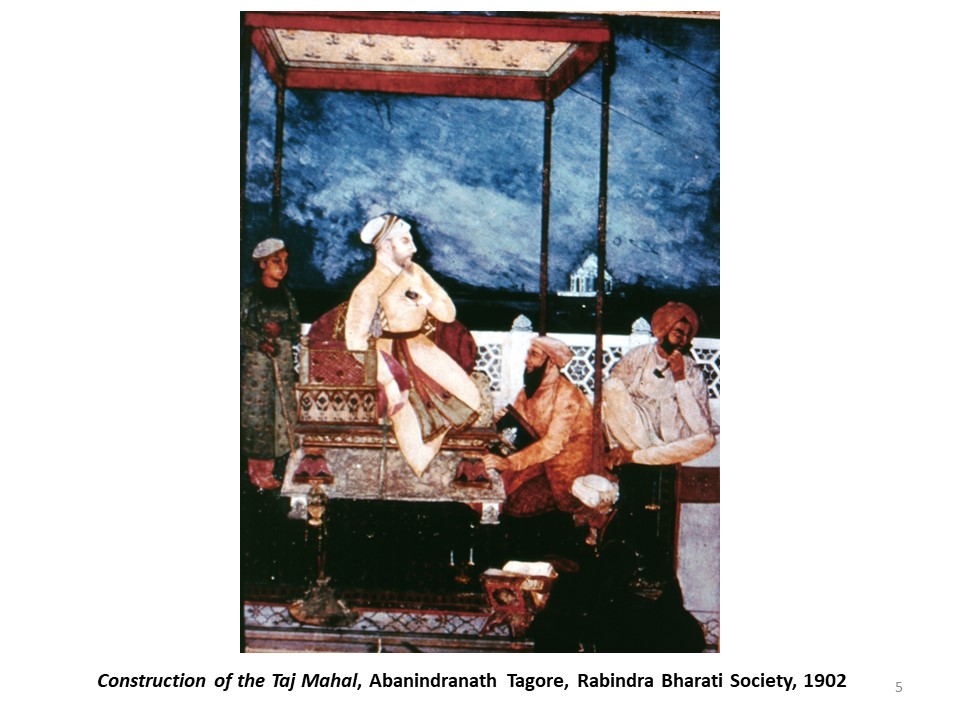
The Building of the Taj, Abanindranath Tagore, RBS

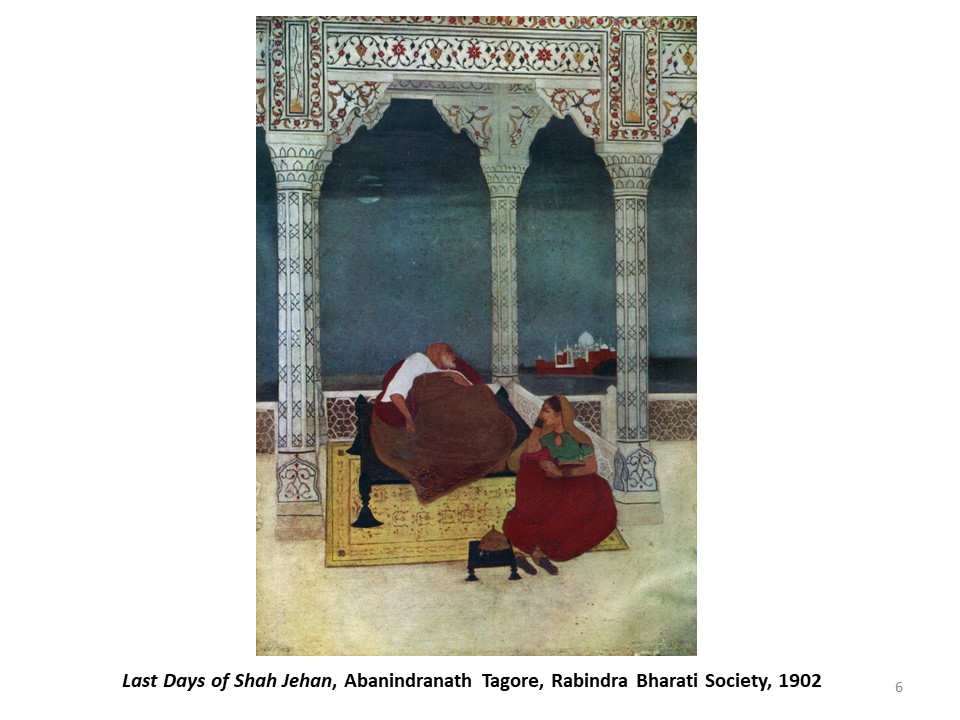
For example, two of the paintings of the post-Havell period in which Abanindranath seems to have invested a lot of attention concern the Mughal emperor Shah Jahan and his commemorative mausoleum to his wife, the Taj Mahal. These are ‘The Building of the Taj’ and ‘The Last Days of Shah Jahan’, both done in 1900-01 and presented at the Delhi Durbar of 1903, an event to mark the

The Building of the Taj/Abanindranath Tagore  (Rabindra Bharati Society, Kolkata)

coronation of Edward VII as emperor of India. The paintings, along with another one by him on a Mughal theme, The ‘Capture of Bahadur Shah’, were displayed in an exhibition at the Durbar, in which the ‘Last Days of Shah Jahan’ was awarded a silver medal. If we are to take these paintings as carriers of nationalism, we must first acknowledge Abanindranath’s location of the national as not restricted to the Hindu past, but in some way including Islam. Of course, the caveat here is Havell’s assignment of ‘Aryan’ cultural qualities to the Mughals and his famous statement “The Taj Mahal belongs to India, not to Islam”, which Abanindranath was no doubt familiar with. Moreover, the Taj Mahal had passed into the romantic western Orientalist imagination as a wonder of the world, and thus an ‘Indian’ monument of far greater popularity than any Hindu monument of India (as is the case even today). So

Abanindranath’s identification of the Mughal emperor Shah Jahan and Taj Mahal as emblems of the nation would in some way speak much more strategically to the European or European-trained viewer.  (This in itself hints at Abanindranath’s national essentialism as being not an invested but a strategic essentialism). Also, the fact of the Mughals’ being the last imperial national dynasty prior to the British, would be meant to have some effect, particularly considering that one of the paintings explicitly featured the act of imprisonment of the last Mughal emperor (Bahadur Shah) by the British. Seen in this light, the three paintings, taken together, immediately awaken the sense of a thinly disguised allegory on national subjection. ‘The Building of the Taj’ captures a moment of the glory of national creativity, when the wonder that was the Taj was built. I will consider this painting in greater detail so that its nuances and ambiguities can be better articulated. ‘The Imprisonment of Bahadur Khan’ presents the explicit subjection of the nation to British rule and awakens the memory of the 1857 Sepoy Mutiny, first war of Indian independence, when Bahadur Shah was nominally recognized by the renegade sepoys as the ‘emperor of India’, a title being assumed for himself at this very durbar by the British emperor. And ‘The Last Days of Shah Jahan’ are emblematic of the nation under British subjection – its native powers grown old, feeble and dying, gazing on the eternal glory of its own past creation with nostalgia, while attended on by a faithful helpless daughter. It is the third and last painting of the set which distills Abanindranath’s most characteristic saturated emotion, that of pathos, which while referring to a specific event in the life of a past emperor, extends itself into universality – the pathos of the past becomes the pathos of the passing, the present continuous, not merely of the nation, but of all nations, all empires, of the age, and of Time itself. Thus, to the British viewer, this allegorical pathos, combined with the realization of the Mughals as a “foreign” imperial power in India, once thought invincible, could awaken the anxious specters of alternate meanings – the rise, subjection and death of all imperial formations, including the invincible British empire, the empire over which the sun never set, with only its monuments of art left by Time as its trace. With the explicit referent of the Sepoy war behind and the simmering discontent which was to erupt as the Swadeshi movement in Bengal in a few years (1905), such a subconscious anxiety is not impossible to imagine as part of the imitational hybridity [vide Bhabha] of the paintings. Stylistically, too, the paintings were a thin hybrid graft of Mughal mixed perspective on British watercolor technique. Partha Mitter characterizes it as a “half-hearted modification of European linear perspective to accommodate the Mughal idiom.”[15]  This would add credence to my view regarding the destabilizing spectral effects of the series, seen in terms of Homi Bhabha’s mimicry. 

The metaphoric overtones of the pathos of “passing” in the ‘Last Days of Shah Jahan’ do not end here however. Painted in 1901, they carry the fin-de-siecle melancholy of the end of an Age [Siva Kumar], the passing of the pre-modern and the arrival of the modern. Fin-de-siecle nostalgia has been read as decadent and reactionary, since it longs for the stability of the past and resists the future. In this case, it may be said that it intuits the disappearance of imperial or oligarchic hierarchy and elitism and mourns this instead of embracing the democracy it will give way to. But such an evaluation presupposes a modernist teleology, and the necessary good of the fragmentation of society and the production of the isolated subject of modernity circumscribed by the global discourse of capital. Instead, the mourning for the passing of a pre-modern past may also be a yearning for a future where this past is reborn in a less flawed incarnation, a disjunction from the modern to the post-modern. This, indeed, is the concern with the communitarian that we find in a variety of turn-of-the-century cultural movements faced with modernity as an inexorable and imminent global phenomenon, from the Arts and Crafts movement in Britain to the communitarian streak of the Bengal Renaissance. But fin-de-siecle decadence hardly puts us in contact with the communitarian. Instead it may be thought of as a hyper-individualistic aestheticism and elitism, the illusory assumption of the sovereign subject of modernity. While it is true that the illusory sovereignty of the modern and the hierarchy of the pre-modern haunt this series of paintings, they point to a different time-consciousness in which the initiating image of the ‘Building of the Taj’ spirals repeatedly into place beyond the ‘Last Days of Shah Jahan’ initiating a new order of being and creation. This because the pathos of this last painting, traveling beyond the passing of an age, distills the sadness of temporality itself, the inescapability of the passage of Time, against whose destruction, only the transcendence of the creative work of art and the creative consciousness can stand. Indeed, we realize that Shah Jahan’s last days are not merely a meditation on the passing of the Mughal empire or of a pre-modern or pre-colonial India, nor the passing of all empire or of an age, but the mortality of time, which, as all Orientalists knew, Shah Jahan encountered early in his life with the death of his beloved wife and whose death he defied for all time with the creation of the Taj. Now, in his last days, the rapid steps of fleeting Time grip once more his contemplation, and with the imminent approach of their limit condition, he perceives once more, the incandescent structure of eternity in the hours and relives, with his gaze fixed on the Taj, his participation in that eternity. He is thus propelled out of pathos, out of time into the perpetual hour of the resurrection which re-instantiates the initiating conditions of the ‘Building of the Taj’. Now however, at his moment of subjection, the disillusionment of his sovereignty through imprisonment and his reduction to anonymity by time/death, the image is inflected slightly differently. Instead of the sovereign subject (literally, sovereign/emperor) of modernist art creation, we discover a field of art production [vide Bourdieu] with participants in a co-creative community – the sponsor, the architect, the artisan, the text and the realm of desire and intimacy. The specifics in the image are instructive. They show us the pre-modern conditions of hierarchic communitarian art production – there is Shah Jahan, the transcendental subject of national art production, determining through sponsorship the choices of architect and  artisan, and faithful abider of the sacred text. Behind him stands his daughter Jahanara, reminding of the subjective domain of familial intimacy which purports to be the affective link awaking memory (daughter/mother) and relating time to the timeless. She will return to sit behind the downsized emperor (now imprisoned discard) in his last days, linking the moment of creation to that of passing. At this passing of an age, the sovereign/emperor/creator/subject has been reduced to commoner and in his return to the resurrected future hour of creation, the pre-modern power relations have been rendered unstable, but the communitarian field of production remains the same – the nation as enduring monument in the field of passing time is not the modernist project of democratic autonomy but the co-creative communitarian project of affective relations, and professional skills of diverse ethnicity. The specter of the transcendental subject is still present, no doubt – Shah Jahan the Mughal emperor of the past, the British emperor of the present is also the nation-state of the future – but related to retrospective memory of the inevitable downfall, he is also the commoner, the artist as fragmented subject, co-constituted by the intersubjective community of art production, opening up the possibilities of an alternate nationalism.

The message of diverse ethnicity/religion in ‘The Building of the Taj’ is also not to be missed, and opens up the multivocality of address in this series. Here what is brought to mind and foregrounded is Havell’s cultural Aryanization of the Mughal and his statement “The Taj Mahal belongs to India, not to Islam.”  Abanindranath’s engagement with Havell’s text confronts the issue of inclusivism. Are the Mughals to be considered ‘Indian’ because they have ‘accepted’ Aryan cultural values and thus identified themselves as Aryan or is their ‘Indian-ness” based on an intersubjective immersion and acceptance through practice of the diverse lived histories of the subcontinent?  Abanindranath’s answer would seem to point to the second option – Shah Jahan, son of Jahangir and grandson of Akbar was born of a Mughal father and a Hindu mother, just as was his father. He is constituted physically and culturally of Hindu and Muslim parts, just as Abanindranth, the Pirali Brahmin is and the historical constitution of the present Indian subcontinent is. This intimate hybridity is reflected in the cultural expression of Shah Jahan. Abanindranathn is undoubtedly drawing from Havell’s statement about the Taj here – according to Havell, the Taj combines Hindu, Islamic and Italian renaissance elements: its unconventional bulbous dome is shaped in the image the lotus bud, its compact faceted cuboid structure influenced by the pancayatana shrine complexes of Hinduism, its minarets, arches, pavilions, calligraphy and other architectural elements drawn from Islamic architectural practice and its pietra dura ornamentation taken from Renaissance Italy.[16] Havell also spells out the Hindu and Muslim co-creation of the project – the architect, Ustad Shah Isa of Turkey was paid Rs. 2000 per month, just as much as were the Hindu pietra dura craftsmen from Kanauj.[17] Though these records are considered questionable today, they undoubtedly background the figures of the architect and craftsman, identified respectively as Muslim and Hindu by their costumes in Abanindranath’s painting. It is this synthesis of elements and cultural traditions that causes Havell to make his pronouncement; “The Taj Mahal belongs to India not to Islam.”  Since Havell was clearly interested in the construction of an Indian art history which essentialized a cultural Aryanism, he is certainly open to the charge of inclusivism here. Abanindranath’s visual echo of Havell’s proclamation regarding the Taj has other subjective connotations. Though nominally a Gaudiya Vaishnav, Abanindranath, like his uncle Rabindranath and several others of the Jorasanko community with their Pirali heterodoxy, saw religion, like nation, not as an institutionalized changeless system of belief and practice but as something open to perpetual transformation through lived interpretation and creative mysticism. The “intimate hybridity” of the Mughals could lend itself conspicuously to such transformations. Shah Jahan’s grandfather, Akbar’s religious eclecticism as also Shah Jahan’s eldest son, Dara Shukoh’s serious cross-religious scholarship and practice come  to memory, when we read the ‘Building of the Taj’ keeping in mind Abanindranth’s own engagement with religion as a heterodox practice of mysticism in the modern period. The charge of ‘inclusivism’ could not apply here, since the concept assumes institutionally defined religions, for which Abanindranath had little sympathy. The painting thus implies a culture of communitarian or ‘organic hybridity’ (Bakhtin) which either evades and exists in spite of the state or is actively promoted by it. To the British emperor as the British viewer at the Durbar, this message of hybridity, in the person of Shah Jahan and the culture of his kingdom posts an oblique commentary. It defines the last imperial formation, though of ‘foreign’ origin, as “Indian” based on its immersion in the lived histories of the nation, an intimate cultural hybridity, dialogic and intersubjective. It holds up this spectral mirror to the present imperial formation, also of foreign origin, but exempt from national identity by its cultural alienation – or is it alternately a challenge/ invitation to the British emperor and his advisors to enter like the heterodox constituents of Jorasanko into a project of creative and mutually transformative cultural hermeneutics and earn thereby the right to be called “Indian”?

The series, of course, speaks not only to the British viewer but also to the Indian. Here, too, the idea of national belonging is defined in terms of creativity, intersubjective hybridity and eschewal of orthodoxy. Opposing a majoritarian Hindu nationalism which can find no place in its history for Islam, locating the Muslim without exception as foreign invader, it grants national identity on the basis of intimate hermeneutic engagement with the habitus of the nation. Such an engagement, as in the case both of the Mughals and the Jorasanko Tagores, is dynamic and mutually transformative, rather than being invested in ahistorical essences. The ‘Imprisonment of Bahadur Shah’, viewed in Delhi, would provoke the memory of a half-century of subjection to the British throne in Indians, since it was 1856 when in this very city, Hindu and Muslim sepoys united to stand behind the last Mughal badshah and reject British hegemony but were humiliated, while now in the same city the king of England was ironically being proclaimed the emperor of India.  Similarly, in the ‘Building of the Taj’ it was Hindu and Muslim together, under the sponsorship and guidance of Shah Jahan, carrying in his person the aura of the rich cross-cultural and cross-religious creativity spawned by Akbar, who engaged in building the hybrid national monument of secular spirituality, the transcendental mysticism of human love. And the “Last Days of Shah Jahan”, for the Indian, would signify not merely the end of pre-British India, but more specifically, the end of the era of tolerance and creative hermeneutic exchange and syncretism/hybrid mysticism between Hindu and Muslim, since these last days were lived in the invisible shadow of Aurangzeb, scourge of Hindus and champion of Muslim orthodoxy. It would portend a future of cruelty and oppression in the name of institutional orthodoxies and ideologies, Islamic fundamentalism under Aurangzeb, civilizational bigotry under the British, the rumblings of Hindu nationalism with the soon-to-come partition of Bengal (1905) and the beginnings of the two-nation theory (Simla Deputation, 1906). Thus, as with its signification to the British, the nostalgia of the last days of Shah Jahan could translate into a yearning for a future where the new Indian nation would be born based on a return to a cultural intersubjective creativity as in a new non-hierarchic version of the ‘Building of the Taj.’  This address to the Indian at large as the constituent of the nation would apply in a more specific way also to the regional viewer of Bengal and its urban center, Calcutta, most well established site of colonial and bhadralok activity. Bengal, as a state, had a large Muslim population and stood, in 1901, on the threshold of political activism. The Mughal/Shah Jahan series was no doubt meant to be a statement of Abanindranath’s orientation in this impending maelstrom, his call to a participatory co-creation of the region, against the exploitative policies of the British. 

And finally, the series was addressed in an intimate way to the Jorasanko family community, presenting at this level the issue of hybridity, community and creativity. That this address was coded into the series and not accidental is attested to by the disclosure made by Abanindranath regarding ‘The Last Days of Shah Jahan’. The painting was done, he tells us, after the death of a daughter in the Calcutta plague of 1900 and the sorrow of this loss is what he brought to bear on the painting.[18] We have once more a drawing into the intimate lived community of the act of creation, amplifying the homologous element of the allegory in the paintings – Shah Jahan has commissioned and built the Taj as a result of the mourning of the loss of his wife and Jahanara, his daughter, mourns the passing of Shah Jahan.  At the individual level this becomes an allegory of the affective life and its power to put one into contact with an orientation towards death as the condition for authenticity. At the communitarian level of the Jorasanko family then, the series comes to mean something quite different – the passing of the lost glory of India or of a collective life of tolerance and creative hybridity or of a pre-modern age come to take on lived meaning in the mortality of time experienced through the affective life, and its challenge to the creative resources of the community to express that which can transcend this mortality. The hybridity of Shah Jahan and his creation is not lost here either – the individual artist and the communitarian collective, even in their autonomy are not sovereign – they are representatives of the diversity of discourses and histories flowing through the nation and region and their intersubjective creation is made in the name of this hybrid diversity. Creativity illumines, engages and transcends difference so that the creation remains a signpost to dialogic understanding and the bridging of multiple dualities under the banner of the primary duality of human death and immortality. An Orientalist and nationalist project thus translates itself into existential terms and finds a home, a practice and a meaning within the affective play of autonomy and immersion at the lived level of the community.


[1] Inden, Ronald, Imagining India, [], p. 229.

[2] Havell, E.B., History of Aryan Rule in India, New York, pp. 492-538.

[3] Havell, E.B., Indian Architecture, London, 1927, p.24.

[4] Hacker, Paul, “Inclusivism” in Incusivismus, Eine indische Denkform, ed. G. Oberhammer, Vienna 1983, pp. 11-28, referenced in Halbfass, Wilhelm, Indian and Europe: An Essay in Philosophical Understanding, Motilal Banarasidas, New Delhi, 1990, p. 403.

[5] Banerji, Debashish, “The Orientalism of E.B. Havell”, Third Text, Vol. 16, Issue 1, 2002, pp. 53-6.

[6] Tagore, Abanindranath, Jorasankor Dhare, pp. 240, 306-7. Abanindranath reminisces about two different instances of the plague which made the family move out of Jorasanko to rented quarters in Chowringhee, the “white part” of town. The first instance, coupled with an earthquake, seems to point to 1896. This move saw the death of Gaganendranath’s eldest son. The second visit, following the plague which killed Abanindranath’s daughter, seems to have been in 1900. Though he remembers this second move as the time when he first met Havell at the home of Gyananandini Debi, this is unlikely, since he was already well acquainted with Havell by 1900. Thus, it is more likely that he met Havell for the first time in 1896 or 1897.

[7] Havell, E.B., The Studio, vol. 44, 1908, p.111.

[8] Tagore, Abanindranath, Jorasankor Dhare, [], pp. 157-8.

[9] Ibid, , p. 101.

[10] Mitter, Partha, Op. cit, p. 299

[11] R. Siva Kumar, “Abanindranath’s Paintings Based on the Rubaiyat of Omar Khayyam” in Lavanya: A Journal of the Chandigarh Lalit Kala Akademi, Vol 1, No. 3, August 1995, p. 21

[12] Mitter, op. cit, p. 288.

[13] Mitter, op. cit., p. 285, 287.

[14] Panikkar, Shivaji K, Nair, Preetha and Das Gupta, Anshuman, “Art, Subjectivity and Ideology: Colonial and Post-Independent India” in Nandan, Vol XVII-1997, Kala Bhavan, Shantiniketan, 1997, p. 28

[15] Mitter, Partha, Art and Nationalism in Colonial India, 288.

[16] Havell, , Indian Architecture, London, 1927, p. 24-7, 84.

[17] Ibid.

[18] Tagore, Abanindranath, Jorasankor Dhare, [], p. 306-7.

Abanindranath Tagore’s Krishna Lila and the Fashioning of a Dialogic National Subjective Space in Turn-of-the-Centry Calcutta

Debashish Banerji

Studies of the participation of art in the formation of nationalism have tended to emphasize its creation of national myths and a continuous history in the service of the nation-state. Whether of the secular materialist kind, Marxist or capitalist or the Orientalist spiritual kind, such historicism has also been viewed as derived inexorably from the discourse of post-Enlightenment modernity. While such determining paradigms have their utility and reality, they succeed in rendering invisible subtler realities of alternate nationalisms, which remain subjugated, because unable to be voiced within this discourse. On the broader historical canvas, the Subaltern Studies group has made its intention the recovery of such alternate nationalisms. However, while valuable for the understanding of subalternity as the voices of socially subjugated minorities, these studies too, have largely conceded to modernity the “mainstream” histories of nationalism. In his by now classic work The Nation and its Fragments, Partha Chatterjee, one of the founder-members of this group, has grappled with some of these complexities of nationalism, subalternity and modernity. Taking his examples of early mainstream nationalism from what has been called the “Bengal Renaissance” of 19th c. Calcutta, he has tried to contest a simple derivation of national identity formation among colonized people from western models and institutions. But in doing this, he has affirmed the Orientalist divide of the national bourgeois psycho-sphere into the distinct worlds of outer and inner, material and spiritual, historical and eternal, colonized and free.[1] However, his analysis is far from a simple reduction, its subtleties amplified and elaborated in the last few chapters, which deal with the ideologies of civil society and community[2]. Here, he reformulates his earlier and more obvious divide, showing at the same time how post-Enlightenment modernity (of which colonialism is an epiphenomenon) premises itself on the plural space of secular civil society and how such a space depends on taxonomic grids of determinable meaning to maintain its order. In opposition to this, he demonstrates a strand of the Bengal Renaissance, which defies the attempt at categorization, resisting determinacy and relationality and thus, causality and historicality. This strand, dialectically opposed to civil society, he sees as “the untheorized discourse of community.”[3] Dipesh Chakrabarty, another member of the Subaltern Studies group, in his more recent Provincializing Europe, begins in many ways, where Chatterjee’s text ends. Chakrabarty extends the definition of subalternity to cover events that resist historicization. In his words. “they are marginalized not because of any conscious intentions but because they represent moments or points at which the archive that the historian mines develops a degree of intractability with respect to the aims of professional history…. Subaltern pasts, in my sense of the term, do not belong exclusively to socially subordinate or subaltern groups, nor to minority identities alone…”[4]  What Chatterjee calls “the untheorized discourse of community” would be considered subaltern in this sense and would be rejected by history writers, whether classical or contemporary, precisely because it would resist linkage in the causal narratives of the nation. Chakrabarty gives closer attention to this communitarian strand of the Bengal Renaissance in his book and attempts to sketch out a new location for it that would render it visible within history. Reiterating the premise of a plural secular civil society as the basis of the modern democratic nation, he points to the necessary formation of public and private domains for its existence. The revolutionary content of the Bengal Renaissance, he contends, was the creation of an alternate space that could exist alongside ordered civil society, a space that was neither public nor private, but stood liminally in-between, capable of offering subjective escape or of performatively subverting or negotiating transformation of the everyday order of civil society. This was the discourse of community, translated into the urban society of 19th c. Calcutta by a multiplication of means, prominent among which must be considered the creative efforts of the Bengal Renaissance. Chakrabarty isolates a number of devices by which this discourse is set in place, including the translation of a village sociality, relationally through extended familiality, actionally through practices such as adda, and ontologically through the formation of a heterogenous subject.[5] Of course, to locate the communitarian within the cultural politics of the Bengal Renaissance may be to risk the ire of Marxists and “traditional” Subaltern theorists alike. Limited within the boundaries of Hindu male bhadralok (gentlemen/bourgeois) society, this discourse of fraternity will be seen as an appropriation by the dominant/elite classes of the culture of the proletariat/subaltern. However, to do this is to fall prey to a structuralism which is blinded by its rhetoric into believing that taxonomies and polarities are truths and not strategies. While the interpretive division of society into bourgeois/proletariat or elite/subaltern is strategically important from the viewpoint of understanding and struggling against certain forms of subjugation, it is also and at least equally important to recognize that the condition of subjection to the forces of capital, whether economic or cultural, is a universal habitus of modernity and calls for a critique more fundamental than that of class struggle, as brought home in Moishe Postone’s recent reinterpretation of Marx.[6] According to Postone, the alienated social relationship of capitalism is ubiquitous and internal to modernity, capital and labor being co-constituents of personhood within it. In Postone’s words, “The modern capitalist world, according to Marx, is constituted by labor, and this process of social constitution is such that people are controlled by what they make. Marx analyzes capital as the alienated form of historically constituted, species-general knowledge and skills and, hence, grasps its increasingly destructive movement toward boundlessness as a movement of objectified human capacities that have become independent of human control.[7] From this point of view, the struggle against subjection can be seen as developing its own fuzzy forms within classes and sub-classes and spilling over to influence other social domains. The interpretive framing of struggle in terms of civil society and community, is thus strategic in a way in which certain aspects of the Bengal Renaissance can be seen as productive of a communitarianism which nevertheless developed its own life independent of class origin and continues as a messy component of contemporary life in Calcutta.

Extending Chakrabarty’s analysis, here I would like to suggest that this communitarian discourse was conceptualized by some of its inscribers as not only an alternate sociality, but as a model for an alternate national intersubjective space, one that could resist the leveling sway of the nation-state. And to his archive of devices, I would like to add the mytheme(s) of the Krishna Lila, the cycle of Krishna’s sports and dalliances with the cowherds and cowgirls of Brindavan, with its regional and national historical transformations, which comes to assume specific meanings in the urban national context of modern Calcutta.

Cultural nationalism, one may even say, is endemically plagued by the kind of ambiguity that the Bengal Renaissance demonstrates. Seeking for liberation from colonial subjection, it organizes collective identity in the form of taste, myth and history. The inevitable fossilization of such forms into authorized markers of the nation-state conflicts fundamentally with the drive for liberation, thus seeding the phenomenon with an internal dialectic. While in most cases this dialectic remains subliminal and unrecognized, it could surface as a source for ongoing productive revision within nationalism. My understanding of alternate nationalism stems from such a dialectic. The Bengal Renaissance, as an early pre-Swadeshi cultural movement, provides us with an interesting example of a nascent cultural politics, its dynamics moving fluidly between lived and imagined communities, locality, region and nation. The dialectic between form and freedom, structure and anti-structure, state and community is active within its discourse and the Krishna Lila mythos is an important medium for such transactions. This dialectic between the Apollonian and Dionysian potentia of nationalism[8] surfaces in the Bengal Renaissance through reasons both specific and general. Modernity and its ontology can be seen as the broader and more general determinant of an alienation against which culture may be seen to struggle through an adaptation of local communitarian and pastoral forms. But from the specific historical context of the region, this dialectic may be seen as a displacement of the analogous relationship between samsara and sannyasa, irrevocably ruptured by modernity. I have tried to develop this theme elsewhere[9] and will not elaborate here except to point out that it is this historical happenstance combined with the prevalence of alternate forms of structuring the same dynamic in Bengal that allows such a clear manifestation to the conflict within cultural nationalism and turns it into the basis of an alternate urban, social and national form.

The term “alternate nationalism” has sometimes been castigated as merely an attempt to reformulate a mainstream nationalism by positing something “more authentic.”  To this view, the drive for nationalism is fundamentally tainted by its need for rational validity, the causal chain of a history that can stand only through its suppression of all untidy incidentals which disturb its narrative. The national field is therefore of necessity a contested one, where histories jostle for supremacy in the words of a variety of myth-makers. To a mainstream history there are always a number of alternate versions, spectral histories which roam the streets in search of a home and occasionally find receptive grounds for rebellion and overthrow in the name of authenticity. There is thus no good or bad nationalism, only nationalisms that vie for supremacy. The voice of the intellectual must be raised against this very phenomenon called nationalism, according to this view, and support for any version of nationalism, alternate or otherwise, should be treated as suspect. But as Chatterjee points out, irrespective of the utopianism of this stance, the institutional hold of nationalism as a determining regime of contemporaneity is so settled and pervasive that it cannot merely be wished away by denying its existence.[10] If we recognize the internal dialectic of cultural nationalism, the notion of an alternate nationalism takes on a different and more radical sense. According to this, nationalism is contested not merely by other versions of itself but by its opposite, an anti-nationalism, which constitutes it as much as is constituted by it. It is in this sense that the challenge to colonialism, urbanity and modernity represented by myths such as that of the Krishna Lila, while itself the harbinger of a new regionality and nationality, can be seen as equally the destroyer of these forms, a dissolution through an appeal to community in the face of state identity. The continued co-existence of such forms of nationalism and its alternates, may lead to a culture of ceaseless revision, where the form of the nation is rendered pliable and creatively dynamic, while ceding ground progressively to the utopic dream of community and philosophic anarchy.

The Krishna Lila paintings, a series of 23 watercolor miniatures on the sports of the cowherd incarnation of Vishnu, are considered to be the point of departure for the artist Abanindranath Tagore, founder of the Bengal School of art. Prior to this, Abanindranath had some European academic training in art from an Italian artist, Olinto Gilhardi and an English teacher of oil and water colors, Charles Palmer. Abanindranath did not complete his studies under Palmer, but the Krishna Lila paintings betray his English watercolor training in his treatment of background landscape. Palmer seems to have been sympathetic towards his aversion to academic training and commented to Jamini Gangooly, Abanindranath’s nephew and co-student, “I had noticed all along that your uncle could not pull on with ‘life study’ and the European principles of light and shade…. It is a good sign that the artist’s temperament revolts against all rigid rules and beaten tracks. Independence leads to personality in art.”[11] When he saw the Krishna Lila paintings, he encouraged Abanindranath: “Mr. Tagore, I should strongly advise you to proceed along this line and produce more pictures of a similar nature. These pictures have a character of their own. You require no studies from life any more. I shall be greatly pleased to see your work from time to time.”[12] The paintings were made in 1897/8, at a time when the literary expression of the Bengal Renaissance was already well established. Born into the bhadralok family of the Jorasanko Tagores, Abanindranath found himself in the thick of the Bengal Renaissance from his childhood. In the shadow of the entrepreneur Dwarkanath Tagore (1794-1846), the milieu of the Jorasanko Tagores into which Abanindranath was born was prominent in the fashioning of various strands of the Bengal Renaissance. Interpretive debates and creative revisions and expressions in the field of religion and literature and cultural events like the Hindu Mela were ongoing concerns in this house and Abanindranath was no doubt socialized into the habitus of cultural nationalism from an early age. Two significant forms of regional mystic and cultic practice which found prominent articulation in the Bengal Renaissance, were Shaktism and Vaishnavism. Of these, it is the urban adaptation of the second at the turn of the 19th/20th c. in Calcutta which interests me here. As paintings, Abanindranath’s Krishna Lila universalizes the literary messages of Vaishnavism in the Bengal Renaissance, but goes further in its creative handling of textuality. While images undoubtedly transcend their textuality, the multivocality of images renders them meaningful in different and untranslatable ways to a diversity of viewership. The articulation and creative exploitation of such textual diversity within the image opens up an intersubjective dialogic space, where continuities and discontinuities are acknowledged and put into negotiation. My contention here is that Abanindranath’s Krishna Lila initiates such a process, which I try to explore in my discussions below on heterodoxy and on the plurality of life-worlds of the modern subject citizen of late 19th c. Calcutta/India, in which the paintings are embedded and which they address variously.

The polysemic possibilities coded into Vaishnavism, from the beginnings of its 8th/9th c. textual appearance in the Bhagavat Purana, have lent themselves to diverse adaptations through the regional history of Bengal and extending therefrom, in national and local histories, such as that of Jorasanko, the extended household of the Tagores. The compounding of the aesthetic, the erotic and the devotional in Sanskrit literature goes back to canonical writings such as the 2nd c. Natyashastra of Bharata and its extensive application in the 5th c. courtly literature of the Guptas-Vakatakas.[13] The 10th chapter of the Bhagavata Purana[14], dealing with the emotional life of the growing cowherd avatar Krishna, particularly his relations with the cowgirls of Vraja, is presented along these lines. The alliance of aesthetic, erotic and devotional constituents in this cycle of spiritual romance has lent itself to a variety of mutable emphases in different locales, periods and milieus depending on contextual circumstances. An outline of such a genealogy would bring to light the specific accretions of meaning present at the threshold of modernity in 19th c. Calcutta and their semantic transformations in this context, generally in the Bengal Renaissance and specially, to the creative handling of the Krishna Lila paintings.

Though a thorough historical treatment goes beyond the scope of this chapter, some broad lines in the adaptation of the Krishna Lila in Bengal may be indicated. The earliest known literary retelling of the Krishna Lila mythos in Bengal is Jayadeb’s 12th c. Geeta Govinda. Jayadeb’s poem is written in a highly aestheticized courtly Sanskrit and amplifies the erotic sentiment present in the Bhagavat Purana by transferring the collective ardors of the Brindavan cowgirls to the individualized subjective interiority of Radha, the feminine counterpart to Krishna. At the same time, his characterization of Krishna as both master and slave of love opens up the way for doctrinal innovations fully exploited by 16th c. Vaishnav theologians. The circulation of the Geeta Govinda throughout the Indian subcontinent over the next centuries made it into one of the most popular pan-Indian texts on the Krishna Lila and an important source (along with the Bhagavata Purana) for Rajput and Pahari painting from the 17th c. on. In Bengal, over the next four centuries, its themes and sentiments were vernacularized into Brajabuli and old Bangla by poets such as Baru Chandidas, Chandidas and Vidyapati, increasing the popular appeal of the mythos and introducing its ideas into the mix of erotico-mystical heterodox cults of the region such as the Sahajiyas, Tantrics and Buddhists.[15] Following this period, Sri Chaitanya (1486-1533) is responsible for the most powerful popular formulation of the Krishna Lila cult and the birth of a formal Bengal (Gaudiya) Vaishnavism. Chaitanya’s approach drew on both Sanskrit and vernacular poems on the Krishna Lila theme and made these into occasions of ecstatic collective contemplation facilitated by singing and dancing. Chaitanya also broke orthodox Hindu sectarian and casteist lines and opened the practice of his mystical Vaishnavism unconditionally to all.[16]

In this respect, it may be valuable to note that while positioning itself at the periphery of Hindu religious practice, the Krishna Lila cultus in Bengal also found itself from the beginning intimately related to Islam. Jayadeb himself was connected to the court of Lakshman Sen (c. 1178-1206), whose reign ends with the establishment of Turko-Islamic rule in the region. The proliferation of Islam as a hegemonic religious doctrine lacking shared roots with the history of regional spiritual discourse created a situation which may be better understood using Pierre Bourdieu’s theory of doxa.[17] According to Bourdieu, doxa are the unquestioned assumptions of a society, fossilized through historical processes so that there is a perfect congruence between the objective order and structures of consciousness.[18] These cultural practices and dispositions are therefore taken to be fixed and without alternatives. The forcible introduction of culture(s) with entirely independent historical roots into this matrix reveal the arbitrariness of doxa on both sides, releasing them potentially as choices. What were previously choiceless doxa now bifurcate into orthodoxy and heterodoxy.[19] The role of mythemes in facilitating processes of heterodox innovations under conditions of alien culture contact is attested to by the Krishna Lila. The suggestive, transgressive and polysemic possibilities of the Krishna Lila mythos formed a powerful catalyzing force in this period from the 12th – 16 th c. in fostering a plethora of heterodox mystic cults in Bengal and in providing them with variant approaches to a common thematic. Thus Baul, Sahajiya, Natha and a variety of sects and cults found themselves sharing a creatively handled vocabulary with Islamic mystic sects such as Fakirs, Pirs and Sufis.[20] This situation continues till today in rural Bengal, loosely institutionalized around collective festivals such as the Baul and Fakir Melas.[21] In the 16th c., the coming of Chaitanya added to this element of heterodoxy a powerful uniting force through an utopic social eschatology of communitas.[22] I use the term ‘communitas’ in the sense given by anthropologist Victor Turner, where he sees the hierarchic rigidities of social structure spawning the yearning for the experience of their opposite – an unstructured euphoric fraternal unity. Turner, in his work The Ritual Process: Structure and Anti-Structure deals with a variety of historical and cultural instances of communitas, of which one is the movement founded by Chaitanya.[23] Though in this exposition, Turner mistakes Chaitanya’s brand of Vaishnavism with the Sahajiya cult, the important identification he makes here is that of seeing Chaitanya’s adaptation of the Krishna Lila as not a temporary euphoric release as in most cases of communitas, but a form of partial withdrawal from the structures of society so as to institutionalize an alternate social form of “permanent communitas.”[24]

This history of medieval heterodoxy and the part played in it by the Krishna Lila is interestingly analogous to the urban situation of 18th/19th c. Calcutta. Here, the Islamic presence can be seen as replaced by colonial modernity, with the pressure of its new civilizing teleology and totalistic epistemology leading towards the formation of modern civil society with its division into public and private domains. For some Bengalis of the 18th c., this alien cultural hegemony served to open up an unsettled space of “jurisdictional uncertainty”[25], where doxa could once more be re-negotiated and orthodox and heterodox formations separate.[26] Here, it is often individuals and families already aligned with the history of heterodoxy in the medieval period which exercised their social creativity in this new urban space and a continued adaptation of the post-Chaitanya Krishna Lila mythos to stake out a domain of social communitas against the new orthodoxies of civil society which gains diverse interpretation.

Thus, in talking about Abanindranath Tagore’s Krishna Lila paintings, it is important to locate their social roots in the Jessore Vaishnav Brahmin family of Kusharis, outcast from Hindu society in the 15th c, due to an apocryphal incident in a Muslim court, and known popularly thenceforth as ‘Pirali’ (or quasi-Muslim) Brahmins. The ‘Tagores’ are a branch of this outcaste family settled in the vicinity of the new colonial city of Calcutta in the late 17th c. and the “Jorasanko” Tagores a further sub-branch, claiming possession of the family deity or aniconic stone (shalagram) form of Vishnu/Krishna. As touched on earlier, the prominence of this branch of the Tagores in the early colonial period can be traced to the mercantile liaisons and negotiations of Dwarkanath Tagore, the grandfather of the poet Rabindranath and great-grandfather of Abanindranath.[27] In this formative phase of the city, Dwarkanath’s uncertain social identity was an advantage which he exploited to the full in his dealings with the cultural plurality of the urban space.[28]

Dwarkanath’s eldest son and Rabindranath’s father, Debendranath embraced the synthetic universalism of Rammohun Roy’s Brahmo faith. Undoubtedly, among other things, it satisfied a longing for religious legitimacy, achieved through creative transcendence, while eschewing orthodoxy. Rabindranath followed in his father’s footsteps and remained an active member of the branch of Brahmoism led by Debendranath. Though this section of the Jorasanko Tagores abandoned Hindu ritual and idol worship and discarded the stone family icon, in the writings of both Debendranath and Rabindranath, one sees a continuation of the Krishna Lila references, metaphors and philosophemes. In the case of Rabindranath, in fact, there is a deliberate self-fashioning through physical appearance, dress and literary expression of an identity based on the tradition of the heterodox medieval Vaishnav cults of Bengal, particularly the Baul/Fakir forms.[29]

Debendranath’s brother and Abanindranath’s grandfather, Girindranath retained the stone shalagram idol and the Hindu self-identification, so that he and his descendents can be seen as more orthodox Gaudiya Vaishnavs among the Jorasanko Tagores.[30] Nevertheless, all branches of the Tagores continued to share a ‘Pirali’ questionable status in the eyes of mainstream Hindu society of the time, so that however they positioned themselves, this liminality combined with the post-Chaitanya legacy of Vaishnavism, freed them to pursue lifestyles and expressions of creative interpretation with close interchange across sectarian borders.

In 1877, Rabindranath published his first poems in the new Jorasanko house journal Bharati. These were a set of Krishna Lila poems written in old Bengali (Braja-bhasha) under the pseudonym Bhanusingha and posing as unknown authentic medieval Vaishnav poems discovered in the Brahmo Samaj library.[31] A decade later, observing his nephew Abanindranath’s restlessness with English watercolors, he advised him to turn to the medieval Vaishnav padabali literature and mine the treasures of the Krishna Lila in his art. In 1897, Abanindranath marked his departure from the themes and techniques of his tutelage with the Krishna Lila paintings. Reminiscing later on these paintings, Abanindranath identifies two simultaneous influences inspiring their genesis – the post-pre-Raphaelite illustrations to a book of Irish ballads gifted to him at that time and an album of 19th c. Indian paintings of the Delhi School.[32] In this performative disclosure he sets up the heterodox hybrid origin of the series. He also points out that Balendranath Tagore wrote an article on the same Delhi School paintings for Bharati. Balendranath’s article in Bharati was titled ‘Dillir Chitrashalika’ (the Delhi School of Art).[33] The subtext of the article is the contrast between the world of the Delhi School paintings and modern Calcutta. To summarize, the paintings present a world of intimate relationships – each individual is distinctly drawn yet each contributes some episodic detail which adds up to establish a context of unified meanings and relationships, a community. It is this communitarian message in its opposition to the fragmenting power of modernity that Abanindranath was drawing attention to in Balendranath’s essay and by extension to the art of both the Delhi School and that of the Pre-Raphaelites. In 1896/7, Abanindranath also met for the first time, E.B. Havell, his mentor-to-be from the Govt. Art College, from whom he picked up the anti-materialist critique of the British Arts and Crafts movement. It is unclear whether Abanindrnath met Havell before or after painting the Krishna Lila, but in either case, he seems to have intuited some of the latter’s ideas of the critique of modernity and the espousal of integrated cultural environments.[34] Thus, when Abanindranath speaks of the homologies between the Irish ballad illustrations and the Patna School paintings, it is their common affiliation to oral traditions of poetry and song and their spiritual and communitarian contexts that play an important part in his identification. Moreover, he positions them as British and post-Mughal -and thus, international and national – peripheries of the Krishna Lila paintings.

Abanindranath’s Krishna Lila paintings are executed as miniatures on paper, typically of size 5” x 8”. Of the 23 paintings in the series, 7 have inscriptions which take up almost half the page. Of these, five are in Sanskrit and two in medieval Bengali. The paintings display a consistent style – the figures are stiff and typal, closer to the manner of the early medieval Chaurapachasika style which continues in some of the later miniature schools, such as Basholi. In this, there seems to be an attempt to develop a figure type belonging to the Gujarat-Rajasthan-west Uttar Pradesh region, thereby acknowledging a location for the events in a more concrete national space, as against a purely idealized mystical space. But the landscape and architectural settings are hardly in the flat simplified highly contrasting opaque colors of the Chaurapanchasika style, substituting a preference instead for a naturalistic muted English watercolor treatment. I will deal further with the implications of style when discussing the emotional content of the paintings.

Here, I would like to isolate some of the key features of the Krishna Lila paintings signaling transformations of post-Chaitanya Bengal Vaishnavism in their specific relevance to modernity and the fashioning of an alternate regional, national and trans-national urbanity:

1.) Heterodoxy and Social Immanence: I have indicated how the regional history of Vaishnavism in Bengal had developed a strong tradition of heterodoxy by the modern period.[35] This included the burgeoning of a large number of syncretic cults incorporating diverse mixtures and variations of Buddhist, Tantric, Vedantic and Islamic/Sufi positions and practices, rendering the field doctrinally malleable and mystically fertile. Of course, there also developed side by side, a fundamentalist Gaudiya orthodoxy, but even this was marked by its relative collapse of caste and class distinctions.[36] The popularity of Krishna Lila themes overflowed sectarian boundaries. Krishna Lila themes and metaphors are reiterated even in Muslim circles through mystical folk songs such as fakir gaan[37] and a perusal of post-Chaitanya collections of Krishna Lila poems or padabalis reveals a substantial number of Muslim poets (pada-kartas).[38]

The new pluralistic urban sphere of Calcutta was peculiarly suited to the development of a creative non-sectarian rhetoric of immanent mysticism based on Vaishnavism. The Jorasanko Tagores, as mentioned above, were important players in the formation of the cultural identity of gentleman/bhadralok society here and in spite of their split into Brahmo and Gaudiya branches, shared a hybrid ‘Pirali’ self-identification creatively straddling heterodox traditions. In both the Brahmo Rabindranath and the nominally Gaudiya Abanindranath, Vedantic, Vaishnav and Sufi elements mixed freely in a self-styled aesthetic mysticism of social and natural immanence.  In the case of the Krishna Lila paintings, their heterogeneity is affirmed at the outset through a deliberate disclosure of the art-object’s textuality as a form of mutual equivalence – art is text as text is art. Historically, this choice offers a challenge to the post-Renaissance culture of specialized visual connoisseurship, itself an instance of modernity’s systemic classification and ordering of the world.[39] Here, though the artistic weaving of text and art undoubtedly follows earlier traditions of Persian/Mughal illustrations, the self-consciousness of Abanindranath’s
Figure 1 – Bhabollasa/Abanindranath Tagore   (RBS)

visual handling of textuality is without precedent. A Persian calligraphic script (nakshi) is invented to make legible the Bengali alphabet which in turn voices Sanskrit poetry.[40]

One can observe this, for instance in the painting “Bhabollasa” [Figure 1]. The theme deals with the preparation for the moment of union. Cloistered in an interior indicative of her subjective isolation, Radha’s expectation readies the celebration of ecstatic encounter.  The inscription reads (in translation):

Prepare the bed with flowers; bring, too, immortal garlands like strings of pearl. Bring clothes fit for dalliance with my beloved friend. Bring betel leaf in a jeweled case. Bring the yellow dress for the night. Know you all that the time for unhindered eternal union with Madhava comes shortly.

This jubilant mood accompanying mystical consummation has been celebrated by innumerable Hindu and Sufi poets alike in South Asia and forms a common theme of songs sung to this day from the time of Amir Khusrau (13th c). At the same time, it opens cultural doors on secular celebrations such as South Asian marriage festivities with their opulent forms of communal sharing. The painting, dealing with the preparations is austere and iconic, but manages through this understatement to suggest more than it says. The lady friends of Radha carrying the paraphernalia of celebration, remind us that union, mystical or secular, occurs in a collective context. The hanging garlands, banana leaves and earthen pot topped by an unripe coconut indicate Hindu ritual festivals, such as of marriage. They also point to what Abanindranath in his later writings, terms as a non-Aryan or anyavrata layer of culture hybridized into Hindu rituals.[41] However, the sparseness of detail also leaves room for interpretation and negotiation by a variety of regional and national constituents who may identify with the theme, while in the inscription, four levels of historicity are visually brought together through translational linkages which set into motion a regional and national dialogic space: from a distance, the inscription has the look of Persian calligraphy and pleases by its abstract aesthetic. Closer scrutiny reveals the alphabet as Bengali, while actual reading of the text shows it to be Sanskrit. The paintings thus participate in the oral traditions of Sanskrit poets who have been vernacularized and Islamicized, with the necessary independence through refraction at each translational level. It faces the viewer in the present as the modern art-object, ready for international consumption, constituted through the universal aesthesis of abstract calligraphic surface, yet like the urban space of the artist’s

Figure 2 – Abhisarika/Abanindranath Tagore (Indian Museum, Kolkata)

city, marked with the unsettled living and open secrets of its present pasts.

2.) Affective Rationality and Emotional Excess: The intersection of aesthetic, erotic and devotional attributes in early Bengal Vaishnavism received a new popular formulation in the 16th c by Chaitanya, which prioritized the emotional over the physical body.[42] This isolation of the “body of feelings” played an important role in identifying the location of truth and authenticity within the emotional body during the Bengal Renaissance. The novels of Sarat Chandra Chatterjee (1876-1938), for example, locate female “purity” in an interior ‘authenticity’ of feelings rather than in the forced circumstances of subjugated bodies under colonialism.[43] In saying this, I am aware that it implies the traditionally theorized split between the outer material domain where physical bodies were compromised and subject to the forces of coloniality and modernity and an inner domain of freedom and self-determination. However, I do not see these domains as watertight entities, nor do I identify the inner domain with the spiritual as opposed to the material. The emotional body here mediates between material and spiritual realms, providing a vantage for negotiating and structuring reality based on what Esha De has
Figure 3 – Krishna Lila: Nau Bihar/Abanindranath Tagore   (RBS)

termed a “feeling-ordered” or “affective rationality.”[44] De, following Foucault, sees the domain of reason as non-uniform, thus identifying plural rationalities. As against the “instrumental reason” of post-Enlightenment modernity, she locates an “affective rationality” which follows a creative logic driven by a specified succession of emotional states. In the Indian context, she sees the various formulations, elite and popular/subaltern, of rasa sastra as instances of such a “feeling-ordered” or “affective” rationality, mediating between material and spiritual realms.[45] As indicated earlier, the epistemes for such mediation go back at least to Bharata’s theories of rasa aesthetics, and their repeated applications and interpretations. The complex elaboration of these ideas as an emotional/aesthetic mysticism in the 10th c. by Abhinavagupta[46] gave them a new discursive power, generating a large body of textual and practical forms in the succeeding centuries. Post-Chaitanya Vaishnava theologians, particularly the writers of Gaudiya doctrine known as the Brindavan Goswamins[47], were prominent  for the adaptation of rasa throry to the Krishna Lila. According to this, contemplation of the pastimes of Krishna would awaken specific experiences of mystical emotion in an ordered hierarchy of ecstatic release/union.

The figure of the Abhisarika is a good example of a mediation between material and spiritual domains in Vaishnava rasa-aesthetics. The Abhisarika is a married woman with a stable location in the material order of the social world. But attracted irresistibly to Krishna, she steals away from home for her illicit tryst. Her path traces the movement of emotion in the experience of rasa – not one of simple transcendence but a transgressive movement between two forms of embodiment – material and spiritual. It is the fertile ambiguity of this image that makes it such a creative trope in the vocabulary of rasa-aesthetics.[48] The Abhisarika appears at least thrice in Abanindranath’s paintings – once within the Krishna Lila series and once each before and after, bracketing the series. The Abhisarika image is not bound within the sectarian concerns of Vaishnav schools, having been imported into its canon from earlier formulations of rasa imagery, such as Kalidasa’s 5th c. Ritu Samhara (Cycle of Seasons). Abanindranath was aware of this, as his post-Krishna Lila Abhisarika [Figure 2] was presented in this context, with Kalidasa’s inscription for calligraphy. Thus a non-sectarian aesthetic mysticism is isolated by Abanindranath of which the emotional states of the Krishna Lila are presented as socially embedded instances. Here, an ‘affective rationality’ works through a classification of human relations and their presentation as archetypal situations porous to a mutable and often transgressive action of affect. Such action achieves its radical power through a participatory culture of emotional excess where the rhetoric of unconditional surrender counters the objectification and commodification of relations as measured exchange introduced by modernity and its institutional forms organized through the nation-state and national and multi-national capital. A situation in the Krishna Lila paintings exemplifying such an affective transgression within what may be seen as a commercial exchange, is to be found in the painting titled “Nau Bihar” (Boat Dalliance) [Figure 3].  Here again, the painting is divided vertically into equal parts of image and text. The image shows a boat with sail unfurled docked on a bank edging the dark blue waters of the Jamuna and dividing it from a moody atmospheric sky of the same color. A light-ash-blue Krishna stands on the boat in dhoti and chaddar, gesticulating with an extended right hand while he holds the left hand of a green sari clad Radha with his own left hand. Radha has one leg on the shore and another lifted as if to enter the boat. Her head is turned back towards two other standing women in saris with pitchers on their heads. Apart from the blue of the water and the sky and some green colored stripes on the oar extending from the boat, Radha, at the center of the image is depicted in a bright elaborately designed green sari and green blouse, capturing the attention. The text inscription below, this time voicing an old Bengali pada (lyric) by the poet Gyandas, is written in the Bengali alphabet, scripted once more in Persian/Urdu nakshi calligraphy. It reads in translation:

Tell, o friends, what should I do

Being a boatman this one is asking for my youth.

A cause for alarm, o friend, fraught with danger

The boatman has put around my neck his own garland.

What was in my fate, o friend, who can change that

Being a boatman (he) touches me as he speaks.                  

It is shameful, o friend, a canker on my repute

With force and cunning the boatman has taken me on his lap.

Gyandas says, O girl, do not despair

Nanda’s Delight is the boatman, what need is there to fear. [49]

Here, Radha and her cowgirl friends, their pots filled with water, are making to cross the river in a boat at sunset. What is an everyday commercial transaction suddenly crosses the borders of propriety and enters a liminal zone of communitarian affect where the emotional life subverts the material exchange through the opening of an erotico-mystical experience of transcendence. In the painting, Radha is shown half-turned, as if in-between the two worlds of material exchange and mystical union, translatable in the context of Abanindranath’s Calcutta as the corresponding worlds of modernity with its ontology of the commodification of lives and relations and communitas with its immanent spirituality. The transgressive movement of the “body of feelings” passes from materiality through eros to spirituality – a movement between two embodied states as imaged by Radha’s pitcher-carrying friends and Krishna respectively. The friends still belong to the world of material transactions, while Krishna in his boat who guides the “shameful” transgressive movement of eros or affect has been specified in the calligraphic lines by Gyandas as “Nanda’s Delight,” from whom “there is no need to fear” – that is, the embodied object of transcendental identity, while Radha as the visual focus of our attention is the liminal transitive engagement between these two worlds. A subtler but similar in-between-ness can be seen in the posture of Abanindrnaath’s post-Krishna-Lila Abhisarika [Figure 2]. Though this nayika figure is alone in the dark with no context pictured behind or before her, there is a furtive twist to the slender body which marks the movement of affect as an engagement between two embodied experiences – that of materiality and spirituality or the world of contractual and commodified relations (modernity) and the world of the ecstatic identity of communitas (community).

In Abanindranath’s paintings, the isolation of the emotional body is also reflected in a deliberate departure from the fleshliness of the traditional Bengali depictions of the Krishna Lila.[50] Moreover, unlike the fluid easy charm of Pahari paintings, which figure both space and time as leisurely movement and seduce the eye to a natural identification and enjoyment, Abanindranath’s paintings with their rigid forms and staccato movements are like scenes forced into slow motion and frozen into frames, which distance the eye by their iconicity. With their abbreviated inscribed titles (about which, more later), they function more as mnemonics in an emotional alphabet, which is being presented so as to reinforce an alternate worlding of the world.[51] The transcendental world of mystical experiences thus becomes immanent in social relations as archetypes of feeling, which through intensity of contemplation, may open the door to liberation through the experience of rasa.[52] The gamut of emotional relations, from the carnivalesque participation of the entire town in the birth of Krishna, through filial, fraternal and specially various aestheticized stages of romantic affect, are elaborated in the paintings, with an intensity of mood sometimes bordering on hysteria. An image which captures well this extreme affect is Akrur Samvad [Figure 4]. The incident has to do with the arrival in Brindavan of Akrur, a friend and relative of Krishna’s, come to take him and Balaram to Mathura for the episode leading to Kamsa’s slaying. The cowgirls of Brindavan, knowing that Krishna will desert them, are distraught.

Figure 4 – Akrur Samvad/Abanindranath Tagore   (RBS)

Abanindranath’s painting shows us an inner courtyard with an open door to the outside through which a glimpse of a ready chariot with Krishna in it can be seen. Centrally foregrounded in the courtyard are four women in saris, with two of them holding up a third who has swooned and in the process of falling to the ground. The text inscription occupying the bottom half of the painting, is once more in Sanskrit written using Bengali characters in a Persian calligraphic style, The lines here are taken from the canonical Vishnav text, the Srimad Bhagavata and echo the emotional excess of the cowgirls (gopis) upon hearing of Krishna’s departure: “O creator, there is no compassion anywhere in thee. Thou dost make creatures meet in friendship and love, and separatest them for nothing, before they are fulfilled. Thy work is like the sport of a child. Having presented to us Mukunda’s face, graceful under curly locks, with well-formed cheeks and prominent nose, most winsome with gentle smiles that overcome all grief, that thou takest him from our view is no good work on thy part.”[53]

This isolation of the “body of emotions” and heightened presentation of extreme affect in a dramatic scene works at subverting the instrumental order of objectified mundane life which characterizes the ontology of modernity, opening an unpredictable door to mystical experience. The swooning of the gopi through excess of emotion is also seen in mystical Vishnavism as an entry into a different order of “divine” reality through trance. Indeed, the “swooning” of the gopi in the painting in a heterodox context echoes the Sufi experience of fanaa (nonduality) often presaged by a trance of fainting. Thus, Abanindranath attempts to adapt the Krishna Lila mythos through the trope of emotional excess in an order of affective rationality, to reposition mysticism and its alternate experiences in the field of modernity.

3.) Collective Ecstasy: The Krishna Lila mythos presents its climax as the utopian moment of a collective union and ecstasy, not through the disappearance of the individual (as in Advaita) but through an ontological shift resulting in the  realization of  an euphoric participatory oneness. This climactic episode is known as the Ras.[54] Here the cowgirls of Vraja all dance in a circle around Krishna, but find at one point that Krishna has multiplied himself so as to be dancing individually with each of them. Each then experiences the unity of the all, while also preserving an intimate individual relationship with Krishna.  In Abanindranath’s depiction of the Ras [Figure 5], his self-imposed naturalistic constraint prevents him from depicting the

Figure 5 – Ras/Abanindranath Tagore   (RBS)

miraculous multiplication. Krishna and the gopis dance around a tree with Radha taking pride of place beside Krishna, as in Jayadeva.  Without going into the doctrinal specifics of this realization, I would like to draw attention to a form of participatory action introduced by Sri Chaitanya in the 16th c. translating this paradigm into the popular culture of Bengal. This is the kirtan, a form of collective singing and dancing resulting in states of altered consciousness and loss of social distinction. The popularity of kirtan at all levels of society in 19th c. Calcutta can hardly be overemphasized.[55] Though Turner, in his discussion of Chaitanya fails to mention kirtan, as an anti-structural practice which positions itself at the periphery or limit condition of modern sociality, it is obviously a primary device for “communitas.”[56] Kirtans were common at the Jorasanko Tagore house. In the context of Abanindranath’s Krishna Lila paintings, these indeed play a central role. The Krishna Lila paintings have for some reason been universally misidentified as illustrations of Jayadeb’s Geeta-Govinda.[57] In fact, only one of the paintings can be clearly related to this text, the verse-inscriptions being from a variety of Sanskrit and Bengali padabalis. Rather, what unifies this body of work, is the fact that the Bengali captions to the paintings each refer to an episode or pala traditionally elaborated in pala-kirtans.[58] Indeed, the coding of such a nomenclature can be traced to the doctrinal aestheticization of the Krishna Lila by the Brindavan Goswamins.[59] As explained above, each pala coded a mnemonic in a structure of rasas. During the consolidation of Vaishnavism in Bengal following Chaitanya, numerous compilations of padabalis, organized by palas, were published.[60] This classification followed the expanding popularity of kirtan-singing and was meant to facilitate pala-kirtans.  Though it is nam-samkirtan (repetition of the Name) which is participatory and collective in the full sense and pala-kirtans along with katha-katha usually conducted  in a performative context, often through folk-plays or jatra, the aspect  of collective ecstacy and communitas in pala-kirtan is undeniable.[61] The Krishna Lila paintings therefore, metonymically subtend a multi-sensory experience grounded in the collective ecstasy of the kirtan.

In this way, by locating the Krishna Lila paintings within epistemes of social transformation in turn-of-the-century Calcutta they can be shown to further the communitarian discourse of the Bengal Renaissance. More specifically, the paintings acknowledge the emerging vectors of regionalism and nationalism (as also a more abstract internationalism) through the presentation of a popular regional and pan-Indian myth while at the same time contesting the statist fossilization of these spaces through the deployment of visual means exposing and promoting a liminal intersubjective space within modernity characterized by negotiations of heterodoxy, feeling-ordered rationality and communitas.

[1] Chatterjee, Partha, The Nation and its Fragments: Colonial and Postcolonial Histories, Princeton University Press, Princeton, 1993, pp. 12-13.

[2] Ibid., p. 200-40.

[3] Ibid., p. 238-9.

[4] Chakrabarty, Dipesh, Provincializing Europe: Postcolonial Thought and Historical Difference, Princeton and Oxford 2000, p. 101.

[5] Chakrabarty, Dipesh, Op. cit., pp. 117-214

[6] Postone, Moishe, Time, Labor and Social Domination: A Reinterpretation of Marx’s Critical Theory, Cambridge 1996.

[7] Ibid,, p.384.

[8] Here I would like to acknowledge my colleague John Tran, from the workshop on Modernity and National Identity in Art, for having pointed me to Nietzsche’s The Birth of Tragedy as a text for deriving these conflictual categories of cultural nationalism. See Nietzsche, Friedrich, trans. Fadiman, Clifton P., The Birth of Tragedy,  Dover New York 1995 reprint.

[9] Banerji, Debashish, “East-West Revisions of Hindu Spiritual Thought in Late 19th/Early 20th c. Bengal”, unpublished paper, 2000.

[10] Chatterjee, Op cit., p. 112

[11] Ganguly, J.P., “Early Reminiscences,” Viswa-Bharati Quarterly (Abanindra Number), Shantiniketan, 1942, p. 20.

[12] Ibid., p. 20-1.

[13] Though one may expect the dominance of the aesthetic and erotic to be peculiar to elite courtly culture, the provenance of the erotico-aesthetic as an independent genre of spirituality can be equally attributed to the seeking for forms of universality among professional itinerant artist communities and followers of cultic practice among a diversity of sects in an era of political integration.

[14] Srimad Bhagavatam, trans. Ragunathan, N., Vol II, Vighneswara Publishing House Madras, 1981 reprint, pp. 243-280.

[15] The rigid distinction between elite/written literatures and popular/oral ones is rarely an accurate model in the Indian context. Even the Marxist historian Sumit Sarkar, who makes the exploration of this distinction one of his objectives in his important paper on Ramakrishna is forced to concede the malleability of these domains. See Sarkar, Sumit, “’Kaliyuga’, ‘Chakri’ and ‘Bhakti’: Ramakrishna and his Times” in Economic and Political Weekly, Calcutta, July 18, 1992, pg. 1551.

[16] De, Sushil Kumar, Early History of the Vaishnava Faith and Movement in Bengal, Firma KLM Private Ltd., Calcutta, 2nd ed. 1961, 1986 reprint, pgs. 67-103.

[17] Bourdieu, Pierre, Outline of a Theory of Practice, Cambridge, New York, Melbourne, 1997 reprint, pp. 159-71.

[18] Krais, Beate, Gender and Symbolic Violence in Craig Calhoun, Edeward LiPuma and Moishe Postone ed., Bourdieu: Critical Perspectives, Chicago 1993, p. 167.

[19] Bourdieu, Ibid.

[20] Dasgupta, Sashibhusan, Obscure Religious Cults, Firma KLM Private Limited, Calcutta, 1st. ed 1946, reprint 1995, pgs. 160-7.

[21] Wulff, Donna M., “The Play of Emotion: Lilakirtan in Bengal” in William S. Sax ed., The Gods at Play: Lila in South Asia, Oxford University Press, New York, 1995, pg. 100.

[22] De, Sushil Kumar, Op. cit., pgs. 79-80.

[23] Turner, Victor, The Ritual Process: Structure and Anti-Structure, Aldine de Gruyter, Hawthorne, N.Y., 1969, 1995, pgs. 154-64.

[24] Norvin Hein sees the idea of lila (play as essence of reality) as a compensation for the lack of freedom in political, social and religious spheres during Muslim rule in India. See Hein, Norvin, “A Revolution in Krsnaism: The Cult of Gopala”, History of Religions 25, no. 4 [May 1986], pgs. 296-317.

[25] See Bhabha, Homi K., The Commitment to Theory, New Formations, Summer 1988, at 5, 22.

[26] Bourdieu, Op cit..

[27] Dutta, Krishna and Robinson, Andrew, Rabindranath Tagore: The Myriad-Minded Man, St. Martin’s Press, New York, 1996, pg. 17-26.

[28] Rabindranath, reminiscing in a lecture, had this to say about his childhood: “My ancestors came floating to Calcutta upon the earliest tide of the fluctuating fortune of the East India Company. The unconventional code of life for our family has been a confluence of three cultures, Hindu, Mohammedan and British. …I came to a world in which the modern city-bred spirit of progress had just triumphed over the lush green life of our ancient village community. Though the trampling process was almost complete….something of the past lingered over the wreckage..”. Ibid., pg. 17.

[29] This is what has led Sashibhusan Dasgupta, to call Rabindranath “the greatest of the Bauls of Bengal.” Dasgupta, Sashibhusan, Op. Cit., pg. 187. Ed Dimock follows Dasgupta’s lead elaborating this theme in a paper titled ‘The Greatest of the Bauls of Bengal”. Dimock, Edward C., Jr., “Rabindranath Tagore–‘The Greatest of the Bauls of Bengal,'” Journal of Asian Studies, November 1959, pp. 33-51.

[30] Dutta, Krishna and Robinson, Andrew, Op. cit., p. 35

[31] Ibid., pg. 64.

[32] Tagore, Abanindranath, Jorasankor Dhare from Abanindra Rachanabali, Vol I, Prakash Bhavan Calcutta, 1975, p. 304.

[33] Tagore, Balendra, ‘Dillir Chitrashalika’, 1895, Acharya, A. and Som, S., Bangla Shilpa Samalochonar Dhara, Calcutta 1986, pgs. 72-82.

[34] There is some controversy on whether Abanindranath met Havell before painting the Krishna Lila. Abanindranath himself mentions showing these paintings to Charles Palmer, his teacher in watercolors and notes his positive reaction, but does not say anything about showing them to Havell. But there exists an undated letter from Abanindranath to Havell (Havell collection, Rabindra Bharati Archives, Shantiniketan) where he mentions working on a series of Geeta Govinda paintings. Few of the Krishna Lila series are specifically from the Geeta Govinda, but there does not exist any other set of Geeta Govinda paintings either. Hence it is very probable that this is the series he is announcing in the letter.

[35] Chakrabarty, Ramakanta, Vaishnavism in Bengal, Sanskrit Pustak Bhandar, Calcutta, 1985, pg. 349.

[36] Sanyal, Hitesranjan, “Trends of Change in the Bhakti Movement in Bengal,” Occassional Paper 76, Center for Studies in Social Sciences, Calcutta, 1985.

[37] Wulff, Donna M., Op. cit., pgs. 100, 110.

[38] I have located at least 25 such poets from a variety of Padabali sources. Here is a partial list: Sultan Nasir, Ainuddin, Afzal, Mohammad, Sayyad Murtaza (a prolific padakarta), Fazil Nasir, Sayyad Sultan, Sayyad Ainuddin, Nasir Mohammad (several padas under this name), Akbar Shah, Kamar Ali, Alaol, Fakir Habib, Najar Mohammad, Mir Faizullah, Mohammad Hasim, Pir Mohammad, Ibrahim Khan, Mirza kangali, Chand Razi, Salbeg, Sayyad Feroze Shah and Yashoraj Khan.

[39] Roger Fry’s indictment of the Bengal School – accepted by Coomaraswamy – on the ground of its being illustration, is an example of the uncritical continuation of this post-Renaissance prejudice. See Fry, Roger, ‘Oriental Art’, The Quarterly Review, vol 212, Nos. 422-3, Jan. – Apr. 1910, pg. 237.

[40] The use of the Bengali alphabet to write Sanskrit is common in Bengal, but for Abanindranath, schooled in Sanskrit College and well versed in the Devanagari script, this must be seen as a choice.

[41] See my discussion of brata in Chapter 3.

[42] This is at least the widely held view of the matter and among the chief distinctions between the Gaudiya amd Sahajiya forms of Bengal Viashnavism, though some debate also surrounds the issue. See Das , Rahul Peter, “Chaitanya’s Vaishnavism in Bengal: Some Enigmas” in Essays on Viashnavism in Bengal, Firma KLM Private Limited, Calcutta, 1997, pgs. 23-38.

[43] See, for example, Dipesh Chakrabarty’s discussion of this distinction in Bankimchandra, Rabindranath and Saratchandra Chattopadhyay in his chapter ‘Domestic Cruelty and the Birth of the Subject’ in Chakrabarty, Dipesh, Op. cit., pp. 135-141.

[44] See the discussion on Rabindranath Tagore in De, Esha Niyogi, “Decolonizing Universality: Postcolonial Theory and the Quandary of Ethical Agency” in Diacritics: A Review of Contemporary Criticism, Summer 2002, volume 32, no. 2, New York, p.42.

[45] Ibid.

[46] Deshpande, G.T., Abhinavagupta, Sahitya Akademi, New Delhi, 1989, 1992.

[47] For a concise introduction, see Dimock, Edward C., “Doctrine and Practice among the Vaisnavas of Bengal” in Singer, Milton ed., Krishna: Myths, Rites and Attitudes, University of Chicago Press, Chicago and London, 1996, 1971, pgs. 41-63.

[48] Within the diverse usages of the Krishna Lila, the Abhisarika becomes a source of varied interpretation and doctrinal variation, as in debates on the spiritual preeminence of swakiya and parakiya prem. Ibid., pgs. 55-60.

[49] Kaho sakhi ki kori upay/Naiyer nabik hoiya e jauban chay/ paromad hoilo soi paromad hoilo/naiyer golar mala mor gole dilo/Je chilo kopale soi je chilo kopale/Nabik hoiya more paroshiya bole/kolonko hoilo soi kolonko hoilo/Bole chole naiya more kole kore nilo/Gyandas kohe dhoni na bhabo bisadh/Nander nondon naiya kiser paromad.

[50] Abanindranath later reminisces about a prominent bhadralok Vaishnav, Sisir Ghosh, editor of the swadeshi Bengali newspaper Amrita Bazaar Patrika, who complained upon seeing his paintings that they did not resemble the physical types of Radha and Krishna as described in Vaishnav literature. Tagore, Abanindranath, Jorashankor Dhare, Calcutta 1971, p.155.

[51] The notion of “worlding” is taken from Heidegger’s later works. See, for example, Heidegger, Martin, Poetry, Language, Thought, Albert Hofstadter trans., Harper & Row, New York, 1975, p. 180.

[52] See Dipesh Chakrabarty’s discussion of culturally mediated experiences of darshan and rasa in quotidian life in the chapter on ‘Nation and Imagination’ in Chakrabarty, Dipesh, Op. cit., pgs.163-79. Also 19th c. mystic Sri Ramakrishna’s description of samadhi at the sight of a British boy in tribhanga pose. See Yogeshananda, Swami compiled, The Visions of Sri Ramakrishna, Sri Ramakrishna Math, Madras, 1980, Pgs. 33-4.

[53] Srimad Bhagvata, trans, by Subbarau, S., Sri Vyasa Press, Tirupati, 1928, Skanda 10, Adhyaya 39, verses 19-20.

[54] Wulff, Donna M., Op. cit., p. 104.

[55] Wulff, Donna M., Op. cit., pgs. 99-111.

[56] Another form of “communitas” which based itself on the Krishna Lila and attained to an even greater popularity was the color-play of Holi or Dol.

[57] See, for example, Mitter, Partha, Op. cit., p.277.

[58] Wulff, Donna M., Op. cit., pg. 104.

[59] Dimock, Edward C., Op. cit.

[60] Sanyal, Hiteshranjan, Bangla Kirtoner Itihas (Bengali), Center for Studies in Social Sciences, Calcutta 1989, pgs 190-205.

[61] Wulff, Donna M., Op. cit., p. 101.
Homologies of Cultural Resistance in Turn-of-the-Centry Japan and India: A Comparative Study of Okakura Kakuzo and Abanindranath Tagore

By Debashish Banerji

In 1902, Okakura Kakuzo, then forty years of age and the head of the Nippon Bijutsuin, came to India, ostensibly on a mission to take back to Japan the Vedantic thinker and yogi, Vivekananda. This did not materialize, since Vivekananda died that year, but he formed a close friendship with the thinker’s premier disciple, Sister Nivedita, who introduced him to the Tagore household. At this time, the Tagores were a culturally prominent extended family in colonial Calcutta, economically successful as businessmen and feudal landlords, several of whose members had the leisure and genius to explore innovational creative expressions in the Arts. Premier among these was the poet, Rabindranath, who had laid already the foundations for cultural nationalism in Bengal, by adapting themes and idioms from medieval Bengali mysticism to a modern romantic articulation of his own. Okakura was brought into contact with Rabindranath’s nephew, Suren Tagore and stayed at the latter’s home. Here, he encountered another nephew of Rabindranath, by name Abanindranath, an artist who was at the time disillusioned with western Academic Naturalism and seeking new expression. Though their meeting was brief, and Okakura left India shortly thereafter, Abanindranath was profoundly influenced by the contact and embarked upon a artistic direction that owed much to Okakura. According to Abanindranath, Okakura taught him the elements of Japanese composition, and, upon his return to Japan, sent his two favorite students, Taikan and Hishida to the Tagore household, on a “cultural exchange” program. Abanindranath learnt from these artists Japanese brushwork and the moro-tai or “hazy style” wash-technique, which he adapted to his own practice. Subsequently, Abanindranath went on to become the founder of a “national” school of Art, based on a hybrid style, reminiscent of the ideas of Okakura and the practices of his followers. Abanindranath was not to meet Okakura again till 1913, when the Japanese ideologue visited India, shortly before his death, and traveled with Abanindranath to see some of the temples of Orissa.

A case of two Asian thinkers and an influential chance meeting. But distancing oneself and taking the perspectival view of these two lives, one finds surprising similarities of pattern, down, in certain cases, to the fractal wrinkles in the incidentals, so that one cannot help wondering at the significance. There are differences, too, no doubt. Firstly, there is a phase lag, Okakura being about ten years elder to Abanindranath and having lived certain phases of the pattern that were to be re-lived by the latter after their encounter. Then, there are differences in culture, circumstance and psychological response. But these differences only serve to bring out in sharper relief the homologies shaping the temporal structures of these lives. Undoubtedly, the intersection of the lives complicates our ability to isolate their independent movements, but even this chance intersection only goes to amplify the homologous pattern. A study of these homologies
would seem to be historically important then, from the viewpoint of distinguishing the significant dynamics and stages in the play of idea-forces in turn-of-the-century Asia, particularly in the trajectories they disclose in two regions with strong and related surviving cultures of thought and tradition, Japan and India.

19th century Japan and India:
To look at the similarities of trajectory in the two personalities, we need first to situate them in context. Here, we find an interesting difference – in that, all of India came under British rule by the mid-19th century, while Japan remained uncolonized. However, this is only a superficial difference, since, in an ironic reversal of action, Japan, in preparing to defend herself from colonization, was forced to embark upon a process of voluntary westernization in the mid-19th century. Thus the universal legacy of western colonization in Asia was equally the experience of late 19th and turn-of-the-century Japan and India. The voluntary modernization of Japan, in fact, only brings out more clearly the inevitable nature of global westernization through the civilizational expansion of Europe.

Yokohama and Calcutta:
In late 19th century Asia, in their respective countries, these were the two most westernized cities. Yokohama was a port town built on a western plan largely at government expense with the express design of attracting western merchants, and distanced from the mainland to avoid confrontation with increasingly hostile traditional forces. The Japanese who settled here were usually adventurer businessmen who were willing to renounce their traditional social roots in favor of a new and western identity. Calcutta was the British colonial capital in India. An older westernized city than Yokohama, developed by the British East India Company as a trading town from 1609, it had had the time to grow and wear a more settled look by the mid-19th century. After becoming the capital of British India in 1857, enlarged administrative functions were added to its earlier predominantly economic ones. A much larger number of Indians lived and worked in mid-19th century Calcutta than the Japanese in Yokohama of the same period. Moreover, the transition from traditional Indian to modern western in the city was more complex, as a large number of natives translated back and forth between the city and its rural surroundings. An educated native elite class had come into existence from the late 18th century, so that the native response to westernization had developed a variety of manifestations by the mid-19th century. Early attempts to reconcile east and west were conciliatory in nature, emphasizing unitarian principles in Indian and European ideal thought or attempting synthetic formulations. However, by the mid-19th century, distinct forms of resistance to westernization were beginning to be voiced, and as already mentioned, the Tagore family was culturally in the forefront of this movement.

Ancestry:
New urban centers like Yokohama and Calcutta provided a context of social structuring outside of tradition. Thus many natives with questionable ancestries found themselves with nothing to lose and could forge for themselves new social identities, often of a hybrid nature. Both Okakura and Abanindranath came from such backgrounds. Okakura’s father was a samurai turned businessman. In fact, his origins are hazed in conjecture, there being some evidence that he might have bought his samurai rank to start with. He abandoned a wife and four daughters to start a new life as the manager of a silk trading house at Yokohama. Abanindranath’s ancestors had been ostracized Brahmins. They had to renounce their ancestral surname and adopt the title “Tagore”. Rumor had it that there were obscure Muslim liaisons with the family. It was Abanindranath’s great-grandfather, Dwarkanath, who had established the family fortune and the mansion at Jorasanko, Calcutta, early in the 19th century, through his mercantile genius. This hazy ancestry and the fresh, though alien social conditions of urban life combined to give both Okakura and Abanindranath a doubtful identity that was both a source of strength and of weakness. Weakness, since it made for a sense of rootlessness; strength, because it liberated them to re-create themselves dynamically in a variety of hybrid identities.

Upbringing and Early Education:
An important difference can be noted here. Okakura’s early years are marked by traditional and familial alienation, characteristic of urban nuclear families with prioritized individualistic achievement in a modern industrial society. The acceptance of a migrant identity seems particularly clear in the case of his father, who deliberately distanced himself from his past, assuming a merchant name, Ishikawaya Kan’emon and taking a new wife, whom he referred to simply as Kono Onno (“this woman”). The mercantile and ignoble connotations of Okakura’s own name, Kakuzo, meaning “corner warehouse” are symptomatic of Kan’emon’s new found industrial identity, as is the scanty attention paid by him or his wife to Okakura. Thus Okakura’s early upbringing was entrusted to the traditionally rooted Tsune, who gave him his an early taste of an extremely different ethical and cultural system – that of the loyalist samurai. Abanindranath, on the other hand, grew up in a caring extended family, which already evidenced a synthesis of western and traditional cultural values. However, here too, the father was much occupied in personal pursuits and the mother in household cares, so that Abanindranath grew up largely in the keeping of servants and poor relatives, visiting for longer or shorter periods from the villages. As with Okakura, these connections opened for Abanindranath a window into another world from that of his parents – a vast world of hunger and death and nature and spirit.

The subsequent boyhood of both Okakura and Abanindranath were spent in the developing awareness of their bi-culturalism. For Okakura, shuttling between studies of Buddhist and Taoist philosophy, poetry and calligraphy at the Choenji temple in Kanagawa and the learning of the English language and western culture and scholarship under American missionaries at the Takashima school at Yokohama. And for Abanindranath, learning (reluctantly) English, mathematics, history and geography under a house tutor and the romantic subtleties of Bengali Vaishnava poetry and philosophy from his largely self-taught cousins and uncles, specially the precocious Rabindranath. They both lost a parent early – Okakura his mother, at age eight; and Abanindranath, his father, at age ten.

However, within the similarities, certain variations of emphasis are observable. Thus, Okakura seems to have grown more comfortable with the English language and western culture in general than with Japanese; while the bi-lingual emphasis in Abanindranath seemed to lean more heavily towards Bengali and later, Sanskrit. Prof. Notehelfer has drawn attention to Okakura’s perfect ease among westerners in contrast with his difficulties of relationship, arising from an “inferiority complex”, with the Japanese. His vastly superior handling of English and his eventual migration to Boston also testify to this. In the case of Abanindranath, his insistence on the use of Bengali as a medium for his theoretical and creative writings and his stationary unwillingness to leave Calcutta add to the more local bias. This early period also left its impression on both, I believe, in terms of pedagogical orientation. Okakura, with his exposure to both traditional and
western institutionalized forms of education, could not but have sensed the differences in approach; while Abanindranath, with a conscious early rejection of western school education for its uncaring and disciplinary normalizing practices, held an abiding distaste for western institutional pedagogy, insisting in its place on an experimental environment of personal attention and self-study, as developed in the traditional gurukula system.

The Orientalist-Nationalist dialog:
Undoubtedly the most decisive relationships in the lives of both Okakura and Abanindranath arose from their encounters with major Orientalist thinkers – Fenollosa in the case of the Japanese and E.B. Havell in the case of the Indian. Orientalism, as a 19th century phenomenon (with its continuing contemporary effects) has been much discussed in recent times, following Edward Said’s influential study of 1978. The major strands of its complex make-up may be summarized:
(1) As an epistemological extension of Colonialism, systematically gathering and classifying information about the “natives”, ostensibly from a disinterested scientific motivation, but in reality, collusively with the manipulative intent of a subjugatory administrative machinery; (2) As a museological construct, backgrounded by a civilizational teleology, which saw in foreign cultures the preserved medieval past of Europe and/or the expression of the alien and the exotic, and wished to “collect” and “eternalize” such cultures through the positing of a static ontology, conducive to political and economic advantage; (3) As an oppositional construct, seeing in the Orient the “other” of the Occident, the “spiritual” opposite of “material” Europe, as a reductionist romantic alternative attempting to inscribe itself as knowledge and policy on native societies, through insistence on the isolation of the “ideal”. In varying measures, these motivations make their appearance in the Orientalism of both Fenollosa and Havell. An ambiguous imperialism combines in Havell with an anti-materialist ideology, based in the British Arts and Crafts movement, to favor a “spiritual” art educational and public works policy in India, aimed at a patristic cultural preservation. Though the officially uncolonized status of Japan invalidates the imperial motive in the case of Fenollosa, an active museological interest mixes with a Hegelian ideological structure to promote an envisioning of the cultural superiority of Japan and the reversal of its westernizing priorities. Modern scholars of Orientalism have also seen the development of Nationalism in colonized territories as often little other than an introjected Orientalism, an acceptance and promotion of its oppositional categories. Indeed, a superficial perusal of the ideas and public lives of Okakura and Abanindranath would seem to indicate this, though subtle differences of motivation, approach and the construction of identity emerge on more careful viewing, pointing to other conclusions. The Orientalist-Nationalist dialog, in the case of both Okakura and Abanindranath, provides a refracting interface for the legitimizing articulation of indigenous preferences within a “civilizational” framework.

The Public Lives:
As in the case of their untimely loss of a parent, a commonalty of their early adulthood, assertive of tradition, was their marriage. Both Okakura and Abanindranath were married at the age of seventeen. In both cases, there were elements of chance, determinative of their influential roles in the field of Art. Okakura had educated himself in Japanese traditional art, music and literature. At the Kaisei Gakko, he prepared himself for a bureaucratic position in the Meiji government by writing a thesis on “The Theory of the State”, but an argument with his wife, led to the destruction of the manuscript and the hurried presentation, in two weeks, of an alternate submission on “The Theory of Art”. Upon graduation, this influenced his securement of a government position, and he found himself in the music section of the Ministry of Education. However, differences with his westernized Japanese superior led him to seek a transfer and brought him into the department of art. In the case of Abanindranath, though an important difference in the lack of necessity or ambition for a public career marks him from Okakura, a similar uncertainty is evidenced in the fact that, like the Japanese, he had an all-round training in Indian cultural arts and engaged in the practice of painting, writing and music. In his reminiscences, he notes that both painting and music vied for primacy in his early attention, but a number of factors, important among which were his encounters with Havell and Okakura, decided his course in favor of art.

In keeping with the Enlightenment aesthetics of Europeanization, the prescribed institutionalized standard for art of the mid-19th century, in both Japan and India, was western Academic Naturalism, using oils on canvas. In Japan, the state sponsored Industrial Art School (Kobu Bijutsu Gakko) was opened in 1876, under the Italian artist, Antonio Fontanesi. In India, by 1867, twenty-two Industrial Art Societies and three Government Art Schools in the major cities – Calcutta, Bombay and Madras – had been established, dominated by the academic policies of the Central School of Industrial Art at South Kensington, London. These insitutions were responsible for a widespread change of taste in the direction of illusionism. The principles of traditional art in both Japan and India had encouraged a simplified two-dimensional modeling, rendering ambiguous the notion of distance, and oriented towards spiritual contemplation and portrayal. In making this assertion, however, I need to point out that it follows characterizations of eastern art as founded by 19th century Orientalists, such as Fenollosa and Havell, in which (a) a common aesthetic is supposed for all “Eastern” art, and (b) the ubiquitous use of the word “spiritual” hides the fact of its relative vagueness to the Orientalist mind, and the lumping of a wide variety of effects and ontologies under its rubric. This issue of a common spiritual ontology and aesthetic would exercise the native ideologues and practicants, such as Okakura and Abanindranath in much more serious and specific ways in their attempt at the formulation of a Pan-Asianism.

Okakura met Ernest Fenollosa in the mid-1870s at the Kaisei Gakko in Tokyo, where he went for higher studies. He studied Philosophy under the American, and was introduced by him to German idealistic thought. He also served as Fenollosa’s interpreter, during the latter’s procurement trips to antique shops and art galleries and for the translation of ancient Japanese manuscripts. Their strategic alliance, combined with Okakura’s official administrative authority, led to the rapid revision of the basis of artistic taste and education in Japan through the 1880s, starting with the closure of the Kobu Bijutsu Gakko in 1882. Swiftly, this was followed by the
museological identification and cataloging of Japan’s “national treasures”, the founding of the very influential art society, Kanga-kai, the reversal of the Ministry of Education’s fifteen-year commitment to the pencil as the instrument of writing in Japan’s elementary schools in favor of the “spiritually expressive” brush and culminating in 1888, with the appointment of Okakura as the head of the art section of the Tokyo Imperial Museum, with Fenollosa serving on its administrative board and the founding in February, 1889 of the Tokyo School of Fine Arts (Tokyo Bijutsu Gakko), with Okakura placed at its head in 1890 and Fenollosa as professor of Esthetics and Art History. The influential art historical journal, Kokka, was also launched at this time, by Fenollosa and Okakura. Using the Hegelian model, the professed aim of the school was to arrive at a synthesis of eastern spirit and western technique in art, and a new “national” art movement, Nihonga, was spawned from these ideas. The two most prominent artists to emerge from these students were Yokoyama Taikan and Hishida Shunso. In 1890, Fenollosa’s contract was not renewed and he returned to America, accepting an appointment as the curator of Eastern art at the Boston Museum of Fine Arts. Okakura encouraged a reversal of training techniques: copies, life studies, anatomy, light and shade, perspective all reduced art to “imitation”. “In order for the particular to reveal the universal, eastern artists had not drawn from life. They had observed nature, meditated upon it, and then through the internal process, had been able to abstract the ideal or inner essence of their subject.” [F.Notehelfer, 335]

Abanindranath received training in pastels, watercolors and oils under British and Italian artists in Calcutta between the years 1885-92. Though versatile in western techniques, his customary restlessness with academia got the better of him soon, and he bored of the prevailing styles of western painting by 1895, seeking new sources of inspiration. Though superficially balanced in idyllic familial harmony, unresolved assumptions in his internalized mix of east and west began to surface as dissatisfaction in him and he turned to a perusal of British and Rajput illustrated medieval manuscripts. A series based on traditional Vaishnava literature painted by him around this time, shows a radical departure from the past, with the abandonment of modeling and one-point perspective, in favor of traditional compositional elements. In 1896, he was introduced to E.B. Havell, the newly arrived principal of the Calcutta Art College. To Havell, following William Morris, the Middle Ages in Europe marked its high spiritual period, based in an integrated and holistic context of religious practice. He traced a fall from the “spiritual” art of medieval Europe, through the “insincere” art of the 18th century and leading to the “materialist” art of the 19th. In classical Indian culture, he found a context, similar to that of medieval Europe. Moreover, he drew attention to the anti-naturalistic bias of both European medieval and Indian art, pointing to their dominant concern with the ideal and the “spiritual” as the basis of representation. As one of his first reforms as the principal of the art school, he auctioned all the classical antiques, used so long in the “copy” class, and bought, in their place, a number of original Mughal miniatures. But this was not for the copy class. In fact, that class was replaced by one in which the student visualized, using meditation techniques similar to those outlined by Okakura, and painted, instead, from memory. Havell quoted the Indian silpa-sastras as authority. Abanindranath, already oriented in the direction of a non-illusionistic art, found Havell with his art school originals and enthusiastic explanations, just what he needed. A close tie and strategic alliance developed between the two, similar to that between Okakura and Fenollosa. Though not a student of the art school, Havell included Abanindranath’s works in the school exhibitions. In 1901-2, Aban’s paintings on Hindu themes won a gold medal at the Congress Industrial Exhibition at Calcutta and in 1903, his painting “The Last Days of Shah Jehan”, done in oils, but in a Mughal miniature style, won awards at several exhibitions and high applause from critics as heralding a new age in Indian painting. It was around this time that he was to meet Okakura, and incorporate important elements of the Nihonga style in his work. Though Abanindranath had no formal credentials, in 1905, Havell manipulated his entry as vice-principal of the Calcutta art school. Aban further de-structured the teaching methods, fostering an experimental creative atmosphere. In 1907, Aban and his elder brother, Gagan, founded the Indian Society of Oriental Art. Similar in many ways to the Fenollosa-Okakura founded Kanga-kai, the membership of the ISOA read like a Who’s Who of influential patrons and officials of Calcutta. In the meantime, with the escalation of the struggle for independence, this art became appropriated by the nationalist politics of the time. Much again, as in the case of Fenollosa, less then a year after the establishment of his native protégé in the seat of power, Havell left India, at first on sick leave, later to be declared “unfit for service in India”; and Abanindranath became the Acting Principal of the art school. Prominent among Aban’s first batch of students were the artists Nandalal Bose, Venkatappa and Kshitin Majumdar. Scenes from Indian mythology, history and nature were the principal subjects, done in inks, tempera or gouache, using traditional metaphors and emphasizing mystical mood through rhythmic delineation and tonal density, effected through color washes.

Decline and Withdrawal:
At the Tokyo Bijustsu Gakko, Okakura’s hour of supremacy was short-lived. In 1896, he invited Kuroda Seiki, a Paris-trained, immensely popular and influential western-style artist to join the school and start a section on western-style (yoga) painting. The political manipulations of Seiki, coupled with other elements of ideological polarization within the school and personal disturbances in his life, led to Okakura being eventually forced to resign from the school as also from his position at the Imperial Museum. Seventeen fellow faculty members resigned with him, and it was with this entire group that, supported by the financial generosity of influential patrons such as William Bigelow, Okakura founded the Nippon Bijutsuin under his personal leadership in 1898. As in the School of Fine Arts, a model similar to that proposed by Havell in India was sought to be emulated, in which art and craft were given equal importance as aspects of a coherent culture. Okakura had houses built for himself and the artists in the vicinity of the Bijutsu-in at Yanaka Hatsune-cho, where a close working and living relationship between artists and students was fostered, similar to that of the traditional schools of apprenticeship or the Indian gurukula. It was during this period that two of the senior students of the Academy, Taikan and Kanzan, developed the ‘hazy’ style or morotai, under Okakura’s influence, making, in his words, “tonal impression the main ingredient of painting.”

But Okakura’s personal restlessness, which had begun to surface after his father’s death in 1896, did not desert him. By 1901, the Bijutsuin was in serious financial difficulty, and Okakura seems to have sought an escape from its responsibility. Okakura decided to accompany an American lady, Miss McLeod and a Buddhist priest to India, with the ostensible intention of convincing Vivekananda to visit Japan. But there were other reasons. For one, from the time of his studies in art with Fenollosa, he had developed the notion of Indian culture and art, specially that of Ajanta, being one of the spiritual root-sources for Japan; and for another, conscious now of stiff personal and political opposition to his ideas, he sought wider support in the idea of a Pan-Asianism, resting on the nationalistic resurgence of other politically and/or culturally subject Asian nations, such as India. In India, he found the occasion to write “The Ideals of the East” and “The Awakening of the East”, two books expressive of his anti-western and pan-Asian sentiments.

After his return to Japan, Okakura sought to escape once more from the turbulent intrigues of Tokyo. He moved to the northern seaside town of Izura, and the principal artists of his school moved with him. But here too, Okakura could not stay for long. On February 10, 1904, Okakura left for the U.S.A. with Taikan, Shunso and others to arrange for exhibitions of these artists’ paintings. It was during this trip that Okakura accepted the position of Advisor to the Chinese and Japanese Department, at the Museum of Fine Arts in Boston. After this, Okakura began dividing his year between Japan and the U.S. From now he concerned himself less and less directly with the art movement that he had given birth to in Japan, and spent more of his energies making addresses in the U.S., about the cult of inner beauty and spirit of the samurai way. The two books that he wrote during this period are The Awakening of Japan” and “The Book of Tea”. In these two books, some subtle shifts in Okakura’s views are observable. In “The Awakening of Japan”, the anti-westernism, though present, is more muted than before, a self-questioning tone having entered into his assessment of modern Japan. “The Book of Tea”, Okakura’s last major work, seems to be a departure from his series of eloquent denouncements of the west. Here, no attempt is made to reiterate the earlier historical arguments, the narrative being a simple telling of the aesthetic perfection of Teaism. But seen in the context of his previous works, this very reticence is meaningful. “Much comment has been given lately to the Code of the Samurai – the Art of Death which makes our soldiers exult in self-sacrifice; but scarcely any attention has been drawn to Teaism, which represents so much of our Art of Life”, he comments in this book. This book along with his increasing distancing from Japanese cultural politics, gives one to believe that in Boston in his last years, Okakura perhaps found a more universal framework for the resolution of the complex contradictions of east and west in his life, a framework however, which he did not have the strength to fully articulate. Soon after a last visit to India, Okakura died in 1913 at his mountain villa at Akakura.

In India, Havell’s departure only served to increase the reputation of Abanindranath and his school. Havell continued to publicize his protégé in England, introducing the work of the school in prestigious international art journals. Moreover, in India, the rise of print journalism, combined with nationalistic espousal, served to widely propagate the art and work of the school. New indigenous and western critics, such as O.C. Gangooly and Ananda Coomaraswamy added their voice to the support of the school, and Abanindranath himself now emerged as a major critical force, with his epigrammatic and poetical ‘mystic’ comments on art and its practice. However, oppositional voices were not lacking. Aban seemed to have stirred a hornet’s nest with his ideas and practice and a battle of opinion raged in India and England as its result. Abanindranath’s principalship was not made permanent, and an Englishman, Percy Brown was brought in in his place in 1909. Though Percy Brown seems to have initially attempted to maintain some cordiality with Abanindranath and his followers, tensions increased with time, mainly over teaching methods and Abanindranath took a long leave of absence on medical grounds. Finally, he resigned from the school in 1915, over a trivial matter. In a pattern reminiscent from Okakura’s life, all his students left the school with him, the center of the Bengal School now shifting from the Art College to the veranda-atelier of Abanindranath in Jorasanko, under the auspices of the ISOA. The method of teaching now followed an even greater informality and intimacy than what Abanindranath had established at the art school. It was an attempt to emulate under modern conditions the traditional teaching structure of India, where the students stayed with the master, learning not merely techniques, but ways of being through a holistic interactive context and the communication of intangible non-verbal messages. Though in this case, the students did not live with Abanindranath, they spent a good amount of time together with him, in his environment. Classes were held, both morning and evening in the south-facing veranda.

The Indian Society of Oriental Art received lavish funding from many sources, including the Government of Bengal. In 1914, a travelling exhibition of two hundred of the school’s works through Europe received mixed though largely favorable reviews. What was held against the school resembles the criticism against Nihonga. In England, The Times observed “Mr. Tagore, like many of his pupils, lacks power of line”, while another critic felt “there is a vagueness of outline which conceals the indefiniteness of thought and sometimes also a weakness of type.” In the 1920s, Abanindranath’s principal students relocated to various parts of India as art college principals and teachers.

From this point, Abanindranath’s involvement with his school grew progressively more distanced. On invitation from the Calcutta University in 1920, Abanindranath delivered a series of lectures, which have been compiled as “The Bageswari Lectures on Art.” Delivered in Bengali, these lectures are Aban’s last major critical pronouncements on art. Here, we find a deliberate diavowal of art as propaganda. Here, he also distances himself from the philosophy of revivalism, regretting that a mannered ‘national’ and ‘revivalistic’ style had become an unnatural obsession, losing touch with reality. As an artist also, his paintings began to show departures in style from the 1920s. Experimentation with brighter color, architectonic and decorative qualities, neo-Folk simplifications and expressionistic distortion entered his work. These changes coincided with changes in the environment and context of Abanindranath. His former students having departed, he was left in greater reflective solitude. In 1930, his elder brother Gaganendranath was struck with paralysis, the shock of this event causing him to stop painting temporarily. Gaganendranath finally passed away in 1938. The changing social conditions had had their effect on the family fortunes of the Tagores, and in stages, the acquisitions of the family had to be sold, ending with the sale of the mansion at Jorasanko in 1941. Abanindranath had to move to a rented house on the outskirts of Calcutta. From 1940, Abanindranath found a new creative pursuit in the fashioning of semi-abstract toy sculptures from found objects, such as pieces of wood, stone, glass or metal. After a few minimal modifications, he would name the piece. The interplay between name and form would give rise to an epiphanic flash of identification in the mind of the viewer. This was an entirely new and personal expression, with no stylistic precedent in Indian or other history. But the principles at work in this art form were no different from what he had practiced all his life – the suggestive play of form and poetry, revealing mystery in nature. It was thus in his last years that Abanindranath transcended the mysticism that was tied to national history, finding the beginnings of an universal idiom. However, his state of withdrawal and his age, along with the investment of energy in founding a national style had left him exhausted, unavailable for a clearer articulation. Abanindranath died on December 5, 1951

The Japan-India Connection:

As already mentioned, both Nihonga and Aban’s school were criticized for similar deficiencies: (1) A deliberate ignoring of modern social reality; (2) a predominant nationalistic historicism; and (3) a washed-out vagueness of form, based in the moro-tai techniques. What drew Abanindranath to adopt these ideas from Okakura? The obvious arguments pertaining to Orientalism and Nationalism have been noted. But it seems to me there were other attractions, related to specific connotations of “spirituality” for both the Japanese and the Indian. A related question that may be asked is “What drew Okakura to seek out Vivekananda?”

Vivekananda was not a Buddhist, but an Advaitin. Advaita is an Indian spiritual philosophy that has been translated as Non-Dualism. According to it, all semblance of multiplicity and differentiation is an illusion, characteristic of phenomenal appearance, but Reality is undifferentiated and unborn. The seeker after Truth arrives at it after a systematic negation of reality to all differentiation. Okakura however, had his own more embracing idea of Advaita, similar to certain Buddhist notions. To him, “the word adwaita means the state of not being two, and is the name applied to the great Indian doctrine that all which exists though apparently manifold, is really one. Hence all truth must be discoverable in any single differentiation, the whole universe involved in every detail…”[Ideals of the East, 235] The emergence of phenomena out of the undifferentiated Oneness would be the natural ontological basis of such a philosophy and its art would naturally seek to capture this ontology. The play of appearance and invisible Presence in Nature has, of course, been a common thread in all traditional Chinese and Japanese art, but the moro-tai gives it a specific formulation. Here, appearance is inundated and rendered porous by Presence through a color emotionalism symptomatic of romantic mood. Steven D. Owyoung has pointed out that, contrary to critical opinion, such effects have a long history in Chinese and Japanese painting [Nihonga, 149]

The Indian school of philosophy that Abanindranath was most influenced by was Bengal Vaishnavism. The Advaitic basis of this sees phenomena as the differentiation of One Person who has multiplied Himself into the many for the sake of Play. Ontologically, here, phenomena are informed with the intense emotionalism of the moods of Divine Love. Thus, it is quite natural that Abanindranath adapted this technique to his purposes. Additionally, the creative exigencies of colonial resistance drew both Okakura and Abanindranath to a self-conscious recognition and amplification of homologous spiritual elements, conducive to the formation of Pan-Asian hybrid identities. My intention here has been to show that the connotational implications of spirituality were much more deliberate, specific and ontologically concrete than has been usually supposed.

The personal lives of Okakura and Abanindranath also afford numerous homologous examples of legendary eccentricities and aberrations, based on such oppositional hybrid identities.

Conclusion:
From the foregoing, clear homologous patterns can be seen in the lives and identities of Okakura and Abanindranath. The bi-culturalism, the opposition to a civilizational teleology, the formation
of hybrid identities, the articulation and social/cultural enactment of a resistant position, aided by an Orietalist-Nationalist dialog, the partial success of its revisionary attempt, the inevitable withdrawal from the institutional center of things, the experimental attempt at alternate social and cultural models reproducing traditional forms in modern contexts, and finally, the further withdrawal to individual and universalistic states of contemplation and expression are the more distinct stages of this pattern. In observing this, I do not read it as a story of quixotic failure, but of the incidence of important repeated strands in the continuing assimilative process of an east-west cultural dialog.

BIBLIOGRAPHY

Anjan Chakraverty. Indian Miniature Painting. Lustre Press, Benares.
Ellen P. Conant in collaboration with Steven D. Owyoung and J. Thomas Rimer. Nihonga,
Transcending the Past: Japanese-Style painting, 1868-1968. Weatherhill, New York &
Tokyo, 1995.
T. Guha-Thakurta. The Making og a New ‘Indian’ Art. Cambridge University Press, 1992.
Yasuko Horioka. The Life of Kakuzo. The Hokuseido Press, 1963.
Okaura Kakuzo. Collected English Writings, 3 vols.. Heibonsya, 1984.
Dinkar Kowshik. Okakura. National Book Trust, India, 1988.
Partha Mitter. Art and Nationalism in Colonial India. Cambridge University Press, 1994.
Benodebehari Mukherjee. “A Chronology of Abanindranath’s Paintings”, Vishwa Bharati
Quarterly, Vol. VIII, Parts I&II. May-Oct. 1942, Shantiniketan.
F. G. Notehelfer. “On Idealism and Realism in the Thought of Okakura Tenshin”, Journal of
Japanese Studies, 16:2, pp. 309-54. 1990.
Alokendranath Tagore. Abanindranath Tagore. National Book Trust, India, 1989.

Authority, Authorization and Authorship in Indian Art

Debashish Banerji

This paper looks at three instances of art belonging to different periods of Indian history and attempts to draw out the role of the artist in the performative matrix of imperial power in each case. How does imperial power use art to authorize itself in each case? In what performances are such uses embedded? What is the nature and degree of the artist’s agency in each case? What are the continuities, changes, innovations in the structural temporality of each case? These are some of the questions raised by this paper in an attempt to reflect on the changing performative space and social persona of the artist in an imperial context and finally focus on the operation of this social agency within the colonial/national interchange of the early 20th c.

Rajya Mandala

My first instance exemplifies medieval Hindu practices of imperial authorization through art. As a case, I draw attention to the images of the king Narasimhadeva at the sun temple at Konarak. The king is represented at the outer entrances to the vimana at the feet and to the right of the standing sun god as a worshipper (IMAGE 1). The same god image is flanked on the left side by a worshipping priest, the preceptor of the king.

KonarakSurya.jpg

This tableau of god, priest and king is then repeated in the garbha griha in front of the now missing vigraha (deity-icon) but here the figures are related in a performative structure – the priest/preceptor in front of the deity and the king facing the preceptor and receiving the prasada of the inaugural puja from him (IMAGE 2).

KonarakNarasimhaDevaandPriest.jpg

Ronald Inden has done pioneering work in laying out the eristical performative space within which medieval Hindu kingship maintained its dynamic authority, using the Rashtrakuta kingdom of the Western Deccan as an example.[1] The construction of a temple and the ritual of power-transfer and royal-divine identification was part of this performance conducted within a knowledge-power matrix involving the mandala of competing and cooperating rulers and the organized vargas (classes/castes) of subject-citizens.

The temple to rival all temples – as in the case of the Rastrakuta king, Krishna III, Kailashnatha, the Lord of Kailash transposed with his mountain abode to the Deccan plains; in the case of Narasimhadeva, the sun god descended to earth with horse, chariot, charioteer and wives, for the conduct of his diurnal journeys – established the imperial authority of god and his replica-representative, the king, for all to see from as far as the eye could see and in an enduring form designed to outlast time, eternal. But this identity was nevertheless subject to the mutative powers of time, the field for the battles between devas and asuras, and needed repeated acts of power and consciousness to maintain itself dynamically as manifest dharma. At the center of this were abhisekha rituals, rituals of anointment representing both the adherence and worship of subject-citizens and the “descent”, avataran, of divine power, shakti into the constructions of time-born humans.

The abhisekha ritual was part of the process of puja whereby divine power was invoked first into the deity-icon and then, into the king by the Brahmin preceptor of the king and priest of the deity, who thus midwived the process of divine birth and transference in both cases. The puja to the deity resulted in the prasada or ucchista of the deity, the divine leavings, charged with divine power, which were first received by the king, thus seen as first or premier of the subject-citizens of the god as divine king, identified most closely in shakti and dharma with this divine in the social polity. It is this process that is represented in the tableaux of the garbha griha at Konarak. The prasada was subsequently distributed among the representatives of the different vargas (classes/castes), who were thus designated subsidiary subject-citizens of the same divine polity, thus also identified with the same shakti and dharma in maintaining their own professional and social duties in a dynamic and repeatedly re-enacted form under imperial leadership.

One of these vargas was the citrakara (artist), a relatively lower order or caste in the social construct. The citrakar was also a necessary midwife in the performative manifestation-space of this divine polity. Unrepresented except through his work, unknown by name except in the documentary records of sutradhars and the internal mythologies of this caste and its patrons, not socially adulated like the Brahman priest, he was nevertheless a primary agent in the materialization of the spiritual social space. Commissioned sometimes from a great distance for the construction of images, sought out often as war booty in the competitive performances of royal kingship, the citrakars developed their own canons, mythologies and oral and written rituals for art making that shared an overlapping reality with religious sastras and re-enacted in their own way the processes of bestowing divine power in material forms.

The agency of the citrakar varied, again eristically, in the field of cultural production[2] within this divine social polity. For example, the choice of representing the king and the forms of this representation in the sun-temple at Konarak may have been made by the king himself, by the royal priest, by some mediating minister or by the head citrakar, the sutradhar, or through relative negotiations between any or all of these, depending on specific instances of what Pierre Bourdieu calls cultural capital accumulation in the field of cultural production.[3] It is also important to note that what the citrakar authored and authorized here was not merely divine-royal authority within the public mandala of social polity but a specific creative instance of an impersonal canon of taste, a form of cultural identity, by which this royal authority proclaimed itself and its superiority to the constituents – competitors, cooperators and subject-citizens – of its mandala. That Konarak, in its splendid ruins, stands even today as a striking marker of originality within the cultural form of Ganga architecture and sculpture, is evidence of this power of authorizing civilization as an aspect of artistic agency in medieval Hindu India.

Rituals of Intimate Enjoyment

The second instance of art I would like to consider is a 17th c. painting from the court of the Mughal Badshah Jehangir (1569-1627), son of Akbar. Jehangir inherited his father’s court atelier, karkhana, and extended it with his own favored artists and interests. Born of Mughal and Hindu parentage, he also inherited an empire which functioned feudally in some ways like the mandala of medieval Hindu India, but with the major difference that eristical performances for the dynamic maintenance of power relations within this polity were not centered on the manifest image of a deity and rituals of the investment and identification of divine will in relative and functional degrees throughout the social polity. Operating within a hegemonic religious context of aniconic Islam, the holy book replaced the divine image or icon as source of social relations and laws in states with Islamic rule, though Jehangir’s father Akbar had devalued the Islamic orthodoxy and priest-jurists (ulemas) and the imperial formation included many Hindu kingdoms, where performances of Hindu rituals continued to mark internal investments and relations of power.

The co-existence of these domains in the imperial formation may be seen as a degree of secularization of the social polity with some of the characteristics of the public space of modern civil society. Indeed, we are dealing here with a time period contemporary with that of the Renaissance in Europe, and much has been written about the Renaissance input in the Mughal courts of Akbar, Jehangir and Shah Jehan. Portuguese traders and Jesuit missionaries were present in Akbar’s court and Dutch and British traders made their entry during Jehangir’s rulership. Apart from the matter of cultural taste, the most overt effect of this input can be thought of as an expanded objective awareness of the world, its size, shape, geography and the major imperial formations that ruled its territories. This enhanced knowledge has to be thought of as backgrounding the assumption of the royal name Jehangir (world-conqueror) by Akbar’s eldest son, Salim.

The Renaissance canon of naturalist art and the cultist authorial status of the signatured artist made its way into Akbar’s court and influenced the art of his karkhana. Iconic paintings of Queen Elizabeth I seen by Jehangir became the source of allegorical paintings painted for him by his artists, mainly Abul Hasan and his disciple, Bichitr. The painting for our consideration is one of the best-known of these paintings – Jehangir Prefers Sufi Shaikhs Over Kings, painted by Bichitr around 1618 and now at the Freer Gallery of Art in Washington DC (IMAGE 3).

JehangirPortrait5.jpg

The paintings of Jehangir’s karkhana have been seen as marked by personal idiosyncratic taste as against the historical and narrative interests of Akbar’s patronage and the painting for our consideration, along with its other family members of allegorical self-portraits of the emperor has generally been considered a full-blown expression of Jehangir’s megalomania. But what interests us here is the life of its content within the performative space of the maintenance and renewal of imperial authority through rituals of power in the royal court. Unlike the public rituals of medieval Hindu India, involving the entire social polity of the imperial formation, the quasi-secular space of Jehangir’s empire was better maintained through private courtly performances. Within the internal domain of the court, what might be called a liminal public-private domain, the messages of allegorical portraits circulated in albums, muraqqa,  for the intimate viewing of courtiers – military generals, ministers and nobles and princes or other royal representatives of vassal courts. What was authorized in these acts of viewership was not only the status of the emperor as ruler of the imperial formation, a continued notion of the chakravartin of the rajya-mandala, but also a more enhanced and geo-politically informed image of world ruler, samrat. As in the medieval Hindu enactment, intimately and inextricably associated with this imperial message came the authorization of civilizational taste, cultural identity; but in keeping with the increased individualism of a quasi-secular and proto-modern social polity, this identity was less concerned with an impersonal canon of public taste than with the authorization of private imperial connoisseurship and authorial genius.

The painting in question quintessentially exemplifies these features. Here we find a middle-aged Jehangir in profile surrounded by an united sun and crescent halo, seated on an enormous hour-glass throne and either proffering or receiving a book from/to a bearded Sufi sheikh. Next to the sheikh and closer to the viewer are three other figures, respectively a likeness of the Ottoman sultan, of James I of Great Britain and of the artist Bichitr himself, holding a painting with animals in his hands.  The Sufi sheikh has been identified as Shaikh Husain, a successor of Chisti saint, Salim of Fatehpur Sikri, after whom Jehangir was named. Two cherubs are seen in the sky above on two sides of Jehangir, one with a bow and the other shielding his eyes from the dazzling majesty of the king. Below, at the base of the hourglass, two more cherubs are busy inscribing a message of millennial longevity for the emperor.

The cosmic connotations of the portrait are unmistakable, though the lineage of divine authority is left ambiguous and does not base itself in a public ritual as in the medieval Hindu case, taking its root in the imagination instead. But as in the medieval Hindu case, it involves a transaction between the emperor and his spiritual guide in which divine power, here exemplified by the book, is exchanged. Is the badshah offering the book to the sheikh or is it the other way around? The picture is inscribed, “Though outwardly shahs stand before him, he fixes his gazes on dervishes”, but the badshah’s eyes are not focused on the dervish or on anyone or anything visible, but gaze ahead into infinity. Are these the eyes of the “realized man” of the Gita, to whom Brahmin, king and beggar are equal? The sheikh, on the other hand, looks up directly and adoringly at the badshah. The sheikh, in his reverence, does not touch the book, but receives (or offers) it on his shawl, here functioning as a wrapping cloth, whereas the badshah handles the book as one intimate with it.

What is the source of the badshah’s divine authority? If it is the book, the subtle signs would place him closer to it than the sheikh. Religious authority in conventional Islamic courts was the province of the priest-jurists, the ulemas, but the sheikh is not an ulema, nor is he a Sufi of the order that supported the ulemas, the Naqshbandis. The Chisti order, to which sheikh Husain belongs was marked by a synthetic eclecticism in religious matters, a turn towards heterodoxy and the prioritization of life as a vehicle of divine experience over the legal strictures of the holy book. Stuart Carey Welch suggests that it may be the autobiographical book of his life, the tuuzk-i-jehangiri which the badshah is offering as divine blessing to the sufi sheikh.[4] Thus a mysterious ambiguity marks the divine authority of the badshah in this painting – an ambiguity in keeping with the doxic unsettlement of the time[5] – is Jehangir born divine, is it by blood, through the divine lineage of Timur and Ginghiz, with which the Mughals from Babur to Akbar were so obsessed, that he acquires his divinity, is it through spiritual discipline or through “inspiration” or through spiritual transmission from the Sufis or their holy books? Thus the central transaction of the painting masks an eristical and negotiated divinity in the discursive and performative space of imperial authority.

The Ottoman sultan and the king of Great Britian, stationed further away from the badshah, reference a global world order in which Jehangir, “world-conqueror” is paramount (samrat). This fantasy-reference is shared by a family of portraits, in several others of which the place of these two is taken by Safavid ruler Abbas I, Shah of Persia, whom a hieratically amplified Jehangir smothers in his expansive embrace (IMAGE 4).

JehangirPortrait4.jpg

Undoubtedly, these portraits were not for the eyes of these other “world-rulers,” but for the members of his own court and imperial formation – viziers, kotwals, generals, governors, administrators but particularly representatives and princes of vassal kingdoms – once more an eristical gesture of authority acknowledging the objectified world-knowledge of a discursive proto-modernity.

Also not to be lost to us as part of this new discursive space is the authorization of an authorial individuality resting on the “secular divinity” of creative inspiration. As mentioned above, the badshah himself, united with the solar-lunar origin of creation is the source of divine creativity on earth, the text of his life-story accepted as spiritual learning and blessing (baraka) by Sufis, creative influence flowing from his person into all his subject-citizens, inspiring them to acts of individual creativity. The artist, Bichitr is himself the example of such a subject, authorizing his own authorial status both through his signature and his brazen appearance in person in this cosmic circle ruled by Jehangir. Nominally representing the creative sphere, he authorizes thereby, as in the medieval Hindu case, the cultural identity and supremacy of Jehangir’s regime, but rooted now not so much in an impersonal canon as in connoisseurship and individual genius.

The eristical authorization of creative agency by the artist goes further than his self-inscription into the allegorical image. Through subtle disjunctures between image and text, the artist offers his critical commentary on the imperial person and regime. We have already noted one such instance of the play between image and text in the case of the relative status between badshah and sheikh. Here the creative mistranslation accrues to the benefit of the badshah, but perhaps such a reversal of role also prioritizes the power of secular creativity over that of spiritual piety and thus indirectly places the artist above the Sufi. The other instance occurs where the two cherubs are writing wishes of millenial longevity for the badshah but through the darkened hourglass the viewer sees the meager remaining quota of sand running into the lower chamber. The sands of Jehangir’s life are running out in this ironic and eristical subaltern comment by the artist Bichitr.[6]

The Delhi Durbar

Our third example comes from the start of the 20th c., in an India under British colonial rule but from the hands of an Indian Bengali artist, Abanindranath Tagore. This painting subtly connects to the second painting of our choice in being about a Mughal badshah, the son and heir of Jehangir, Shah Jehan. The painting represents the Construction of the Taj Mahal, designated by Orientalist favor the eighth wonder of the world (IMAGE 5).

AbanindranathConstructionofTaj.jpg

This painting was submitted along with two other Mughal-themed paintings for display at the exhibitions of the 1902-3 Delhi Durbar to commemorate the coronation of British king Edward VII as emperor of India. This spectacular event, masterminded by the Viceroy, Lord Curzon can trace its hybrid genealogy to British public coronation rituals and Hindu medieval ones, both concerned with the investment of divine authority in kings as a public performance eristically establishing the order of the social polity. However, unlike the pre-modern emphasis on divine authorization, Curzon’s commemoration had for the mythological source of its investment, western civilization with its teleological spearhead of universal modernity, a gift of technology and rationally systemic institutions assimilating into itself the “primitive” practices and paraphernalia of subject non-western peoples, seen as the static and eternal living museum and tourist preserve of Europe’s past.

There was no coronation ritual enacted here and the British emperor did not put in an appearance. Once again as in the medieval Hindu case, the spectacle was a major public one, involving all sectors of the entire population of India, united for the first time as a subject subcontinent within the world imperial formation of Great Britain. Within this all-inclusive performance of imperial power, our painting takes its place within the institutionalized secular public space of authorizing cultural  excellence through competitions meant both to select for and example imperial authority and civilizational taste.

The source of divinity here has been displaced from the unitary deity of pre-modern Hinduism to slippery transactions between colonialist post-Enlightenment rational positivism and Orientalist romanticism, each with their own internal conflicts.[7] What is the authority invested in the emperor and emanating from him into the body-politic as the controlling and ordering principle of the imperial formation? Is it Universal Reason, the immanent divine property of the Enlightenment or is it Creative Inspiration, the romantic godhead of a post-Renaissance Orientalism?

The painting in question makes its appearance within this institutional space from a regional/local proto-nationalist cultural history of engagement with colonialism, today designated the Bengal Renaissance. This engagement, in the case of Abanindranath, is a creative choice of response to the inflected interpellation of British Orientalism, as brought to him through his close contact with E.B. Havell, principal of the Calcutta Govt. Art College and an Indophile follower of the Arts and Crafts Circle of William Morris. The painting shows Shah Jehan seated on a throne with a young girl, presumably his daughter Jahanara behind him and a bearded and turbaned man with a painting of the Taj in hand sitting on the ground directly in front and showing the emperor this object. Also seated on the ground, obliquely to the front and back of the emperor, respectively, are an old man reading from a book and a younger turbaned man with a chisel in hand, immersed in thought.

We find a number of elements in this painting which correspond with the allegorical portrait of Jehangir, but configured to other significances. Here too, the badshah looks straight ahead, as if lost in reverie. But it is not the ambiguous source of divinity that is in question here. The badshah wears no halo and handles no book. Instead, taking the place of the sufi is the architect of the Taj, design (naksha) in hand. The central transaction here does not involve a divine investiture, nor does it eristically establish the superiority of the badshah thereby in the circle of kings. Instead of the world rulers, what we find arrayed around Shah Jehan are the constituents of the field of cultural production – the patron surrounded by the architect, the craftsman, the canonical written tradition and the domain of subjective intimacy and inspiration.

Moreover, in comparison with Jehangir’s portrait, we may think of a double displacement here –  the holy book is present, but has moved to a secondary place at the bottom of the painting; the artist, who was at the bottom of Jehangir’s painting with his handiwork has moved here to the position of imperial confidante, in closest communion with the badshah. It is a creativity which authors the marriage of rationality and romanticism, positivism and orientalism, here exemplified by the Taj which becomes the immanent divine principle bestowing authority on the emperor and through him on the subject constituents of his empire and their co-construction of the monument of civilizational taste.

In the secular modernity of the now undisputed public space of British imperialism, the artist Abanindranath may also be thought of as exercising his authorial agency through subtle creative displacements of authority based on an interpretive retelling of Havell’s famous line on the Taj: “The Taj Mahal belongs to India not to Islam.” [8] Is the badshah standing in for British imperial authority and the architect, Shah Isa from Havell’s telling, for the artist Abanindranath, their relationship made the primary eristical gesture, more important now than the wars of kings in authorizing empire?[9] This would seem to be the obvious reading, crafted for the consumption of the exhibition examiners as well as the procession of British authorities in this subcontinental performance of imperial authorization.

But if it is the principle of creativity that is the authorizing source, is not the badshah also an alter-ego for the primary agent, the artist? And is not the artist himself not a monolithic subject but a field of dialogic and eristical negotiations, made up internally of the constituents of the field of cultural production, here seen arrayed around the badshah?

In Havell’s version, the Taj Mahal belongs to India, not Islam because it is the real-symbol of a hybrid civilization, Hindu and Muslim, traditional and innovative. In fact, the painting of our consideration cannot be taken in isolation but needs to be considered along with the two others he submitted for the exhibition and thus present simultaneously within the performative space – only one of which survives at present – The Last Days of Shah Jehan (IMAGE 6).

AbanindranathLastDaysofShahJehan.jpg

This painting shows the aged Shah Jehan, now imprisoned in the same pavilion of creation by his son Aurangzeb, with his eyes transfixed on the Taj. Taken with this painting the Construction of the Taj presents a thinly disguised allegory for the rise and fall of imperial authority but the endurance of the work of creation – produced not authorially but collaboratively by the hybrid constituents of the emerging nation.

From these three examples dealing with the place of art and artist in the performative field of imperial authorization, what emerges is the progressive visibility of the field of cultural production and the prioritization of civilization and creativity at the center of the eristical negotiation. Starting from a premodern maintenance of the symbolic unitary source of royal authority and the invisibility of the artist, we move to a proto-modern condition where the artist makes his appearance and the performative field is marked by an ambiguous eristical play between religious, political and creative power. This negotiated divinity still however vests itself in an unitary source – artist as authorial subject as a parallel to the unitary imperial authority of the king or of God. In the third case, we find a colonial/national eristical ambiguity inscribed into the performative field, a suggested transition from colonial/imperial to national/democratic authority and the emergence into full visibility of the field of cultural production in place of the rajya mandala of past representations. The authorial subject, mark of modernity, is ambiguously and suggestively doubled with the post-modern emergence of the negotiated field of civilizational authorship, here brought together under the hybrid patronage of imperial/national authority and casting the future trace of anarchistic utopia.


[1] Inden, Ronald. Imagining India. Cambridge, Ma: Blackwell, 1990,  pp. 213-262.

[2] I have adapted here Pierre Bourdieu’s analysis of the “field of cultural production.” Bourdieu views the production of cultural goods in terms of power relations in a symbolic economy of social advantage. See Bourdieu, Pierre. The Field of Cultural Production. New York: Columbia University Press 1993, pp. 29-144.

[3] Ibid.

[4] Welch, Stuart Cary. Imperial Mughal Painting. New York: George Braziller, 1978, p. 82.

[5] My use of the term “doxa” here also follows Pierre Bourdieu, for whom it refers to the unquestioned and unarticulated assumptions of a society, fossilized into its cultural practices, so as to be beyond choice or alternative. During periods of intense culture contact, a society’s doxa often stand exposed as arbitrary, leading to “doxic unsettlement.”  See Bourdieu, Pierre. Chapter on ‘Doxa, Orthodoxy, Heterodoxy,’ Outline of a Theory of Practice. Cambridge: Cambridge University Press, 1977. pp. 159-171.

[6] Welch, Op. cit.

[7] Enlightenment positivism, “the white man’s burden,” was riven with the ambiguity of whether non-white peoples were fully human, candidates for the gift of rationality or racially inferior species. Orientalist interest, similarly suffered from the dichotomy of treating non-western cultures as stereotyped preserves of museology and tourism [vide Edwarrd Said], or of seeing them as domains of cultural interchange. See Banerji, Debashish. “The Orientalism of E.B. Havell”, Third Text. London: Routledge, Vol. 16, Issue 1, 2002, pp. 53-6.

[8] Havell, E.B., Indian Architecture, London, 1927, p.24. Though Havell’s pithy statement on the Taj occurs in this text much after  Abanindranath’s Shah Jahan paintings, Havell’s art historical ideas were already well developed during his tenure at the Calcutta Government Art College and Abanindranath could hardly have been unfamiliar with them.

[9] Havell, Op. cit., , p. 24-7, 84

The History of Indian Art History: Interpretation and Interpenetration

Debashish Banerji

To compare Indian art historiography with art historiography in general, we need first to constellate these categories – general art historiography with western art historiography and Indian art historiogaphy with the art historiography of colonized people. Art History as a nascent discipline is born in the west, particularly in Renaissance Florence, in the work of Giorgio Vasari (1511-74). It took shape as a discipline under circumstances similar to the birth of all modern academic disciplines, as a way to arrive at a complete and comprehensive knowledge of the human species and its world, in its historical evolution towards perfect rationality . Art was seen as a precious human expression, capturing the truth of beauty in the natural world and the Renaissance was seen as its most fulfilled, rational and technically perfect manifestation. This provided a datum for the comparative measurement of the art of other periods and places in Europe. “Man, the measure of all things” was the new motto; left unsaid because deemed axiomatic, of course, was the qualifier “Renaissance rational” to “man”, later to become “western civilized man”. The expansive “Enlightenment” drive for abolishing all darkness, was sponsoring in the meantime, elaborate “voyages of discovery”, mapping the world, in a systematic effort to know all. A scientific methodology of objective study was developed and applied to every conceivable area related to the human being and his world, to become the “disciplines” of research, aimed at an organized totalism of knowledge. The study of the arts, “Humanities”, more properly to be seen as the “sciences of human expression” were born to complete a paradoxical rational understanding of the subjective domain. By the 18th century, this search for “pure” knowledge had emerged in the form of systems of attention in academies of knowledge and had revealed its intimate relation with the more ignoble ends of western colonialism, extending its disciplinary metaphor into an objectification of the “darker continents”, to know their otherness and to subjugate and civilize. In this, a peculiar ambivalence found expression – whereas the native inhabitants of the colonies were deemed “human”, and hence potentially the same as western man, yet they were considered racially inferior, doomed always to remain the subordinate of the civilized west. Paralleling the subject-object relation of the Enlightenment scientific episteme, a master-slave relation would always prevail between colonizer and colonized. The function of the sciences of man and human expression in the colonies – archaeology, anthropology, history, philology – would be to map the unchanging racial essence of the natives, so as to classify the human populations of the world in comparative scales against the centrality of western civilized man. It would also provide certain practical or technological benefits: it would create the conditions for the efficient execution of (i) the opportunistic goal of disciplining and exploiting colonized “others” as forms of objectified resource for the benefit of western man; and (ii) the “noble” or “altruistic” goal of bringing the benefits of a rational organization – i.e. civilization – to the natives, to suppress their otherness, all the better to control them. With respect to the second of these goals, an additional but variant strand was provided by Christian missionaries in colonized territories, in their “selfless” efforts to save the souls of heathens.

Combining post-Enlightenment thought and Christianity, a firm basis and a universal philosophical framework were provided for many preceding western ideas in the late 18th century by the German philosopher G.F. Hegel (1770-1831). According to Hegel, the basis of unbridgeable racial differences across the world was spiritual. The human species expressed through its history the progressive manifestation of Spirit, evolving inexorably towards perfect embodiment. In this evolution, races were seen as manifesting historically partial evolutionary experiments, expressing Spirit in its temporal embodiment as Zeitgeist or “spirit of the age”. Such historical developments were however, structurally predictable, entirely conditioned by a dialectic relating to a form of consciousness, which was specific to each race. These forms of consciousness could be arranged hierarchically in a classification which led from brute matter to the perfect embodiment of spirit. In Hegel’s view, the non-European peoples of the world represented races which had been involved in earlier phases of the Spirit’s evolution, which had reached its culmination in German rational Protestantism of his time. Thus the notions of racial essences, of unchanging cultures and nations based on these, which our late 20th century finds itself obsessively engaged with, received their clearest philosophical articulation in a grand totalizing narrative by Hegel. Moreover, this teleological narrative, prioritizing rational and Christian Europe, took into its purview all aspects of human culture, spanning the world spatially and temporally and classifying these in a singular structure. Thus, in Heidegger’s phrase, he can be seen as the initiator of the modern “Age of the World-Picture”, though, as I have pointed out, his real achievement lies in articulating within an integrated edifice the totalizing epistemological assumptions already implicit in the Renaissance and the Enlightenment. Further, germane to our present consideration, his relational history of world cultures, includes the history of art, presenting an evolutionary view of the art of different “nations”, including that of India.

Though Vasari in the 16th century had concerned himself only with the history of western art, his epistemological assumptions were not very different from those of Hegel. For Vasari, as others of his time, the human expression called “art” was a product of rational cultivation and could not be extended to “uncivilized” non-western cultures . Its ideal was the perfect embodiment of beauty in natural forms. The original moment of the expression of this ideal was seen to be the Classical Age of Greece, from which Vasari traced its fall to its nadir in the “Gothic barbarisms” (Preziosi 1998: 13) of the Middle Ages and subsequent recovery and rise to its fullest glory and perfection in the Renaissance art of his own time. Vasari’s Lives of the Most Eminent Italian Architects, Painters and Sculptors from Cimabue to Our Times (1550) presents a canonical reading of art, against which all other artistic expression should be seen as derivative and judged. However, no justifications are provided by Vasari for any causational or other relationship between the art of different periods, though a foundational notion of “progress” is to be found in his work.

Following Vasari, an art history with universal pretensions, in which non-western art featured in some relational way in a consideration of western art was formulated only in the 18th century by J. Winckelmann (1717-68). It was only in the second part of the 18th century, largely based on the work of Winckelmann and others, that art history as a discipline claiming the status of an “exact science” emerged. In Winckelmann’s work, the teleological notion of “progress” is applied to studies of stylistic evolution in art. In his History of Ancient Art (1764), Winckelmann followed the lead of the Gottingen School of historians who concerned themselves with problems of “universal history.” As a precursor to Hegel, Winckelmann saw the primitive artistic experiments of non-western cultures of the past lead by “cultural diffusion” (Mitter 1977: 192-3) to the flowering of Classical Greek art, which became the datum of perfection for him, later resurrected in the Renaissance. As an “universal historian”, Winckelmann acknowledged both the potential of non-western cultures to produce art and a process of evolution, dictated by “inner necessity” in the art of all cultures. However, in practice these arts did not match up to the art of Classical Greece because the evolutionary process could not reach its culmination in these cases for various circumstantial reasons. Though Winckelmann does not give any consideration to Indian art, he sees Egyptian art as a precursor to Greek Art. But Egyptian art fails to fulfil itself and can only offer the fruits of its experiments to Greece, due to “climatic reasons” (Ibid.).

In comparison, Hegel’s arguments for the failures of non-western art are more iron-clad. Non-western arts were doomed to fail for spiritual, racial, essential reasons. In Hegel’s universal evolution of art, Indian art features, but is given no history. This is because, in Hegel’s evolutionary history, India and China occupy opposing ahistorical positions, while the beginnings of history in Asia are the special spiritual prerogative of Persia, with its awakening to political consciousness. India and China, on the other hand, express no evolutionary will, remaining unconcerned by change. Whereas China, for Hegel, is all Material, unquestioningly and forever subject to dynastic rule, India is all Spiritual, ahistorically determined by religious structures such as caste, unconcerned by changes of political control. Indian art therefore, in keeping with its essence, is expressive of a restless spirit with inadequate natural forms to ground it. It is monstrous, excessive and unnatural. However, it finds a place in Hegel’s history because he sees it as the lowest rung in his culturally hierarchized teleological museum of universal art. In this conception, there are three phases, the first being symbolic, the second classical and the third romantic. Indian art represents the symbolic phase, where matter refuses to yield to spirit; Hellenic art represents the classical, where matter adequately clothes the spirit; but the highest in art is the romantic, represented by the Christian art of the Renaissance, where spirit suffuses and radiates from matter, without however, distorting it. This is the final destination of art, the dizzy zenith of representation, beyond which it disappears from sight into a higher expression of spirit, religious experience.

The 19th c. saw the consolidation of British colonial power in India, particularly after the acquisition of the country by the British Crown about mid-century. Of course Orientalist interest in India as an object of systematic study had been instituted from the 18th c., with the founding of the Asiatic Society of Bengal by Sir William Jones in 1784. Indeed, it was from the work of men like Jones and Colebrooke that Hegel received his knowledge of India. But before the mid-19th century, there was little interest in attending to a history of Indian art. Though there was no dearth of articles and books illustrating and discussing Ajanta, Sanchi, the Taj Mahal or the temples of Bhubaneshwar and private collections and public museums were busy stocking up on Indian artifacts, Indian “art” was considered an exotic curiosity, not deserving of the exalted pedigree of “fine art”.

The first histories of Indian art, written in the middle and later part of the 19th century, were dominated by an interest in race. We have already seen how theories such as Winckelmann’s or Hegel’s utilized non-western cultures to construct a progressive history of the west. By these views, India preserved in its culture the past of Europe. This sense was further amplified by a curious wrinkle in the racial constitution of British colonialism. The philological discovery in the late 18th century of the relationship between Sanskrit and European languages and the study of the Rig Veda as a record of conquest, led to the notion of the Aryan race, which had migrated from Central Asia to displace the local Dravidians of India through invasion. The same Aryans were held to have migrated North to Europe and been responsible for the rational heritage of Classical Greece. Thus a division was posited between the Northern and Southern Aryans, the first the ancestors of the “rational” and “dynamic” civilization of Europe; the second the progenitors of the “irrational” and “static” civilization of India.

J. Leitch’s 1850 English translation of C.O Muller’s Ancient Art and its Remains contains a summation of what was currently written of Indian art. Muller labels Indians as “the most eastern members of the Caucasian race” and concludes that, though “their grotto temples [are] worthy of admiration, we miss altogether the directing mind which could have employed and controlled this industry for architectural purposes.” From this Muller surmises that the “architectural and plastic sense in India was only awakened by examples and connection of various kinds from without.” “The flourishing period of Indian art (if we may use the expression),” he says doubtfully, “goes no further than the first century B.C….The revolting licentiousness of the representation in Elephanta … points to times of internal decay (Muller 1850: 257-60).”

The first comprehensive study of Indian art came in four progressively expanded architectural histories published by James Fergusson between 1855 and 1876. Fergusson started with a few dozen monuments and eventually included nearly five hundred in his consideration. He covered a period from the Mauryan dynasty (4th c. B.C.) up to the beginning of his own century. Along with a section on Islamic architecture (which he referred to as “Mohamadan”) he categorized Indian architecture in terms of Buddhist, Jain, southern Hindu, northern Hindu and modern Hindu styles. Fergusson took a characteristic and explicitly racial approach to Indian art, each of his categories the product of a distinct race, following a different inherited, and inherent tradition. He espoused a theory of devolution, where the high-point of Indian architecture and sculpture was seen as early Buddhist, retrogressing to the excesses and atrocities of Hindu architecture: “The Indian story is one of backward decline, from the sculptures of Bharhut and Amravati topes, to the illustrations of Coleman’s ‘Hindu mythology’ (Mitter 1977: 264).” The superiority of Buddhism over Hinduism was one of the widely held evaluative myths in Indological Orientalism of the time. Buddhism was seen as a more “rational” ideology than the phantasmagoric complexities of Hindu thought; moreover, the fertilization of Buddhist culture by the civilizing power of Greece, as in Gandhara, was seen as the propreitary mark of European superiority. In Fergusson’s reading, Gandhara had intervened between Sanchi and Amravati, becoming thereby instrumental in “the most remarkable monument in India (Ibid. 267)”: “Though it may, in some respects, be inferior to either of the parent styles, [Bharhut and Greek] the degree of perfection reached by the art of sculpture at Amravati may probably be considered as the culminating point attained by that art in India (Ibid.).” The implicit racial bond here was, of course, the Aryan pedigree of early Indian art – i.e. Buddhist, rapidly deteriorating through mixture with inferior Dravidian stocks in later “Hindu art.” In contrast, the higher and purer Aryan breed of western man was responsible for a continuous “steady forward progress, toward higher aims and better execution (Ibid.).” In general, Islamic architecture was better received by western scholars than Buddhist or Hindu, who approvingly commented on the technical and aesthetic superiority of the western dome and arch in Islamic structures, though these were not considered “Indian”, but “Semitic.” Fergusson condemns the “Semitics” for “the effiminacy and corruption inherent in Eastern dynasties”, but notes that they make no art of value except when they rule “a people of another stock (Fergusson 1876: 490-2).” Still, he offers eleven “true styles” along with two “bastard styles” of Islamic architecture in India, before the coming of the British period (Ibid.).

Henry H. Cole, Prince Albert’s confidante and the planner of the Great Exhibition of 1851, reflected views very similar to those of Fergusson. Cole represented a kind of British patron of handicrafts, and spawned a trend whose culmination we see in William Morris’ Arts and Crafts movement. Cole hoped for the vitalization of industrial design in England through the study of the pre-industrial crafts of India. After the success of the Indian Crafts display at the Great Exhibition, the Central School of Industrial Art at South Kensington was founded in 1857, with Cole at its head and he was appointed by the government to purchase Indian objects for permanent display at the new museum at Marlborough House, with a view to serving as “superior examples of industrial design for students (Mitter Op. cit: 227).” Cole wrote the original catalog for the collection of the museum and shows his derivation from Fergusson in it. He reveals his collusive Orientalism early in the catalog by making explicit that his reason for studying Indian art is to “learn … of its people” and because “in a more practical aspect it bears on the commercial interests of [Britain] (Cole 1874: 2 ff.).” Cole proceeds to a history of India’s races, their styles and their decline, largely derived from Fergusson: “To understand what is meant by Indian sculpture it is necessary to be familiar with certain types produced by different races and at different periods (Ibid.).” Thus, the Hegelian framework of art history continues to be reproduced, with the world divided into static races with essential characteristics that have come to be expressed in distinct and singular artistic styles, these races or nations subservient to Europe, its incomplete proto-stages, peripheral embellishments of its Grand Exhibition, serving with the sub-rational vitality of their pre-industrial crafts the artworks of the European mind. As for Indian art, with Fergusson, Cole believed in a swift decadence from an early “Aryan” beginning in the Vedas and in Buddhist art to the monstrosities of Puranic Hinduism.

The predominance of racial criteria in the classifying and judging of Indian art renders the attempts of these writers laughable in retrospect, but we should not forget the serious issues related to colonialism that were involved in these judgements. Cole, for example, who believed in the “rational” superiority of Buddhism over Hinduism, equated the Indo-Aryans with the Hindus, and turned Buddha into a “Turanian (Mitter. Op. cit.: 259).” Fergusson however, who agreed with Cole on the “rational” superiority of Buddhism, was keen to assert European kinship with the Buddha, and thus made him an Aryan. It was the “superstitious fetishism” (Ibid.: 264) of the mixed Turanian and Dravidian races that were responsible for ‘decadent’ Brahmanism. Further, he introduced a third, yet more inferior race, the Dasyus, who were responsible for the medieval temples of Orissa (Ibid. 265).

George Birdwood was Cole’s successor in the project of bringing Indian handicraft to Britain to improve British industrial design. His Handbook of the British Indian Section for the Paris Universal Exposition of 1878 continued Cole’s approach of racial aesthetics and its paean to “the Indian’s qualities as an ideal craftworker (Birdwood 1878: 50-1).” Revising his text two years later as Industrial Arts in India, Birdwood expanded it to include a full historical overview of Indian art, beginning with a racialized consideration of Buddhist expression, historically followed by that of the Jains, replaced by later-appearing Brahmins and finally, by the Muslims. In this work, he detailed the development of Indian “decorative arts” based on the works of Fergusson and Alexander Cunningham, with an emphatic equation of the highest quality as “pure Aryan”, uninfluenced by the Turks. “The chief Aryan influence on the arts of India has been that of the force of a superior intellect, which is the distinguishing mark of Indian art (Birdwood 1880: 125).” In his description, this influence reached India through the Greeks, Persia and the commerce with the West as well as through the Vedic Arya and Brahmanical Hindus, “a race found in the south by an admixture of Dravidians, in the northeast with Tauranians, etc (Ibid.).” However, Birdwood had no doubts about the subordinate ranking of Indians where it came to the “superior” western abilities of producing “fine arts”. In one of his several notorious provocative pronouncements on this subject, he went to the heart of the matter by saying “… painting and sculpture as fine arts did not exist in India (Mitter 1994: 32).” Of course, his classic statement on the subject of Indic art is his now-legendary comment made about a Javanese stone Buddha and written up in the Journal of the Royal Arts Society in 1910: “This senseless similitude… by its immemorial fixed pose, is nothing more than an uninspired brazen image, vacuously squinting down its nose to its thumbs, knees and toes. A boiled suet pudding would serve equally well as a symbol of passionate purity and serenity of soul (Smith 1911: 2).”

This was the first decade of the 20th century and western perceptions of art were in a state of flux. Artists and art critics had disrupted the notion of a canon based on the naturalistic perfection of Hellenic or Renaissance art. In Britain itself, the Pre-Raphaelites had heralded a revaluation of medieval art, with its subjective and ideal criteria for representation. In Paris, Impressionism had revolutionized the art-scene, putting to question the basis of artistic judgement. In the same year of Birdwood’s comment, the art critic Roger Fry coined the term Postimpressionism for an exhibition of modern painting he held at London. Birdwood’s comment was the spark that set off a conflagration of counter-opinion leading to the revision of western attitudes to Indian art. The new ideologues who held that Indian art was indeed “fine art” included Vincent Smith, E.B. Havell and Ananda Coomaraswamy, all of whom were to write extensively on the subject. The rupture they represent is closely related to the revision in the basis of western art history occurring in the early years of the 20th century. According to a new aesthetics of modernism, preached by critics like Roger Fry, artistic form was to be judged not against optical realism, but on its intrinsic merit.

A year after Birdwood’s comment, Vincent Smith published a book entitled A History of Fine Arts in India and Ceylon; from the Earliest Times to the Present Day. As coded into the title, Indian art was explicitly acknowledged here as meriting the ranking accorded to the productions of the western canon of excellence. To make his point, Smith invoked Roger Fry’s views on modern art. He sought to demonstrate the value of Indian art as an expression of “creative power,” as distinct from “decorative or industrial art, … which is merely the outcome of skilled, hereditary craft.” He added, “I am convinced that India has produced at various periods not a few works of Fine Art in both Sculpture and Painting (Smith 1911: 4).” This, however, did not change for Smith, either the racial essentialisms or the relative superiority of western art. “Indian art” was essentialized now to mean the Buddhist-Jain-Hindu complex, which was further conflated as “Hindu art” – an attitude which was to haunt Indian art history through the nationalist period and has lately been labeled (I believe too hastily) as the germ of neo-Hindu chauvinism. In Smith’s words, “Hindu art, including Jain and Buddhist in that comprehensive term, is the real Indian art (Ibid.).” Though he sees the designation of “fine art” as applying to early Indian art (stretched by him upto the Gupta period), the medieval and modern periods, from the 7th c. to the present display a predominant history of decay. “Medieval art at its best possesses qualities entitling it to respectful considerations on artistic grounds,” he says patronizingly, but quickly adds that the majority of it may be dismissed as “monstrous and impossible creations… to my mind… impossible to defend… on artistic grounds (Ibid. 5-6).” As for Mughal art, Smith could not bring himself to credit the “Semites” with artistic possibility. Forced to acknowledge architectural masterpieces, such as the Taj Mahal, he says: “Mughal architecture… is not Indian.” “The architect of the Taj… was either a Venetian or a Turk (Ibid.).” The equation of races with styles in Smith’s mind creates complicated confusions that seem farcical today. For example: “Ajanta and Sigiriya have a Hindu element, though basically they are Indo-Persian in form (Ibid.).”

A key issue for the establishment of relative hierarchical standards between western and “Indian” art became the anomalous phenomenon of Gandhara art of the Kushan period. The Greco-Roman influence in this art needed to be evaluated in the context of the history of Indian art. We have already had occasion to consider the opinion of Fergusson, who thought that its intervention was critical in the vitalization of a decadent Buddhist art, leading to the high-mark of Amaravati. Cole, Vincent Smith and a number of others seconded Fergusson in this. The location of supreme Buddhist inspiration was seen as Gandhara and the impact of superior Greek influence in Gandharan sculpture, though far inferior to its distant European origin, was yet held to be the standard of excellence in Indian art, against which all later productions were to be judged. In Vincent Smith’s words, “The Gandhara … sculptures … would be admitted by most persons competent to form an opinion, to be the best specimens of the plastic art ever known to exist in India. Yet even these are only echoes of the second rate Roman art of the third and fourth centuries (Smith 1889: 268).” Establishing such precedents in the early civilizing influence of Europe over India, amplified the moral justification of present British occupation and its right to decide on the forms of culture to authorize in India.

However, further revisionary strains in modern western art history were to question even the legitimacy of a canonical distinction of “fine arts” or of the hierarchical positioning of cultures in an art historical enterprise. One movement that raised issues leading to such a trend in Britain was the Arts and Crafts movement of William Morris. All the India sympathizers we have considered so far, though critical of industrialism, were yet convinced of the superiority of western civilization on two grounds: (1) race; (2) rationality. Though a pervasive racism runs through 19th century European thought, it rested for its support on the assumption of a superior western rationality, most manifest culturally in the Greco-Roman classical age and in the Renaissance. However, the most thorough and comprehensive critique of industrialism and its discontents in Britain came from William Morris and his Arts and Crafts movement. According to this movement, the roots of industrialism lay in the Renaissance, which marked an ontological shift from community towards individualism. The splitting off of the individual from the anonymity of the integral social expression of community, brought with it the culture of connoisseurship, the patronage of genius and the distinction between ‘art’ and ‘craft’. Morris saw in this the roots of materialism, the locus of human goals fixed in worldly convenience and enjoyment, leading to and becoming dominant in 19th century industrialization. This led easily to the polarizaton of Materialism and Spirituality in Arts and Crafts ideology, with its typification of industrial Britain as Materialist and pre-Renaissance medieval culture as Spiritual. Morris thus stood for the abolition of the distinction between art and craft and the contextualization of both as aspects of an integrated communal culture. While on the one hand, this implied a subjugation of the ego into the anonymity of a larger communal and a transcendental purpose; on the other, it meant a rejection of mechanized mass production. Contrary to popular supposition, however, the Arts and Crafts proponents did not call for the disappearance of the machine, but for its adaptation as an aid to human expression (Mitter 1977: 248-51). Thus, for the Arts and Crafts followers, issues relating to the distinction between the “fine” and “decorative” arts were unimportant from an art historical standpoint, as was the issue of the superior ranking of western culture. E.B. Havell (1861-1934) and Ananda K. Coomaraswamy (1877-1947) were two followers of Morris’ movement responsible for giving a new radical turn to the study of Indian art history based on the ideas and concerns of this movement.

Havell’s roots are firmly in this Arts and Crafts movement. The civilizational superiority of Europe over India was an ambiguous and doubtful question in his mind. The oppositional spirituality to the civilizational materialism of post-Renaissance Europe, which others in the movement located in medieval European culture, Havell saw in Indic civilization. In a reverse application of Fergusson’s devolutive principle in art, Havell classified European art into three periods: the spiritual (Middle Ages); the intellectual (Renaissance); and the material (post-Renaissance). Artistic decline came in the seventeenth century, heralding the ‘insincere art’ of the eighteenth and finally, the ‘materialist art’ of the nineteenth. But the germs of the decline went back to the Renaissance when art ceased to be a communal expression (Mitter 1994: 251).

It was this insight, based in medieval European art and detached from imperial interest, that drew him to seek for the standards of Indian art appreciation and criticism as evolved from within the Indic tradition itself, rather than in extraneous European absolutes. Havell was well aware of his fundamental difference from prevailing critical opinion in this: Indian artistic expression begins from a starting-point far removed from that of the European. Only an infinitesimal number of Europeans, even of those who pass the best part of their lives in India, make any attempt to understand the philosophic, religious, mythological and historical ideas of which Indian art is the embodiment (Mitter 1977: 271). As a corollary, he was to take issue (as also was Ananda Coomaraswamy) with the prevailing view that the Buddhist divine ideal found its supreme expression in the Greco-Roman art of Gandhara. “I started with the premise”, he writes in the Introduction to ‘The Ideals of Indian Art’, “that the Buddhist divine ideal… was not, as archaeologists have generally assumed, a debased imitation of a Greco-Roman model, deficient in technical achievement for lack of anatomical knowledge, but an imaginative creation, purely Indian in origin, derived from the teaching of Indian yoga philosophy which was adopted by Mahayana Buddhism (Havell 1972 reprint: xiii-iv).” From his contextualized Arts and Crafts position, Havell also delineated an integrated approach to the study of the Hindu temple as a complex synthesis of fine and applied arts. In Partha Mitter’s words, “…Havell saw Hindu architecture as an embodiment of a hierarchical principle of decoration, from the simplest abstract ornaments to large figure reliefs. So to view the sculptures in isolation was to miss the point. Every aspect of temple decoration was infused with a ‘spiritual’ principle that gave unity to the architecture… Lacking such a synthesizing vision, earlier teachers had tacitly accepted the low level of Hindu sculptures, concentrating on the ‘useful arts ‘ in expectation of an artistic revival (Mitter 1994: 250).” Moreover, in keeping with this perception, he was to consistently discourage a decontextualized connoisseurship and advocate an integrated approach to modern artistic, critical and art historical practice in India. Whatever his other shortcomings then, in these respects important for art historical practice in general, and Indian art history in particular, Havell represents a radical trend, which needs to be acknowledged.

Much of what has been said about Havell could be said for Coomaraswamy. The principal contribution of these two thinkers is in establishing Indian art history as an independent discipline, not leaning on western canonical or stylistic approval, but contextualized within its own culture with internally developed standards. The difference between Havell and Coomaraswamy can be seen in that though Havell was politically a British loyalist, Coomaraswamy was more actively associated with the Indian nationalist movement. In effect, however, this does not seem such a great difference, since as has been pointed out by recent scholars of Orientalism, they both still shared the essentialized racial ideas that made Indian art ahistorical and an expression of “eternal scriptures” rather than changing social forces . The dangers of this approach have been brought home in recent times in no small measure. Though Hegel’s teleological civilizational structure has been collapsed in the work of Havell and Coomaraswamy, his ahistorical national and racial essence remains. India, the spiritual opposite of the material West, distanced and sealed from the “outside” in its hermetic search for unique internal principles by which it has eternally abided and must eternally abide, renders itself ineffective in the technologically proliferating modern world. More seriously, it defines itself monolithically in terms of orthodox structures, erasing difference and heterodoxy from its past and present as being “un-Indian”. With Jainism marginalized and Buddhism vanished from the present, a homogenized Hindu nation-state can expel or otherwise “cleanse” “foreign” elements, such as Muslims and Christians from its social body tomorrow in the name of nationalism.

I believe these are exaggerated and reductionist understandings of the ideas of Havell and Coomaraswamy. Though it is true that some degree of racial essentialism is present in their work and that they grant a hegemonic role to pan-religious Indic spiritual notions such as those of dharma, karma, dhyana, moksha, nirvana, chakravartin, etc., a sophisticated and flexible use of an inclusive nature is made of such “civilizational” concepts. Nevertheless, it is true that a preponderant ahistorical focus is brought to bear by them on Indian art. As I have shown in my study of the changes in approach to Indian art history within the history of art historical ideas in the west, a persistent Orientalizing of Indian Art is evidenced in it. From a lack of recognition to a derogatory subordination, the history of Indian art has been subject to western projections of prejudice through time. With Havell and Coomaraswamy, we seem to have moved only from an active to a passive prejudice – from subordination to othering. The history of Indian Art History following the work of Havell, Coomaraswamy and others of their generation and persuasion, such as Stella Kramrisch, has grappled since with this stigma. How to avoid subjective distortion in the study of other cultures? Is it even possible? This is an issue again, not limited to merely Indian art history. It is a pervasive concern in all contemporary culture studies – whether of colonized nations or of different milieus within the west.

However, be it noted that Coomaraswamy’s History of Indian and Indonesian Art (1927) has still much to offer to us. Apart from its intuitive brilliance, the scope of its coverage (within the restricted timespan of its consideration) and its identification of complexities, even its ahistorical surmises are not insignificant. I believe that temporally consolidated, “eternal” meanings are an important aspect of Indic relation to its sacred art, which should not be discarded for exclusive political or other historically grounded interpretations. In many ways Benjamin Rowland’s Art and Architecture of India (1953), follows Coomaraswamy, though it makes for certainly better reading. In it, racial identifications, as with Coomaraswamy, continue, made in fact, more explicit and graphic (Rowland 1953: 3). Like Coomaraswamy, his book also excludes Islamic art from its scope.

Later works, such as Roy Craven’s Indian Art (1976, revised 1997), J.C. Harle’s The Art and Architecture of the Indian Subcontinent (1986), Susan Huntington’s The Art of Ancient India (1985) and Vidya Dehejia’s Indian Art (1997) avoid the obsessive racial identifications of earlier works. In all cases, with the exception of Huntington’s book, they are also inclusive of the Islamic Period. Roy Craven’s revised edition and Vidya Dehejia’s books additionally address the British and Modern Periods. Of these works, J.C. Harle’s still perpetuates the technical and stylistic approach to art. Though Huntington’s study is the most comprehensive and detailed of the lot (within its timespan), its presentation also tends to the clinical. Roy Craven’s and Vidya Dehejia’s are easily the two most readable books and can be treated as popular introductions, which nevertheless, approach the subject with depth and thoughtfulness. I particularly like Dehejia’s book for its attention to the social conditions of the production of art and its ability to convey a hint of the flavor of the artwork in its social embeddedness, without pressing modern assumptions into the study of the past or indulging in wild surmises beyond the availability in the artwork.

It is impossible to escape from one’s subjective prejudices, but it is possible to enter into relationship with otherness through a “hermeneutics of dialog” (Franco and Preisendanz 1997: XII). In the case of art history, this allows the artwork to speak of the ontology of practice which makes it possible – the agencies of artist, patron, user and tradition – and the choices that come to birth in it. For this the artwork is queried in the context of its production, but at the same time, we query our own assumptions, the psychological constitution of the object of attention in our consciousness. Art History is a discipline born in the west but the history of art historical practice has been one of meeting a progressive demand of universalization, allowing it the possibility in the present to be a decentralized methodology for relating to cultural otherness, without maintaining walls, by risking oneself in dialogic engagement.

BIBLIOGRAPHY

Birdwood, George (1878). Handbook to the British Indian Section, Paris Universal Exposition. London and Paris.
Cole, Henry Hardy (1874). Catalogue of the Objects of Indian Art Exhibited in the South Kensington Museum. London.
Coomaraswamy, Ananda K. (1927). History of Indian and Indonesian Art. Leipzig.
Craven, Roy C. (1976, revised 1997). Indian Art. London.
Dehejia, Vidya (1997). Indian Art. London.
Fergusson, James (1876). History of Indian and eastern Architecture. London.
Franco, Eli and Preisendanz, Karin (1997). Beyond Orientalism: The Work of Wilhelm
Halbfass and its Impact on Indian and Cross-Cultural Studies. Amsterdam-Atlanta, Ga.
Harle, J.C. (1986). The Art and Architecture of the Indian Subcontinent. New York.
Havell, E.B. (reprint 1972). The Ideals of Indian Art. Varanasi.
Huntington, Susan L. (1985). The Art of Ancient India. New York, Tokyo.
Mitter, Partha
– (1994). Art and Nationalism in Colonial India 1850-1922: Occidental Orientations. Cambridge.
– (1977). Much Maligned Monsters: History of European Reactions to Indian Art. Oxford.
Muller, C.O. (1850). Ancient Art and its Remains. Trans. J. Leitch. London.
Preziosi, Donald (1998). The Art of Art History: A Critical Anthology. Oxford and New York.
Rowland, Benjamin (1953). The Art and Architecture of India; Buddhist-Hindu-Jain. London.
Smith, Vincent
– (1889). “Graeco-Roman Influence on the Civilization of Ancient India”, Journal of the Asiatic Society of Bengal. Calcutta.
– (1911). A History of Fine Art in India and Ceylon; From the Earliest Times to the Present Day. Oxford.

The Hybridity of Colonial Indian Art and Gaganendranath Tagore’s “Cubism”

Debashish Banerji

The rapid contemporary globalization of the world has thrown together people from different territories and cultures into haphazard physical proximity, creating heterogeneous identities and diaspora in urban centers planetwide. The varied interactions of these populations are productive of innovative cultural patterns, marked by departures so radical from the traditional norms of parent cultures, that we need a new vocabulary to conceptualize these forms and processes. Hybridity is a word that comes to mind in this context, characterizing the jazzy, experimental nature of contemporary cultural mixing. The seeming innocence of such a celebratory view of hybridity, belies however some serious problems with the concept, both semantic and historical.

Historically, contemporary globalization may be seen as a penultimate stage in the thoroughgoing completion of a hegemonic western Enlightenment project. Armed with world-conquering technologies, the exploitative drive of Enlightenment Man as subject, seems poised to possess its “other” (object), the world. Displacing and uprooting territorial populations as capital resources, it exerts its homogenizing pressure constituting humanity as identical, though it may maintain superficial ethnic differences as cultural capital. Seen thus, contemporary globalization takes on the character of the late-20th century phase of a self-fulfilling prophecy, whose earlier name was Colonialism. The Renaissance mapping of the world, the voyages of discovery, the civilizing missions, the creation of new markets and resources, the exploitation and coercion, the moral disciplining, the classification of populations and cultures, the fixing of identities prepared the way for the cloning of the nation-state and the emergence of independent “third-world” nations committed to perpetuating the model of western ‘progress’, albeit for the primary benefit of the west. It is in this grim context of Colonialism that the concept of “cultural hybridity” makes its appearance in contemporary cultural theory, resurrected by Homi Bhabha from Bakhtin to explore the politics of cultural resistance .

The Foucauldian critique of Orientalism, launched by Edward Said , has played a key role in indicating the epistemology of colonialism, specially in determining its hegemony in Asia. According to Said, colonial representations of the Orient as an essential and static ‘other’ of the west, went hand in glove with imperial machinery to subjugate it. Thus, Orientalism invents the eternal and spiritual Orient, the opposite of the historical and material Occident, and utilizes its powers of persuasion and coercion to superimpose this invention upon the reality, all the better to control it. But apart from the questionable relation between invention and reality, this account of colonial hegemony depends for its justification on the a/trans-historical coherence of Orientalism as a discourse. It is in the context of this and such shortcomings, that Homi Bhabha reevaluates Orientalism through the invocation of psychoanalysis as not coherent, but conflictual in nature . In Bhabha’s analysis, this conflicted quality of Orientalism arises from the constitution of the “otherness” of its object analogically to the fetish. Thus, the Orient is approached on the one hand, through systematic acquisition of knowledge for its mastery, but on the other, as paranoia and fantasy in its irreducible alterity. In the fulfillment of its purpose, the eradication of the marks of difference through the reproduction in its own image of the colonized, it is haunted most strongly by anxiety in its otherness. Thus, the general act of imitation or mimicry on the part of the colonized becomes an anonymous destabilizing agent for the colonizer . This pathology of Orientalism opens up, for Bhabha, the possibilities of anticolonial resistance. If imitation haunts anonymously with its otherness, hybridity explicates the source of subversion by estranging identity through the sunken or denied aspects of the other. “When the words of the master become the site of hybridity … then we may not only read between the lines but even seek to change the often coercive reality that they so lucidly contain.”

In Bakhtin’s terminology, such subversive hybridity was classed as “intentional”. In contrast to this, Bakhtin identified another type of hybridity, which he called “organic” . Developed on a linguistic model, “organic hybridity” was the unconscious basis of change in languages. Though seemingly anonymous, such changes nevertheless could possess profound cultural implications – “they are pregnant with potential for new world views, with new ‘internal forms’ for perceiving the world in words”.

These unconscious processes of organic hybridity are “natural” factors of culture change, but colonial situations display other manifestations of these processes. The cultural intersubjectivity of such unnatural and forced liaisons may produce forms that are marked by an unprecedented strangeness. Such an understanding of hybridity need not be restricted to the subversive. In a general sense, adapting a paradigm from Pierre Bourdieu, through the heightened unfamiliarity of the contact, the doxic ground of unquestioned behaviors becomes unsettled and individual agents from either culture may find themselves in a liminal space, where doxa stand exposed as arbitrary choices. The creative will of the individual agent here comes into play in making the choices that produce the innovational hybrid object. In this sense, even Bakhtin’s “organic” hybridity is seen as not unconscious, but determined as individual act of conscious choice under specific circumstances of cultural intersubjectivity.

The entire history of Indian artistic production in the colonial period may be seen in this light, as characterized by a hybrid identity. The influence of western Renaissance style in Indian art in fact, makes its appearance in the 16th century, in the Moghul art produced under Akbar. Akbar is known to have appreciated copies of the Dutch masters brought into his court by missionaries, and to have encouraged his artists to incorporate elements of naturalism into their works [Fig. 1]. Through his reign and those of his immediate descendants, however, these elements of naturalism were seldom made an exclusive method [Fig 2]. However, the idea of paintings that imitated nature was certainly a novelty, which is known to have fascinated the kings. This provides a clear example of the exposure of the arbitrariness of doxa when put into contact with difference.

‘British occupation of India, establishing itself in political dominance of the entire subcontinent by the 1850s, played its part in the demise of the miniature tradition. Where excellence in art is determined by verisimilitude, proficiency in mirroring the natural world, this implies an ontology where the location of ‘truth’ is the natural world. This fact, dimly grasped by the Moghul monarchs, was what made Academic Naturalism the art style par excellence of the colonial project, based in Enlightenment objectivism. Truth was nature, the world, the “other”, objectified as being outside, and therefore needing to be “captured”.

Company Painting’ is the name designating this tutored form of western-style painting, patronized chiefly by British officers in the 18th and 19th centuries. Though the main employment of the British-trained Indian artist was in painting portraits of British officers and the household members of petty potentates (rajas, nabobs), the intention was also to serve the Orientalist interests of European residents and visitors [Fig. 3].

In other words, mimicry. In Bhabha’s text, the colonizer constructs his colonized “other” as one who will be recognizably the same as the colonizer, but still different : ‘not quite/not white’ . Bhabha’s example is the Indian civil servant in British India, trained in British ways, who mediates between the imperial power and the colonized people. Such a mimic Englishman, is at once reassuring and disturbing, for “mimicry is at once resemblance and menace” . In Bhabha’s analysis, the destabilization resultant from this is implicit and anonymous, an inexorable moment in the self-conflicted dynamic of colonial desire. In this light, the Company artists, quite inadvertently and with no individual agency, tilled the ground of contestation, leaving it unstable for the appearance of individualized resistance in the form of the culturally hybrid.

The culturally hybrid did soon make its appearance, however, in the guise of Raja Ravi Verma of Kerala, whose work, though a continuation of naturalistic depiction, extended the thematic base to include melodramatic presentations of Hindu mythological subjects. Verma’s paintings became hugely popular over the length and breadth of the subcontinent, and were reproduced as postcards, advertisements and porcelains [Fig. 4]. It may certainly be said that his popularity among Indians rested on the hybridity of his art- its depiction of Hindu subjects combined with its adherence to the ‘superior’ and ‘correct’ style of prescribed western practice. But though such hybridity could hardly be seen as intentionally subversive, it did serve some indirect subversive ends. For one, as per Bhabha, , Verma’s art, as recognizable imitation, yet conspicuously “other”, could not but amplify the general paranoia in the colonizer, already prepared by the imitators. Additionally, by its mythologism and historicism, it stirred Hindu nationalist patriotic feelings. And finally, by presenting simultaneously the ancient Indian subject and the modern western method, it brought to the threshold of articulation the opposed ontologies of the two, inviting the critique which would release these into consciousness as choices.

It remained for a group of ideologues and practitioners who converged in and around what came to be called the Bengal School to provide this critique. The founder of the Bengal School was A. Tagore (1871-1951). His work and that of his school has been called revivalist, but in fact, it forms part of a hybrid articulation of an anti-Enlightenment ontology. Three other thinkers that need to be invoked in the context of the Bengal School are E.B. Havell, Ananda Coomaraswamy and Okakura Kakuzo . The location of truth for these thinkers was not in the external object, to be ‘possessed’ or ‘captured’ by technology, but in the eradication of subject and object through a ‘knowledge by identity’. In Coomaraswamy’s version, the statue of the idol in the temple was not just ‘out there’; it was simultaneously ‘in here’. From different cultural origins, around the turn-of-the-century these thinkers represent the beginnings of the recognition of a global liminality – that intermediate space, where consciousness in colonizer and colonized, subject and object, facing alterity in one another, becomes unfamiliar to themselves, leading to a variety of alternate positionalities, based on alternate supposed locations of truth. Arising through creative negotiation from a ground of indeterminacy, these are the culturally hybrid. Reversing orthodoxy in the territory of its origin, this same liminality was manifesting at the same time as the subjectivism of European modernism.

A. Tagore, opened through his uncle, Rabindranath and other familial sources, to the mystic emotionalism of Vaishnava aesthetics, was strongly impacted also by the Pre-Raphaelite medievalism of Havell and the Zen orientation of Okakura, and driven to develop a subjective style, the basis of a new practice, the Bengal School [Figs. 5,6]. The work of all these individuals was not unproblematic, however. Though himself ambiguous about his political stance, the art of A. Tagore and his school were appropriated into nationalist politics, and he has been criticized for normalizing an invented, derivative style as essentially Indian.

But none of these critics have recognized the fundamental liminality of A Tagore’s work. We may content ourselves with observing three characteristics of such liminality: (a) from whichever side of the divide, the liminal space uproots doxic tradition, making it impossible any more to identify distinct cultures, leading to the unclassifiable and strange hybrid newness of the work. (b) As a corollary to (a), the liminal space, estranging one from tradition, individualizes, offering choices where before there were none. For the production of art, this has important consequences. However it may be used communally, art no longer proceeds from accepted collective presupposition. As product of individual choice, it becomes the aesthetic object, which stands on the ground of questioning, constituted equally by criticism and creativity. (c) The liminal space of hybrid identity is marked by bi- or multilingualism. Like the English texts of Coomaraswamy, peppered with Sanskrit, it is a site of dialogic negotiations of cultural concepts marked by identity and difference. A monolinguistic reading of the cultural productions of this space, privileging a dominant culture has to be scrupulously avoided, and substituted with a search for homologies in both cultures if the text is to be interpreted.

The art of A. Tagore and his school, nevertheless, by deliberately eschewing the presence of the industrial west, becomes the opposite of mimicry, destabilizing through hermetic exclusion. Thus, though A. Tagore’s work can be seen as hybrid, this hybridity manifests not Bhabha’s transgressive engagement with colonial culture, but an alternate identity, amplified through homologous complementarities. This leads me to propose a modification of Bakhtin’s distinction between organic and intentional hybridity. As questioned by me earlier in this text, perhaps all “organic” hybridity is also “intentional”; further, the “intentional” category reveals a vertical and horizontal dimensionality. Vertical intentional hybridity is Bhabha’s transgressive type and manifests engagement with hierarchy; horizontal hybridity is assimilative and complementary, basing itself on the telescoping of cultural homologies. In colonial contexts, both often operate simultaneously, feeding into each other to create the complex and open-ended dialog of liminality.

A clearly-mapped expression of this 2-dimensional model is visible in the ‘cubist’ paintings of G. Tagore. G. Tagore (1867-1938) was A’s elder brother. Though never formally considered a ‘member’ of the Bengal School, G. worked with his brother in the same ‘atelier’, the south-facing veranda of their ancestral home in Calcutta. Along with his brother, he came early under the spell of Japanese art. His own work from around 1910, shows the predominant use of Indian ink and a preoccupation with rapid calligraphic brushwork, like that of the Japanese sumi-e painters [Fig. 7].

The modulation of monochromatic ink against white paper was related in the Japanese Zen tradition to the dualism of form and emptiness – the seeming variety and solidity of the world of forms anchored only as shadow in a featureless transcendence. G. Tagore’s ink paintings partake of this quality, but like his brother’s, retain an irreducible localism which defies categorization as simple Japanese imitation. The Zen ideas themselves are echoes of very similar Indian Buddhist and Advaitic ideas. G. Tagore’s work of this period can therefore be seen as ideologically continuous with that of the Bengal School, and expressive of a hybridity of resistance through exclusion and amplification of cultural homologies – i.e. horizontal hybridity.

But from 1915, G.’s artistic interests diversified to the incorporation of western modernist elements in his own paintings . His first works from this period, which show some recognition of the urban landscape are a set of satirical social and political cartoons in an Expressionist vein [Fig. 8]. These works are characterized by the appearance of a critical consciousness and thus a deliberate manifestation in art of the vectors of social and political power.

From about 1917, a preoccupation with interior space and artificial lighting are seen to enter his paintings. Whereas, following an eastern tradition, forms in his earlier paintings stood silhouetted against a uniform presence of light, now the staged psychologism of projected light and designed space draw his attention. Nor is its political import lost on him. In one of his earliest untitled examples of such exploration (1917), artificial light is equated with the projective ontology of colonialism and its hypnotic and manipulative powers to subordinate through terror [Fig. 9]. In another painting of the same year, the duplicitous quality of projected light, messianic and propagandist, is appropriated by the ‘nationalist’ cause, in a depiction of his uncle, Rabindranath, delivering a political speech [Fig. 10].

From the 1920s, G. started using a quasi-‘Cubist’ idiom to extend the implications of artificial lights and built spaces. In a vein similar to that of the Rabindranath painting, he painted the ‘nationalist’ scientist, J.C. Bose, appropriating the light at its source through his own projective machinery [Fig. 11]. The painting is titled simply “J.C. Bose demonstrating his apparatus”. The ‘apparatus’ in question could be a projector and diffraction grating, demonstrating the bending of light. An oneric atmosphere surrounds the scientist, his form and the intersecting shadows around him modulated into overlapping planes, revealing spectral presences.

Cubism, as initiated and practiced by Picasso and Braque since 1907, was part of the European modernist rejection of naturalism. In the wake of the Post-Impressionists, Picasso invoked the Cartesian three- dimensionality of naturalistic illusionism only to problematize it in terms of the two-dimensional reality of representational space. However, G. Tagore’s paintings express their problematic through the explicit device of artificial light and interior space, creating psychological effects [Fig. 12]. Thus Ratan Parimoo sees these works as closer to the Expressionistic Cubism of Lyonel Feinenger [Fig. 13]. Like Feinenger’s , G. Tagore’s Cubism reveals intermediate planes of existence through the intersection of lights and interiors. But in his work, these intermediate planes, starkly articulated through varying shades of Indian ink, are full of mysterious life-forms.

Thus staging and lighting, the two principal means in the exhibitionary order of colonialism, projecting themselves onto reality through intersecting Cartesian categories, becomes the subject of these paintings [Figs. 14,15]. But the mutual interferences of these categoric projections, and their contact with elusive ground, create the dislocated and problematic liminal spaces, pregnant with the ambiguous potential of alterity. G. Tagore’s so-called ‘Cubist’ paintings thus become themselves the site for the enactment of their own dynamic – the birth of the unclassifiable within the interstices of colonizer-colonized relations, constituted through a simultaneity of horizontal and vertical hybridities.

BIBLIOGRAPHY

1.) Francis Baker et. al, Europe and its Objects, 2 Vols., Colchester: University of Esssex, 1985.
2.) Francis Baker et. al, The Politics of Theory, Colchester: University of Essex, 1983.
3.) Pierre Bourdieu, Outline of a Theory of Practice, CambridgeUniversity Press, 1977.
4.) Anjan Chakraverty, Indian Miniature Painting, Banaras: Lustre Press.
5.) Roy C. Craven, Indian Art, London: Thames and Hudson, 1977.
6.) Partha Mitter, Art and Nationalism in Colonial India, Cambridge University Press, 1994.
7.) Ratan Parimoo, The Paintings of the Three Tagores, Baroda: Maharaja Sayajirao University, 1973.
8.) Edward W. Said, Orientalism, London: Routledge and Kegan Paul, 1978.
9.) Edward W. Said, The World, The Text, The Critic, Cambridge, Mass: Harvard University Press, 1983.
10.) Neville Tuli, The Flamed Mosaic: Indian Contemporary Painting, Mumbai: Heart-Mapin, 1994.
11.) Robert L. Young, Colonial Desire: Hybridity in Theory, Culture and Race, New York: Routledge Press, 1995.
12.) Robert L. Young, Torn Halves, Manchester: Manchester University Press, 1996.

The Bengal Renaissance and the Bengal School of Art: Revivalism or Modernity

Debashish Banerji

Even during the period of its formation, the question of whether the Bengal School of Art was a revivalistic school was hotly debated. To reconsider today whether he Bengal School was revivalistic, we have to consider if there is any consensus on what is the Bengal School. Is it definable in terms of a style or theoretical principles? Is it just an atelier, consisting of a master and his students? Is it isolated in space and time or is it a continuing tradition or a transhistorical potential?

The name “Bengal School” was not a form of self-identification. It was a later re-appellation of what had more commonly called itself the Oriental School of Art. At the time of its founding, it was the first modern self-conscious school of art in India, attempting to define itself in terms of identifiable principles, that have become closely linked with India’s struggle for political and cultural independence from the British. Fostered and promoted by both British Orientalist and nationalistic interests, it rose in prominence to become the equivalent of a “national school” of art in the first two decades of the 20th century. Subsequently, its hegemony was challenged and it collapsed from national to regional status through its re-appellation as the “Bengal School.” Presently, it has been further localized in time to a period of the early decades of the 20th century and in membership to the artist Abanindranath Tagore and his direct students. However, a hazier understanding of the “Bengal School” also persists, expanding the envelope to include students of students of Abanindranath and those consciously or unconsciously continuing to create art along the lines laid down by the master and his original coterie. These include individuals practicing to this day, particularly in India, but by no means restricted to Bengal. The students of Abanindranath belonged to various parts of India and in the 20s, most of these students found employment as heads of art schools throughout India. Though with the reduction in popularity of its theoretical and stylistic concerns, the numbers of those who still profess affiliation to the school has sharply declined, it continues to retain complex and distinct self-identifying features so that a leading contemporary Bengali artist, Ganesh Pyne, who has not studied under the “lineage” of master or students comprising the school, can claim its membership for himself.

Nevertheless, it is first and foremost a localized phenomenon, and as such is a movement of art founded by the Bengali artist Abanindranath Tagore along with his students, Nandalal Bose, K. Venkatappa, Samarendranath Gangoly, Asitkumar Haldar, Sailendranath De, Kshitindranath Majumdar, Samarendranath Gupta, Surendranath Kar, Hakim Muhammad, Sami Ujjama, Nagabowatta from Sri Lanka, Mukulchandra Dey and Debiprosad Roy Chowdhury (Mitra 1963: 325-6). The originating moment of the Bengal School may be seen as 15 August 1905, the day that Abanindranath assumed office as Vice-Principal and Instuctor of Indian Art at the Calcutta Govt. Art College, at the instigation of its principal, E.B. Havell. 1905 can be marked as the year of the inception of the Swadeshi movement in Bengal, as a response to the partitioning of the state by Lord Curzon. Thus it marks a watershed in nationalistic activity. The Swadeshi movement aimed at promoting indigenous culture and industry and boycott of British consumption. Abanindranath and his students were undoubtedly influenced by this movement, the artist contributing a poster featuring the state personified as the Mother, Banga Mata (later to be called Bharat Mata) for a political rally at the time. The tide of nativism swept through Bengali culture, impacting Abanindranath and his students to search for a “native” artistic expression. Themes from history, mythology and folklore and a conscious emulation of miniaturist styles of Indian Mughal and Rajput painting formed the staple of the Bengal School. For these reasons, the Bengal School has been called revivalistic.

However, the Swadeshi movement was not the only input determining artistic practice for the school. There were transnational figures, such as E.B. Havell and Okakura Kakuzo who were interested in an international and pan-Asian reawakening of spiritual forms of culture to stem the threat of rank materialism and pervasive westernization arising from colonialism. Abanindranath’s artistic expression was partly addressed to these concerns as well. Moreover, the Swadeshi movement itself was prepared by more than a half-century of creative and revisionary religious and cultural activity in Bengal, which has been called the Bengal renaissance. Abanindranath’s own immediate family upbringing in the extended Tagore household of Jorasanko put him into contact with some of the principal founders of the Bengal renaissance, so that he could be seen as continuing in the visual arts what this 19th century movement had already achieved in religion, music and literature.

The “Bengal Renaissance” was not a self-conscious movement with a leader and a following, like the “Bengal School”, but a community response to conditions of change, which developed through the efforts of independent creative personalities, who, nevertheless, were often in close interaction. The Bengal Renaissance may be said to have prepared the indigenous cultural conditions for the emergence of political activism towards independence in Bengal. In this, the Renaissance represents a combination of forces of revivalism and innovation or reform in its creative constitution. Within the Tagore household at Jorasanko, in the formative years of Abanindranath, there lived two of the founding personalities of the Renaissance, the artist’s grand-uncle Debendranath and his uncle, Rabindranath. Debendranath was a prominent religious reformist, thinker and mystic who was one of the towering figures in the Brahmo Samaj founded by Rammohun Roy. David Kopf has seen the Brahmo movement as the central intellectual thrust for the Bengal Renaissance (Kopf 1979). Whether one admits this or not, certainly the powerful influence of the Brahmo Samaj on all sections of middle-class intellectual life in Bengal cannot be underestimated. The Brahmo movement was a synthetic attempt at creating an universal religion based on unitarian principles. In its origin and in the formulation given to it by Debendranath, it was not made into an exclusive cult, but saw itself as a reformed and Vedantized Hinduism, which at the same time embraced Islam and Christianity. In this, one may clearly see both strands of revivalism and innovation at work. Rabindranath was Debendranath’s son and imbibed the Brahmo doctrine of his father. To the Vedantic universalism of its doctrine however, he was to add elements of Vaishnav, Sufi and Baul mysticism to create his own poetic vision of a human growth to universality. I believe that Abanindranth attempted in art what Debendranath did in religion and Rabindranath in poetry – i.e. create an universal style, synthesizing Rajput, Mughal, Japanese and western stylistic techniques and Vaishnavic, Vedantic, Sufi and Zen mystic doctrines in an inclusive artistic vision. Thus, I do not see the work of Abanindranath as only or even primarily revivalistic – it seems to me to be more innovative and synthetic. However, how much of this rubbed off on his students is difficult to tell. Revivalism certainly forms an important part of the students’ work, but by dint of following the stylistic practices of their master, their paintings, though often less adventurous than his, also express a synthetic quality.

To locate the Bengal School in the Bengal Renaissance, we need to look at the conditions that gave rise to the renaissance and the turn given to it by some of the principal figures in it, particularly those who had the greatest impact on Abanindranath Tagore, the founder of the Bengal School. As mentioned above, the Brahmo movement was one such factor at the vanguard of the Bengal Renaissance, and specially in the formulation given to it by Rammohun Roy and Debendranath Tagore, had a strong impact on both Rabindranath and Abanindranath Tagore. Though Abanindranath did not become a Brahmo, he assimilated its universalism and the Vaishnavic and Sufi poetic elements added to it by Rabindranath and utilized these in creating his own artistic vision and practice.

The British occupation impacted 18th century Bengal in its socio-religious domain through three major adverse movements, one practical and two epistemological: (1) Practically, through political and mercantile domination, adding a new layer above all others to the hierarchic structure of social oppression. (2) Epistemologically, through the two normative teleological vectors of (a) a post-Enlightenment rational civilization, which viewed Hindu society with its caste system, superstitions, idol worship, fatalism and civic unconcern as ignorant, unscientific, unprogressive and repulsive; and (b) a missionary Christianity which saw the religious beliefs and social practices as polytheistic, devilish and “heathen” and eminently in need of Christian salvation through conversion.

A curious mixture of different intentional attitudes in the British found expression as a result of these three. Though meagre-salaried, the post of a writer of the East India Company became covetable for the British, due to the opportunities it opened up for carrying on private business and for fleecing Indians unfairly (Bose, N.S. 1975: 6). On the other hand, rationalistic thinkers such as Macauley and James Stuart Mill severely criticized the irrational backwardness of Indians and actively promoted a civilizing mission, based on western education and a scientific reformation and restructuring of Indian life. Further, Protestant missionaries, such as William Carey and his associates of the Serampore Mission worked tirelessly to ameliorate the backward conditions of the natives, and in the process, convert them to the “one true faith”. In spite of their distorted understanding of Indian life, these latter two thrusts can be credited with the spread of literacy in Bengal, particularly Calcutta. The missionaries translated and published Sanskrit books as well as books of western education. In 1818, they started the first journals in Bengal, mainly the English monthly, Friend of India, the Bengali monthly Digdarshan and the Bengali weekly Samachar Darpan (Ibid.: 24). Missionary institutions like the Serampore Mission may also be credited with laying the foundation of English education in Bengal and other provinces, both for men and women.

Another important western activity which powerfully impacted indigenous minds was the increased anthropological interest in Europe that followed in the wake of Colonialism and spawned the western descriptions of the East, that has been called Orientalism. Much attention has been paid recently to this phenomenon as a conscious or semi-conscious part of the disciplinary mechanism of Colonialism. The collusive nature of Knowledge and Power in the construction of categorical and exclusionary identities as manageable modules in an organized technology of control has been highlighted in the work of Michel Foucault and applied to the Colonial context by Edward Said (1978) and his followers. Without laboring the point here, we may observe that the first organized manifestation of Orientalist interest in India came with the founding of the Asiatic Society of Bengal in 1784, by Sir William Jones (1746-94). Though Indians were not allowed into its membership until 1829, its research activities opened up an understanding of ancient India which fertilized indigenous minds, giving them the raw materials to construct an image of national glory.

The above factors, combined with the relative affluence resulting from the employment of Indians in colonial service or as merchants or landowners, were largely instrumental in the emergence of a western-educated middle-class, particularly among the urban Bengalis of Calcutta, which has been called the bhadralok. Though a section of this class was intent on merely aping British ways as a sign of civilizational superiority, others responded to the western (mis)understandings and mistreatments of Indians with a mixture of shame and anger, and sought to answer the charges of irrationality, barbarism and selfishness through calls for social and cultural change. Of course, this is not to suggest that without the British intervention, Indian intellectuals would never be awake to a social or moral conscience, but rather to point to the catalytic role played by colonial occupation in quickening and intensifying an Indian Renaissance. It is also to indicate that the religious and social reform movements internalized, due to these causes, the liberal humanist values of a post-Enlightenment Europe and thereby found new standards for measuring indigenous conditions.

These new standards however, were not accepted wholesale, but engendered numerous conundrums in their cohabitation with Hindu values, which were voiced in an internal debate that raged with many variations in Bengali bhadralok society. The differences among these thinkers were often subtle, and categoric labelling seldom serves to do justice to their complexity. Nevertheless, broadly the debate could be said to fall into the dual camps of Reform and Revival. On scrutiny, both camps reveal internal struggles in the construction of an Indian modernity using selectively western and traditional values. On the Reformists’ side, the emphasis falls more markedly on rational reconstruction of individual and social life; while for the Revivalists’, the preservation of the riches of tradition were the greater concern. In the socio-religious domain of 19th century Bengal, some prominent examples of Reformists are Rammohun Roy, Keshub Chandra Sen, Henry Dorozio and Ishwar Chandra Vidyasagar; while among the Revivalists could be counted Radhakanta Deb, Vivekananda and Bhudev Mukhopadhyay.

Undoubtedly, in this regard, the person who could be called the Father of Modern India, is Raja Rammohun Roy (1772-1833), whose efforts at social and religious change, individually and through his organization, the Brahmo Samaj, created the groundwork for a modern Bengali (and national) social identity. Well versed in Persian, Arabic, Sanskrit and English, he tackled the problem, not merely of Hindu superstitionism, but of all sectarian narrowness and fanaticism in religions. From a thorough study of the religious scriptural texts of Christianity, Islam and Hinduism, he arrived at a monotheistic universalism, which he believed to be the essence of all Religion. He started weeklies in Bangali and Persian, in which he wrote tracts, often under different names, reinterpreting Islamic, Christian and Hindu doctrine to emphasize their monotheistic bases. His first publication was the Tuhfat-ul-Muwahhidin in Persian which tried to lay a common foundation of an Universal Religion in the doctrine of the unity of the Godhead. He also spoke out against idolatry, superstition and sectarian narrowness in this work. Addressing the Hindus, he published several translations in English and Bengali of the Upanishads and other Vedantic literature and wrote an English book titled The Abridgement of the Vedanta. In these works, he exhorted Hindus to purify their religious practice of the mass of customs and rituals related to idol worship and cleave to the monotheism of the Vedanta. Similarly, in 1820, he published The Precepts of Jesus, the Guide to Peace and Happiness – a work directed at Christians, in which he isolated the teachings of Christ from the miracles and emphasized the rational, humanitarian and universalistic bases of Christian morality. This precipitated a controversy with the missionaries which was to continue for several years. Rammohun started several organizations to propagate his religious ideas, the most significant of which was the Brahmo Sabha (later called the Brahmo Samaj) in 1828. This was a religious body, “to teach and to practice the worship of the one God”, with a temple of its own, where congregational worship took place, free from idolatry and superstition, modeled mostly on Unitarian worship. Related to these efforts at the reform of religion, were his social crusades for the amelioration of the condition of women and for the availability of western education for Indian children. He opened a number of schools for Bengali children and the founding of the Hindu College in 1817, as an institution of higher learning for Indian youth, initiated by him jointly with David Hare, was a landmark in the history of the growth of western education in India. Rammohun is also rightly famous for his long and successful campaign for the abolition of sati, the self-immolation of widows on the funeral-pyres of their husbands, and he fought incessantly against child marriage and for female education. To achieve these goals, he was among the first Indians to use the instrument of the vernacular press, to organize public opinion through meetings and petitions and thus, to precipitate social change both through indigenous institutions and government intervention. These methods would later become the foundations for political agitation in India.

Rammohun collected around him a small number of very able Bengali intellectuals, who aided him actively in his pursuits. Among his closest allies was the rich industrialist Dwarkanath Tagore, the grandfather of Rabindranath, who financed many of Roy’s projects, though he himself remained on the periphery of the action and never became a Brahmo. His son, Debendranath Tagore (1817-1905) however, was attracted to Rammohun’s ideas and activities from a young age and embraced Brahmoism as a faith. After the passing of Rammohun in England in 1833, Debendranath took charge of the Brahmo Samaj and gave it a new direction. He changed the Samaj from a loose society into an organization with members formally initiated by ceremony. He drew up a declaration of faith, established a theological school, sent out the first Brahmo missionaries, and created a new liturgy, the Brahmo Rites. However, during the leadership of Debendranath, a latent knot in Rammohun’s thinking became reified and led to a breach in the Samaj. Though Rammohun was outspoken against the caste system, he never himself abandoned his Brahmin status and saw Brahmoism as the “true Hinduism” and not a breakaway sect. However, in calling for humanitarian reform of religion, he privileged the rational over the mystical, essentially putting to question the entire psycho-spiritual orientation of Hinduism. Debendranath, on the other hand, was more inclined towards the contemplative and mystical bhakti aspects of Hinduism and not minded towards rationalistic tampering with religion. With a stress of devotion, ethical duties, and the near-Vedic but non-idolatrous Brahmo rites, the Samaj moved closer to the Hindu mainstream and quickly grew in numbers. But a younger group of the Samaj, headed by Keshab Chandra Sen, was more iconoclastic, and clamored for an emphasis on rational editing of religion with an eye to social reform, such as the overt repudiation of Hindu cultism, the rejection of caste and the liberation of women from domestic seclusion and patriarchal oppression. This brought about a split in the Samaj in 1866, Debendranath’s group calling itself now the Adi Brahmo Samaj.

The factors which played into the cultural renaissance in 19th century Bengal were the same as those which led to religious and social reform and eventual political activism. The British occupation of India, bringing with it western education with its basis in post-Enlightenment scientific rationalism and Christianity, along with the political subordination of the native peoples, resulted on the one hand, in the appearance of a western-educated native middle-class intelligentsia and on the other, in the growth of an awareness in a section of this intelligentsia, of the need to affirm a modern native identity. Cultural representations of such an identity, initially of a regional “Bengali” variety and later extending to the idea of an Indian nation, saw a marked impetus in the 19th century and could be seen as a crucial factor in the creation of ideal images of liberated Bengali social existence and an inner domain of resistance to Eurocentric hegemony, which paved the way both for reform and anti-colonial politics. The particularly expressive forms of culture which gained prominence in 19th century Bengal were all mostly literary – namely, prose, poetry and drama. Music, specially as a medium of popular appeal, also saw much increase; though, a Bengali renaissance in art lagged behind and arose only in the early 20th century.

The appearance of an urban environment in Calcutta, along with the availability of western education, played no small part in the birth of a modern cultural Renaissance. The missionaries of Serampore, albeit with religious motive, studied and produced educational and propagandist literature in Bengali prose, which might be seen as the beginnings of modern Bengali prose literature. Figures like Ishwarchandra Gupta (1812-59), Gaurishankar Tarkavagish (1799-1859), Madanmohan Tarkalankar (1817-1858), Debendranath Tagore and Akshoykumar Datta were all prominent precursors to the appearance of a modern Bengali literature, through their poetic and journalistic exercises. However, none of these figures could be said to belong to the cultural renaissance proper. In the words of Nemai Sadhan Bose, “the flowering of the Renaissance began with the poetry of Madhusudan Datta, the drama of Dinabandhu Mitra and the novels of Bankimchandra Chatterjee (Ibid.: 337).” Of these, we are primarily concerned with Bankimchandra as a shaping influence on modern Bengali literary and political consciousness.

Undoubtedly the father of the modern novel in India was Bankim Chandra Chatterji (1838-94). Like others of his age, Bankim internalized the rational positivism of the west and the organic life of native Bengal and thought deeply in his novels about the conundrums raised by the confrontation of these forces and the new life-forms that were seeking to be born therefrom. Several of Bankim’s novels were set against a historical background and utilized this means to probe the social and philosophical issues of a life under various forms of oppression. Bankim was a believer in destiny, but also in the ability of human beings to dominate destiny through intellect, courage and self-restraint. Bengali women play very important roles in most of his novels as powerful and courageous figures. Indeed, through his positivistic portrayals of his heroes and heroines, there run the parallel threads of the two major mystic traditions of Bengal, which Bankim inherited – the Vaishnav and the Shakta. If it is a reformed Vaishnavism that he introduces early in his Krishnacharitra, his later works are informed with the vision of the Divine Mother as an inspiring presence and motivator for violent action in the cause of truth and justice. The last works, Anandamath, Devi Chaudurani, Sitaram and the revised Rajsinha, all have a historical background of war and violence, mythically invoking the Mother Kali or Durga. Small wonder that Bankim’s stories were to serve as such inspirations for the political extremists of early 20th century Bengal and he has been hailed as the prophet of revolutionary nationalism. The justly famous Bande Mataram from Anandamath became the clarion call of an entire generation of Indian freedom fighters and came close to becoming the national anthem of India. Of course, the reason that it is not the national anthem today, is the same that was held against Bankim as a thinker at a later stage of the freedom struggle – the claim that it (the song) and his version of nationalism meant little to non-Hindu Indians, particularly Muslims. However, the seminal contribution of Bankim should be seen for what it is – the generation of powerful and abiding messages and images that were to move an entire people, showing the power of cultural representations to shape history. Along with his stature as a novelist, Bankim’s contribution as an essayist and journalist need to be acknowledged. In 1872, he started the Bangadarshan, a literary and cultural journal, carrying articles on history, archaeology, phonetics, music, literary reviews, humorous and miscellaneous writings, all in Bengali. Some of Bankims’s own novels were serialized for the first time in the Bangadarshan. This activity evidences Bankim’s reformist idealism. Indeed, in the latter part of his life, he stopped writing fiction altogether and focused entirely on this journalistic activity, leading the revolutionary, Sri Aurobindo to comment that if the earlier Bankim “was an artist…, the later Bankim was a seer and a nation-builder (quoted in Bose, Op. cit. 353).”

The subjective, yet all-pervasive vision of Rabindranath Tagore, the great seer and poet, marks the completion of the 19th century. It may be argued that Rabindranath’s genius had not grown to its full maturity by the end of the 19th century, yet the unmistakable stamp of that genius was noticeable in all the branches of literature he had touched by that time. While still in his teens, he published his Sandhya Sangit (Evening Songs, 1881), in which Bankimchandra was among the first to foresee the rising sun of Bengali literature. Soon, he was to publish the now famous literary deception of Bhanu Singher Padavali (1884), hiding behind the pretence of a “genuine” medieval Vaishnav text. This was followed by the publication of Prabhat Sangit (Morning Songs) and three more volumes of poetry. But the acme of this period is to be found in his Sonar Tori (Golden Boat), published in the 1894, the year of Bankim’s passing. In 1891, Rabindranath launched a literary journal, Sadhana, on which the mantle of Bankim’s Bangadarshan fell after the latter’s death. By the end of the century, the foundations of Rabindranath’s views on nationalism, humanism, transcendentalism and the synthesis of east and west found voice through this journal. In the words of Nemai Sadhan Bose, “the Golden Boat had been launched and it was destined to make history for nearly fifty years (Ibid.: 354).” Rabindranath’s output was the most prolific and consistently of the highest quality. It is not possible to do any justice to the scope of his work in this short essay. He left his mark in every genre of Bengali literature – the novel, short story, drama, essay and literary criticism and richly deserved the Nobel Prize which he was awarded in the early 20th century. He can be credited with having fashioned a modern Bengali language, whose impact extended far beyond the pages of his books to enter into living speech. Actively concerned with the political, social and spiritual independence of India, his novels, essays and social programs were powerful factors in the shaping of the national consciousness. Against all forms of narrowness, Rabindranath’s vision of the human being, based on the Vedanta, was one of spiritual growth into the image of the Universal Man, Vishwa Manav. This universality needed to be reflected in all human social institutions, from sectarian religion to nationalism. Towards this cause, all forms of oppression needed to be challenged and overcome, but the means to this overcoming were of prime importance to Rabindranath and needed to be free from hatred and violence. The poet came to tower, not only over the literary scene of Bengal, but the entire cultural sphere of the nation as a spiritual guide, Gurudev, whose advice was sought by all, including political leaders as disparate as Gandhi and Subhash Bose. Indeed, all his works are laced with Vaishnav mystic metaphors translated into an extraordinarily wide range of contexts. However, this romantic Vaishnavism flows into the transcendental philosophy of a Brahmo Vedanta; the lyricism of Kalidasa and the lofty metaphysics of the Upanishads were given the earthy vigor of rustic folk idioms and cast into moulds often adapted from western forms. During his lifetime, Rabindranath was undoubtedly the most vital creative force in the cultural renaissance of India and represents its finest achievement.

In the sphere of art, the Renaissance in Bengal had a late start at the turn of the century. Under British occupation, the miniature tradition of the Punjab and Rajasthan was discouraged, as being naive and not possessing the most rudimentary skills, such as the ability to depict perspective or shading, necessary for naturalistic rendering. By the mid-19th century, twenty-two schools of Industrial Art had been set up throughout the urban centers of colonial settlement, aimed at teaching the natives the rudimentary skills of drawing and painting, according to precepts of academic naturalism. The students of these schools were largely employed as technical draftsmen by the British government, but many also were commissioned to make portraits of the native rulers (rajas, nababs) or of the officers of the colonial Crown; or to paint romantic landscapes or exotic scenes as souvenirs for the British stationed in India. Under these conditions, a principal of the Calcutta Govt. College of Art, E.B. Havell, who was closely affiliated with the later Pre- Raphaelite movement of William Morris, challenged the western orthodox notions of art and its teaching, and entered into a collaboration with Abanindranath Tagore, a nephew of Rabindranath, which was to revolutionize the idea of art in India and steer it to its modern expression. The ideas of Havell and Abanindranath hearkened back to the conceptual bases of classical Indian art. In this, Havell saw a similarity with medieval and Pre-Renaissance European theories, which saw art as the representation of spiritual ideas in sensible forms rather than an imitation of nature. Abanindranath was profoundly influenced not only by Indian classical and miniaturist traditions, but by the Zen art of Japan, to which he was introduced by the Japanese nationalist ideologue, Okakura Kakuzo and his students. Abanindranath learnt and adapted the Japanese technique of the wash, and used this along with Indian and Japanese compositional schemes in a quasi-miniaturist format to evoke scenes from Indian history, landscape, folklore and mythology. Though this was hailed as a national revival of art, it was more in the nature of a modern reconstruction based on broad interpretations of Indian art amplified with homologous concepts taken from other traditions. In 1905, Abanindranath was brought in by Havell as vice-principal and Indian art instructor of the Govt. Art College at Calcutta and became instrumental in a thorough revisioning of the art curriculum and pedagogical methods, leading to the founding of a new art movement, later to be called the Bengal School. The year 1905 may also be seen as the initiation of the Swadeshi movement in Bengal, arising in response to the Partition of Bengal by Lord Curzon in that year. As part of the demonstrations accompanying the heady revolutionary activity of this year, was the use of what could perhaps be called the only explicitly political painting of Abanindranath, his Bharat Mata. Interestingly, like Bankim’s vision of the Mother in Anandamath, Abanindranath’s too was conceived originally as Banga Mata, Mother Bengal, but transformed to symbolize the entire nation at the call of the political forces. Abanindranath and his students, promoted by Havell in England and Okakura in Japan, were among the first Indians of the Bengal Renaissance to attain to international recognition, a phenomenon that was instrumental in the subsequent discovery of the genius of Rabindranath and his award of the Nobel Prize. By the 1920s, Abanindranath’s art movement, aided by the popularity of print journalism, had managed to influence the idea of taste and norm in art sufficiently to cause a widespread modification of art practice in the country and the installation of all the master’s students in positions of authority in national art schools and policy centers all over India.

Thus, in the context of the Bengal Renaissance, the Bengal School shows itself as a creative effort to synthesize elements from the Bengali, Indian and transnational past into an expression that bridges the discourses of tradition and modernity. Tradition implies the existence of a community through a continuity in time, with oral and performative practices that are handed down and reproduced with improvisatory innovations through the generations. Cultural expressions manifesting in much of the Bengal Renaissance cannot claim such continuities. In the literary experiments of Bankimchandra and Rabindranath, a new language, at once exalted and colloquial, is produced. It is a language that helps to bridge Sanskrit classical textuality and communal Bengali speech. It thereby attempts to “create” a new community – one defined not in terms of western civilizational norms but with the expectation of a standard of refinement based on ancient India, combined nevertheless with the quotidian complexities of modern existence. Narrated in novelistic form, a structuring of events in time following a “western” and thereby “modern” format is expressed, and with themes familiar enough to bhadralok society to make them interesting. The popularity of Banikim’s and Rabindranath’s novels and Rabindranath’s poems and plays in Bengali turn-of-the-century society are evidence of their ability to “create” community – Bengali common speech changes after Rabindranath. At the same time, this “modern” individualistic creative enterprise is itself backgrounded by a “tradition” of heterodox Bengali mysticism, already alienated from homogenous cultural continuities and combining Buddhist, Tantrik, Vaishnav and Sufi metaphors in varying subcultural combinations. The difference lies in a translation of the trope of such a tradition into a modern setting in Bankim and Rabindranath. The recognition of the national and transnational domains as new forms of quasi-community bring new demands upon the practices of universalistic mysticism, and these are addressed by the writers of the Bengal renaissance.

A similar attempt is made in the field of art by the Bengal School. There was no living Indian tradition of artistic practice from which Abanindranath could draw. So he synthetically “created” a tradition out of British, Japanese, and Indian folk and textual sources. This tradition was “framed” in classical Indian terms, to give it the sense of continuity in a discourse of nationalism. This “framing” emphasizing Indian historical themes, moral messages and “traditional” miniaturist styles was carried out mostly by Orientalist and nationalistic critics, such as Havell, Coomaraswamy and Sister Nivedita. But this framing and this discourse did not exhaust the universe of meanings that found expression in the work of Abanindranath and his disciples. In Abanindranath’s own case, a sub-tradition for the creation of modern universalistic traditions already existed in his extended family at Jorasanko, and this he certainly drew from. Moreover, as with the work of Rabindranath and several others of the Bengal Renaissance, a heterodox tradition of Bengali mysticism was “translated” by him into an urban and modern discourse. And yet, it was not as if these hybrid elements were alien to common Bengali experience. Metaphors, sentiments, ideals that were living to the “traditional” discourse were tied to homologous elements from other cultures and presented. His paintings could speak thus to several registers of community and create several traditions – (1) a private community of the Tagore subculture; (2) a regional Bengali community, such as that addressed in Rabindranath’s novels; (3) a “national” community, where pan-Indian cultural and religious symbols are integrated; (4) a “pan-Asian” community, where Sufi, Zen and Vaishnav mysticisms are synthesized; and (5) a transnational community, where universalistic aesthetical principles prioritizing subjectivity are presented as an alternative “spiritual” approach to art. Skilfully negotiating these registers, Abanindranath and his disciples blurred and bridged the division between “tradition” and “modernity”, in the process of creating a “new tradition” and a “new modernity”.

BIBLIOGRAPHY
Bose, N.S. (1975). The Indian National Movement: An Outline (2nd Ed.). Calcutta.
Guha-Thakurta, Tapati (1992). The Making of a New ‘Indian’ Art: Artists, Aesthetics and
Nationalism in Bengal, c. 1850-1920. Cambridge.
Kaviraj, Sudipta (1995). The Unhappy Consciousness: Bankimchandra
Chattopadhyay and the Formation of Nationalist Discourse in India. Delhi.
Kopf, David

  • (1979). The Brahmo Samaj and the Shaping of the Modern Indian Mind.
    Princeton.
  • (1969). British Orientalism and the Bengal Renaissance. Berkeley and Los Angeles.
    Mitra, Sisirkumar (1963). Resurgent India. Bombay, New Delhi, Calcutta.
    Mitter, Partha. Art and Nationalism in Colonial India, 1850-1922: Occidental
    Orientations, Cambridge, 1994.
    Paniker, K. Ayyappa (ed). (1983). Indian Renaissance. New Delhi.
    Poddar, Arabinda (1977). Renaissance in Bengal: Search for Identity. Simla.
    Proceedings of a Seminar organized by The Asiatic Society, Calcutta (1972). Renascent Bengal (1817-1857). Calcutta.
    Ray, Rajat Kanta (ed.). (1995). Mind, Body and Society, Life and Mentality in Colonial Bengal. Calcutta.
    Said, Edward W. (1978). Orientalism. London.
    Said, Edward W (1993). Culture and Imperialism. New York.
    Tagore, Rabindranath (1917). Nationalism. London.

Reflections on the Ideal of Human Unity

This is an archived material originally posted on sciy.org which is no longer active. The title, content, author, date of posting shown below, all are as per the sciy.org records
Reflections on THE IDEAL OF HUMAN UNITY By Debashish Banerji

Originally posted on sciy.org by Debashish Banerji on Mon 09 Oct 2006 11:33 PM PDT  

THE IDEAL OF HUMAN UNITY - Chapters XXXII - XXXV: Reflections By Debashish Banerji

Chapters: Internationalism, Internationalism and Human Unity, The Religion of Humanity, Summary and Conclusion.

In these last chapters of The Ideal of Human Unity, Sri Aurobindo draws together the threads that he has introduced earlier in the work, leading to his conclusion. Though Jan Smuts was yet to coin the word "Holism" to encapsulate the idea that a directed tendency towards the formation of ever-larger aggregates is observable in Nature, each such distinct stage marked by the presence of an identity and properties exceeding those of the sum of their parts, Sri Aurobindo's model of History follows this course. Indeed, this teleology follows naturally from Sri Aurobindo's master-idea of the progressive manifestation of intrinsic spiritual Oneness in Time, expressing itself politically as the drive towards world-union.

In earlier chapters an analysis of the processes of historical identity-formation, leading from tribes, through city-states and empires to the birth of the nation and its universalization as an unit of collective identity in the modern period has been carried out by Sri Aurobindo. In the course of this analysis, he has taken us through the determinable formative steps of the modern nations of Europe, expressing the contentions of centrifugal and centripetal forces in the process through brilliant impressionistic selections of historical event. He has concluded from this that (1) the forms that political unity has evolved in the formation of modern nations can be reduced to the ideas of the nation as State and the nation as Federation; and (2) all political unities, however cleverly or stringently maintained, are precarious unless accompanied by a real psychological unity.

These conclusions are important for the development of the last chapters, since they are now applied to the future scenario, seen as inevitable by Sri Aurobindo, of world-union. Just as past collective units of political and psychological identity have seen enlargement through history to their present reality as nation, so the nation-unit will be enlarged to the future world-unit. Thus the processes which have gone into the political and psychological building of national identities may very well apply in the transition from nation to world. Let us note at this point, however, that such a model of History, for Sri Aurobindo, does not translate into an ideology, as for instance, in Marx, an attempt to push the process along by constructed means. Rather, it takes the form of an analysis of possibilities and a measuring of their advantages and limitations. What is left as subtext only, is Sri Aurobindo's knowledge, expressed in his letters, that when the Supermind descends, it will decide for itself the forms of its action. In the meantime, a clear seeing of tendencies and their consequences provides us with useful hueristics of evaluation and choice.

The idea of a World-State, like that of the Nation-State, Sri Aurobindo sees as a danger. This may come about by the domination of one or a block of a few nation(s) over the world or through the ascendance of an internationalist ideology, such as Socialism. At the time of writing the book, both forms of danger lurked unseen by common eyes in the imminent future, in the imperialistic world-designs of Nazi Germany and the Communistic expansionism of Stalinist Russia. But the insidious moves towards global State-control may take other and more innocent seeming initial forms, leading eventually to complete totalitarian centralizations and the regimentation of individual lives worldwide. One such form may be a world-organ, formed by the common consent of free nations, whose sole initial function may be to mediate international conflicts through an appeal to reason and the common good. But reason is not the sole driving power of human goals and the "common good" is an ambiguous idealism, relativistic and prone to hegemonic appropriation. Such a world-organ could be driven to ensure its function through progressive interference in the internal affairs of nations, and to secure its existence through the progressive centralization of information, economy, administration and finally, legislation and defense under its World-Statehood. Sri Aurobindo is at his most eloquent when exposing the insufficiencies of the rational ideal of State control, its inevitable uniformitarian and totalitarian consequences, its destruction of individual liberty and the spiritual life. Moreover, he sees the rationally designed and enforced equalizations of Socialism as resting, in their maintenance, on just such State totalitarianism, a socially engineered utopian idea, "not only the logical outcome, but the inevitable practical last end of the incipient urge towards human unity, if it is pursued by a principle of mechanical unification - that is to say, by the principle of the State.... The State principle leads necessarily to uniformity, regulation, mechanization; its inevitable end is socialism. There is nothing fortuitous, no room for chance in political and social development, and the emergence of socialism was no accident or a thing that might or might not have been, but the inevitable result contained in the very seed of the State idea... A strict unification, a vast uniformity, a regulated socialization of united mankind will be the predestined fruit of our labour". [SABCL, pp. 482-3] Further, on Socialism, he has to say, "Socialism pursued to its full development means the destruction of the distinction between political and social activities; it means the socialization of the common life and its subjection in all its parts to its own organized government and administration. Nothing small or great escapes its purview. Birth and marriage, labour and amusement and rest, education, culture, training of physique and character, the socialistic sense leaves nothing outside its scope and its busy intolerant control. Therefore, granting an international Socialism, neither the politics nor the social life of the separate peoples is likely to escape the centralized control of the World-State". [SABCL, p. 479]

Certainly, in Sri Aurobindo's vision, the liberation from all forms of oppression, the oppressions of colonialism, of chauvinism and of capitalism must constitute any acceptable form of future society, but the peril of the oppression of individual liberty by machinery of whatever kind is a defeat of the human spirit and its destiny. On the other hand, alternate to the World-State, the principle of free variation that has developed as nationalism may be maintained in the form of a federated world-union. The idea of voluntaristic federation appeals to our sense of Liberty, just as the idea of Socialism answers to the sense of Equality. However, the idealism of a loose voluntary federation of national or regional social/cultural groupings of humankind rests on the assumption, once again, of the clear perception by each constituting unit, of the "common good" as the "common goal". Such an assumption could only be justified under prevailing conditions of conscious psychological development, which present world-conditions do not evidence. A persistence of the federal idea, under existing conditions, could not maintain itself on a basis of free choice and would inevitably transit in a direction of greater central control, as has happened in national federations, such as that of the U.S.A. Thus, "a federal system also would tend inevitably to establish one general type for human life, institutions and activities; it could allow only a play of minor variations. But the need of variation in living nature could not always rest satisfied with that scanty sustenance". [SABCL, 553] Attempts to ensure the free variation, on the other hand, would, under present conditions, tend to a breakdown of unity; "a looser confederation might well be open to the objection that it would give too ready a handle for centrifugal forces, were such to arise in new strength. A loose confederation could not be permanent; it must turn in one direction or the other, end either in a close and rigid centralization or at last by a break-up of the loose unity into its original elements". [Ibid]

Thus, whatever the political turn the urge for world-unification might take, however idealistic, its engineering and maintenance by rational and mechanical means is demonstrated by Sri Aurobindo to lead to failure, without the corresponding development of the principle of psychological unity in the peoples of the world. The ideal of Internationalism seems at first sight to provide the foundations for such a psychological basis. Sri Aurobindo points out that this ideal was a child of the French Revolution, with its triple call for "Liberty, Equality, Fraternity" for all human beings. Of these, the mechanical solutions to world-union have rested, as shown above, on each of the first two principles predominantly. But it is the third, the principle of fraternity, which if it can be made real and active, can provide the necessary psychological basis for a durable union. This is so because fraternity takes its origin in the spiritual truth of Oneness which is the Power that seeks realization through world-union. Moreover, it would seem that just as the ideal of Equality is linked closely to the idea of the State; so, the ideal of the brotherhood of all human beings would be bound to the idea of Internationalism. If an international sentiment could awake in the peoples of the world, replacing the narrow separative and genocidal nationalisms which prevail, the necessary psychological conditions would have been laid for the eventuality of world-union.

But can an international sentiment develop anywhere near the same passion and effectuating power that makes people die for their country? Sri Aurobindo points out that nations have come into existence, serving territorial and cultural commonalities, which give them a basis of vital necessity less evident in the case of a world-union. Moreover, nations define themselves as identities and acquire power through a double process of amplifying factors of internal unity and external difference; whereas the international idea could not derive the strength that comes from opposition and resistance. "[T]he collective ego created would have to rely on the instinct of unity alone; for it would be in conflict with the separative instinct which gives the national ego half its vitality". [SABCL, 539] It also suffers from the danger of the rooting out of free variation and cultural diversity, if made into a dogma and applied prematurely. This is more obvious today than when Sri Aurobindo was writing, though his prophetic thought shows ample indication of its possibility.

Indeed, today, the international idea is swiftly becoming a world-reality. Technological developments and economic interdependence have shrunk the globe, throwing cultures together in a huge planetary churning. "The International Style" in architecture defines our living and working spaces in uniform and utilitarian urban cityscapes. Uniform life-styles, dress-habits, consumptions and acquisitions, mark off the middle-class and the affluent everywhere, while the poor struggle to be admitted into the International club. Multinational conglomerates control our doing and having, dictating expectation, taste and goal worldwide. Globalization has not meant the socialization of the world but its capitalization. Though it is true that, relatively speaking, in more urbanized sectors, a wider mix of nationalities coexist amicably, it should not be forgotten that fraternity is easy when all men do the same. I do not believe that the "international sentiment" has grown any greater than at the time of Sri Aurobindo's writing, and if there is any emotional identification with larger groupings left today, it is as intenser and narrower temporary forms of localized ethnic or religious fanaticism while the majority of the "globalized world" falls into the anodyne of domesticated sleep.

And yet, the globalization process proceeds inexorably, moving towards the external and mechanical fulfillment of Sri Aurobindo's prophecy. The scaffolding of world-union completes itself, with or without our adherence. Cyberspace spreads like an invisible Indra's Net throughout the world, bringing the All into Each point; while the circulation of the Euro promises significant political changes in the not too distant future, initiating the process of regional unifications. But the vital or intellectual ideal of Internationalism "is not powerful enough to mould the whole life of the race in its image. For it has to concede too much to the egoistic side of human nature, once all and still nine-tenths of our being, with which its larger idea is in conflict. On the other side, because it leans principally on the reason, it turns too readily to the mechanical solution. For the rational idea ends always as a captive of its machinery, becomes a slave of its own too binding process". [SABCL, 554]

What then could bring about the conditions of consciousness that can humanly match the unifying mechanics of civilization? Sri Aurobindo finds a closer correlate to the ideal of Fraternity in the Religion of Humanity. As it is commonly understood however, this too has a rational foundation, as the liberal humanism of post-Enlightenment Europe. A faith that all humans beings are the same everywhere and an urge to serve humanity in its betterment, irrespective of nationality, caste, creed, gender or culture is the wide formulation of this ideal, less cold than Internationalism since it puts the heart's passion behind its charitable rationality. But this ideal too is doomed to insufficiency and failure if it retains its rational basis and cannot embrace the possibility of the spiritual realization of the Oneness of all beings as its individual and collective goal. Such a spiritualized religion of Humanity would alone be able to transcend personal and ethnic egoisms in the living realization of the One embodied in myriad forms. Though such a possibility looks distant, Sri Aurobindo says, "But if it is at all a truth of our being, then it must be the truth to which all is moving and in it must be found the means of a fundamental, an inner, a complete, a real human unity which would be the one secure base of a unification of human life. A spiritual oneness which would create a psychological oneness not dependant upon any intellectual or outward uniformity and compel a oneness of life not bound up with its mechanical means of unification, but ready always to enrich its secure unity by a free inner variation and a freely varied outer self-expression, this would be the basis for a higher type of human existence".

The inexorable unification of the world will proceed, with or without our permission; but the choice is ours to match in consciousness and in individual and social expression this unification, through the practice of a collective yoga.

Attachment:

Integral Psychology – Theorizing its Disciplinary Boundaries

This is an archived material originally posted on sciy.org which is no longer active. The title, content, author, date of posting shown below, all are as per the sciy.org records
Integral Psychology – Theorizing its Disciplinary Boundaries

Originally posted on sciy.org by Debashish Banerji on Wed 26 Aug 2009 06:11 PM PDT  

INTEGRAL PSYCHOLOGY – THEORIZING ITS DISCIPLINARY BOUNDARIES:
A TALK AT THE CULTURAL INTEGRATION FELLOWSHIP,  SAN FRANCISCO, 2008
Debashish Banerji


Today I would like to reflect on the relationship between the ancient Indian discipline of yoga and the modern western discipline of psychology. I undertake this reflection in a spirit of a cross-disciplinary and cross-cultural dialog, so as to explore what may be the boundaries of the emerging discipline of Integral Psychology.

To begin my reflection, I wanted to start by acknowledging a piece of New Year Meditation music by Sunilda played at the start of this meeting. I would like to repeat the message embedded within this piece as something that we should keep in our consciousness through this exploration. This message says: “Thou always and everywhere Thou, nothing but Thou, in the essence and in the manifestation.” This is the message of integrality given to us by Sri Aurobindo, and this is the reality that we are groping towards in our exploration of Integral Psychology.

The theme of Integral Psychology is an inviting one. Integral Psychology brings us straightaway into the domain of integrality - integrality of experience, integrality of consciousness. As  I said earlier, my response to this invitation is this present reflection on the two fields, the ancient Indian field of yoga and the modern western discipline of psychology. I will start by looking at the western field of psychology. I am no psychologist but I look at this field as a discipline, something belonging to the whole corpus of “logies,” disciplines that emerged in Europe from the 18th century. Actually this corpus of specialized scholarly disciplines can be traced back to Aristotle. But in the form in which we have them today, its modern institutional form, as systemic fields of universal scholarship which have  structured modern society, it’s really from the 18th century that we have the beginnings of this disciplinary approach to knowledge. This approach takes its roots in the European historical phenomenon known as the Enlightenment.

The Faith of the Modern Academy
Thus, our institutional fields of scholarship may all be termed post-Enlightenment scientific disciplines, marked by a central unifying faith. This one characteristic factor marks off the initiation from pre-modernity into the modern age - a change of faith. It is not a loss of faith, it is a change of faith. This change of faith is that of the movement from a world with its faith centred in the Divine to one with a faith centred in the Reason. The faith centred in the Reason is also a faith and behind it too, as with all faiths, there are certain supra-mundane considerations. This faith starts from our observation and intuition that the world is composed of rationally understandable laws, that all around us there seem to be the manifestations of Reason. Nature itself is instinct with an Intelligence. The whole cosmos runs according to a rational plan; at the cosmic and the sub-atomic level there is the operation of Reason; so we humans, possessors of Reason, and recognisers of this fact - how easy it is for us to think that it’s only a matter of time before we can ourselves arrive at the Reason that has structured this universe?

In other words, Omniscience. It is the will to the Omniscience of Reason that is inaugurated by the 18th century Enlightenment. It is this view that spawns the entire gamut of knowledge-disciplines, the systemic and systematic search for knowledge by the reason, carried out by humanity, by the collective endeavor of human beings seeking to discover the laws of reality. We are still seeking; and whereas there was a certain initial priority given to the purity of the search, in what have been called the Pure Sciences, and only secondarily to its application, in what are called the Applied Sciences, the Technologies, today many critical thinkers are reversing this scheme and saying that from the beginning, underlying the will to Omniscience has been the will to Omnipotence.

In other worlds, it is the Will to Power, to the exploitation and enjoyment of “the Other,” for which we seek Knowledge. But even this view of the priority of Power may have its nobler side. We may counter that it is to create a perfect world that we seek for knowledge. This attempt to create a perfect world by ignorant people is in itself an aspiration. But behind this aspiration, there is much darkness. The blindness of human understanding, in trying to create a perfect world, has resulted in exploitation, in inequalities and imbalances and all the other ills of modern society. We have sought for knowledge, but we have sought for it using human reason. And human reason, while understandably a faculty that can recognize the presence of Intelligence in the universe, is not the faculty that can arrive at its integrality. The reason feels sorely its own lack as a faculty that can apprehend integrality and yet it posits itself as the master of the undivided and integral world. This is the great paradox of the rational disciplines of this era and “Psychology” is one of them.

The Aspirations and Limitations of Science
I bring this up because if we are to move towards something more conscious, an alternate Psychology, something we might wish to call Integral Psychology, we have to recognize the limits of the present field, the disciplinary limits, and then from these limits we have to be bold enough to determine the possibilities of an alternate – by which the lines of a critique can be made possible, and the limitations of the discipline overpassed. So there is on the one hand a search for integrality, a search for integral knowledge implicit in Science. Science starts off with certain assumptions. That is why I said it’s a faith. The locus of its faith is that nature is rational, nature is ultimately simple and that nature’s rationality is comprehensible and in fact, identical with human rationality. In other words, a complete description of Nature can be reduced to a few and perhaps one law by which everything can be explained and human reason can arrive at that law. This Mahavakya that is sought for by Science is essentially the Logos, the unitary Divine Word. So this is one of the aspirations of Science: its instrumentality is insufficient, but this is one of its key aspirations. This epistemological aspiration (or may we say, ambition or hubris) leads also to a totalistic locus to each of its disciplines. This absolutism or will to singularity gives a paradoxical religious character to the Sciences – a competitive assumption of universal Truth. In the case of the Human Sciences, this raises in the collective imagination, the image of Humanity as a whole, definable and knowable in its subjective universality through Psychology; and within this field, each claimant to knowledge becomes a discipline with its votaries or devotees who accept it as providing the singular Truth of the Universal Human.

The other aspiration that I have already touched on is the seeking for a perfect world, a perfect humanity, the perfectability of humanity. The Enlightenment makes its beginnings with a very bold departure from the medieval ages in Europe by positing that the world we find ourselves in is not a perfect one, and that it is within human capacity to perfect this world. But it tries to go about this too with the use of the human reason, the use of the intellect, insufficient, incapable of integrality. How can that which is imperfect build perfection? It can only build endless approximations towards perfection, simulations where the variables multiply but can never arrive at the whole. Thus, in both of its aspirations, its bid for perfect Knowledge, through Science, and its bid for a perfect world, through Applied Science, Technology, it is marked by a fundamental and irredeemable lack. Moreover, this lack of wholeness in our understanding and our dealings, combined with the precarious interdependence of the world, and the impurity of our motives, introduces new dangers at each stage of our progress, dangers that become more unforgiving the more sophisticated our grasp becomes. This indeed is the condition of our contemporary world, whose ecological, economic and cultural balances have been severely disrupted by modern technological meddling.

Finally, we need to consider the method of seeking; what is the methodology of Science? The methodology of Science is that of an ignorance seeking for knowledge through trial and error and through the accumulating consensus of a variety of people investigating together the object of knowledge under acceptable standards of verifiability and repeatability. It is to be noted that the legacy of this methodology, born in the Enlightenment, defines our epoch and creates its disciplinary boundaries. It has also yoked all of mankind to this effort and this method; as touched on earlier, in its totalistic ambitions, it has for the first time in human history, created the idea of Humanity as a whole marked by a common human goal. This temporally-constructed definition of “humanity” and its epistemological and methodological bearings implicitly inform our understanding of the “Humanities,” “humanism” and “humanitarianism.” This method has led us from theory to theory, from expansion of understanding to expansion of understanding, from piecemeal understandings to larger piecemeal understandings. But it has not brought us face to face with integrality. Integrality cannot be pieced together from the fragments of understanding, however large or systemic.


The other notable aspect to the methodology of Science is its necessary distinction of the knower and the object of knowledge, or the subject and the object. As the late Enlightenment philosopher Immanuel Kant brought out with incisive clarity in his Critique of Pure Reason, the Subject can never know the truth or reality of the Object, the Object will in-itself remain always transcendental to the Subject. The Subject can only arrive at models to explain its own subjective experience of the Object. The best such model to describe the correlation of subjective perceptions, reduced to objectively measurable and universally verifiable dimensions, is what the rational knower can aspire for, no more. This limitation is implicit to Science, yet hardly overtly acknowledged. Its implications for the “human sciences,” eg. Psychology, are even more marked, since we presume to arrive at the truth of human subjectivity itself through this knowledge discipline, a paradoxical and irreconcilable blurring of boundaries of the kind known in postmodern thinking as an “aporia.” In terms of Applied Science, this paradox extends to the disciplines of psychiatry and psychotherapy, where the “practitioner” assumes a position of knowledge dominance over the “patient,” without acknowledging that by dint of disciplinary limitations, the object of knowledge is never comprehensible.

The Disciplinary Formation of Yoga
At this point, let us turn our attention to yoga. Yoga has its own history and its own disciplinary boundaries, which are not the same as those of Science. Nor are their goals the same. Firstly, yoga’s seeking for knowledge ends with practical experience. It is not a theoretical science. It is not a total system of objectified understandings describing the laws of  nature with which one can then manipulate the world. It is a practical discipline for the attainment of truth as experience. But associated with yoga, there is a theoretical discipline, though subordinated to its practical goals. This is known as Darshana . Darshana and Yoga form an inseparable pair in the disciplinary construct of Indian epistemology. Darshana, which has been translated as philosophy, is the theoretical system that describes Reality in terms which explain the cosmology, the interrelations, the processes, the goals that are explored as a practical discipline through yoga. So Yoga and Darshana comprise the two aspects related to Knowledge and Power, which we find analogically addressed as Science and Technology in the modern western tradition.

But we should immediately see the differences – as a reverse priority to the western discipline, the applied aspect, yoga becomes the primary concern of the Indian disciplinary formation with the theoretical aspect supporting it. And as a corollary, the theoretical aspect does not claim absolute power over the Knowledge domain, is not in seeking for an absolute epistemology, a singularity in expression, but a description of Reality which will facilitate its own experience (through yoga) for those interested in realizing it. Moreover, the theory of practice which yoga is, is not meant to be verified or applied in an objectified empirical form, but individually and subjectively, as experience. Again, neither Yoga nor Darshana is really concerned with the perfectibility of the world. I am speaking here about the pre-modern disciplinary formation of Indian yoga, not its modern post-Enlightenment variants, which have been modified through their engagement with humanistic trajectories. Here, we have to acknowledge that both science, including the science of psychology, and yoga are in transition. Neither of these is fixed. They are changing and today, more than ever before, they are in flux; and the attempt of this exploration is to express some aspects of these conscious and unconscious changes occurring within the hybrid postmodern epistemological landscape, and to also acknowledge what needs to be theorized, because it needs to be theorized. Without theorizing it, this transition is not understood, nor are its imperatives, possibilities and choices well directed. So, the next question to address would be - what are the pressures for change in both disciplinary formations of psychology and science that we are seeing today as a result of postmodern circumstances and where in this flux can we locate the possibility of an Integral Psychology?

Disciplines in Flux and a Non-Dual Epistemology
In this consideration, we need to look first at what the traditional disciplines envisaged and then predicate what is in transition. Yoga, as I pointed out, was not interested at all in the perfectibility of the human race or in humanity. Yoga was not done for humanity, nor today is it done for humanity. Even Integral Yoga is not primarily engaged in for humanity, this is in fact one of its disciplinary boundaries. Yoga is done for the attainment of the Divine and for the realization by the individual, of Reality. It may be asked where humanity fits in this, whether or not, somehow, reality is subsumed by humanity, whether humankind is not created in the image of God. This is in fact one of the founding intuitions of the western tradition, and remains one of the inheritances of Science. If there is some truth in it, nevertheless, it is the individual experience of Reality as Conscious Being which forms the primary goal of yoga, any humanistic or post-humanistic goal can only be thought of on that basis.

Again, if we look at the yogic systems, we find firstly that the methodology is markedly different from the western discipline of science. It isn’t the idea of moving from ignorance to knowledge using the mind. Whatever yoga we look at, there is the premise that consciousness is not restricted to the mental. Consciousness has locked potencies of self-assured knowledge that we have to arrive at, these awakenings of consciousness, of forms of perception and action that far overpower our human consciousness and that grant us knowledge by experience, knowledge by identity. Thus, the unbridgeable distinction of subject and object, which forms a necessary premise of rational epistemology, is replaced here by a faith in non-dual experience and knowledge based on this. Indeed, one may say this is the implication of Darshana, a seeing in which the distinction of subject and object collapses and Reality is experienced as non-dual consciousness. These are the epistemological foundations of yoga as a science, as a practical psychology.

So, in its very basis, the individual is called upon to exceed himself in yoga, we are called upon to discover, at first through intuition, and opening to knowledge, other comprehensions of Reality that move towards identity. Sri Aurobindo has a chapter in ‘The Life Divine’ called ‘Methods of Vedantic Knowledge’. In this chapter, he clarifies that the debates engaged in by the masters of yoga in pre-modern India did not proceed on the basis of the question, ‘what do you think?’ but rather, ‘what do you see?’ or ‘what do you experience?’ It is by the growth of intuitive and phenomenological comprehension that we arrive at knowledge, knowledge by identity, forms of consciousness which make Reality self evident to us. So this epistemological foundation of yoga is a major difference from the foundation of psychology as a science and this needs to be theorized and understood, if we are to engage in the cross-disciplinary dialog implicit in the building of the postmodern discipline of Integral Psychology. But, on the other hand, the traditional yogas have not really sought for integrality. Neither have they sought for perfectibility of human nature or of humanity as a whole, because they have felt these things are outside their domain. Sri Ramakrishna commented with regard to Vivekananda’s social service programmes, which the latter termed “Practical Vedanta,” that this was not really legitimate to the field of yoga.

Now, Sri Aurobindo envisages a perfect world, but at the same time, he, too, does not think it legitimate to travel outside of oneself to help others. The perfect world is to come about through the expansion of knowledge within, through the performance of yoga, but not through social service, not through humanitarianism or humanism, seen as the “helping of others.” And so this whole issue of humanity as the focus of sciences, of theoretic or applied science, is another area that needs to be addressed in arriving at the boundaries of Integral Psychology, that this is not what Integral Psychology is meant for.

A Cross-Disciplinary Concern
From the above discussion, we may arrive at a number of differences between the two disciplines of our consideration, which need to be acknowledged in negotiating the boundaries of Integral Psychology: If we hold that the seeking for the knowledge of an integral description of human subjectivity is the goal of this discipline, the dialog of the western “human science” of Psychology with the Indian theory of practice, Yoga, yields the following aporia for our considerations: (1) An empirical study of human behavior by objective measurement of samples of human population can at best yield statistical median characteristics as descriptors of human consciousness, that can hardly say anything about subjective experience, human potential, the submerged interrelationships of consciousness, or the limits of the human. Instead, the locus of such a knowledge must be sought through individual introspection, experience, and comparison with the constructs of others who have established adequate approaches towards such descriptions (darshanas/yogas). (2) The seeker of such an integral description of human subjectivity cannot remain unchanged in the basis of his/her knowledge as a rational subject but as part of the disciplinary method, aim at the transformation of the basis of knowing to forms of non-dual experience. (3) An integral discipline of human subjectivity cannot assume prefigured limits to human consciousness, but will seek the extension of the boundaries (if any) of human consciousness based on its refusal to limit consciousness to mentality and its openness to trans-personal experience. (4) An integral description of human subjectivity cannot remain a theoretical construct practically applicable by a rational knower of this construct in instances of therapist-patient interactions in psychotherapy or psychiatry. The proper or primary field of application of such a description is the individual practitioner him/her-self, as a dual discipline of knowledge and self-transformational practice. As a “humanistic” discipline, its extension can find its legitimate field of social application in communities of transformational intent through processes of consciousness communication and sharing.

Vedantic Darshanas and Integrality in Yoga
Let us move on to consider the idea of integrality in “yoga.” If we attend to the traditional yogas, we find that there are three major pre-modern fields of yoga related to darshanas that exist within the corpus of knowledge called Vedanta. These darshanas are given the names Adwaita or Unqualified Non-Dualism, Vishista Adwaita or Qualified Non-Dualism and Dwaita or Dualism. Adwaita takes the stance that Reality is Transcendental, that the entire phenomenal universe, is not only irrelevant but non-existent. It is phantasmal and illusory and can be erased from the consciousness. This Adwaitic view is part of a broader system of what might be called Mayavadin philosophies and yogas. Mayavadin yogas all envisage a reality that is outside of the domain of phenomena, or a non-reality, if you wish to call it that, for the Buddhists. But whatever it is or is not, it is to be sought for outside of the phenomenal realm.

Vishista Adwaita takes a different stance. For Vishista Adwaita, Qualified Non-Dualism, there is one Reality which modulates itself in a variety of differences, and whatever we experience are  modifications or modulations of this Universal Reality. Dwaita takes a third stand. According to Dwaita, the Divine is personal, a Being with which or with whom, we relate as persons, and this relation will always be that of an inferior to a superior. We will have an ever-increasing devotion towards the Supreme Being but we will never be one with that Supreme Being. This Darshana leads to its own kind of yoga and all the Bhakti schools of India derive from it. We may even say all the dualistic devotional traditions of the world, including Christianity, could be constellated with Dwaita.

There is profound truth to each of these Darshanas and their corresponding yogas. None of them are false. The great mystic and yogi, Sri Ramakrishna, after having the Adwaitic realisastion, threw it aside saying ‘I don’t want to be sugar, I want to eat sugar’. We wish to enjoy the relationship with the Divine. Who is there to enjoy, if you are the Divine? Why did the Divine create a world in which there is the Enjoyer and the Object of Enjoyment, if this distinction was meant to be erased? At the same time, the Divine and the human are related in an integral way, so that each of us is the Divine. We are names and forms of the one Being.

In the traditional approach, these three poises of yoga have been seen as distinct. There have been many schools that have grown up out of these and out of certain combinations of these. But there has been no attempt to seek for an integration. The seeking for integration, for one Reality, for an integral Reality, is intrinsic to the human being. This is why Science starts with the assumption that Nature is ultimately simple and we can arrive at a single Law. It is the faith of Science. How can we posit such a faith? We can posit it because we intuit it. At the origin of the birth of modern Science, there is an intuition of this kind. On the other hand, when we look at the yogas, we find that the founders of these fields have appealed to a certain body of knowledge that went before them, the Vedanta. That’s why they have all named themselves after Vedanta. Each of the founding figures of the Vedantic Darshanas has interpreted the Vedanta, and through their interpretation has tried to validate himself. They have selectively interpreted the Vedanta to support their poise of experience. It is because the Vedanta contains more, is more fertile and not exhausted by any of these interpretations, that other schools can also find support in it. So each of these Darshanas is true but each of these is partially true. Yet the very fact that they look back at the Vedanta means that they see there the source of an integrality, an integral source to which they must subordinate themselves. The Vedanta itself is pervaded and penetrated by this intuition and experience of the integrality of Reality. Yet there has been no attempt to integrate the darshanas since there has been no totalistic epistemological demand in Indian philosophy, no seeking for an exclusive statement of Knowledge which is absolute. The preferential right of individuals to approach Truth in a variety of ways through the disciplines of yoga (adhikara-vada) and the subordination of darshana to yoga as a cognitive aid to praxis has diluted this demand. It is not that sectarian rivalry and antagonism has not existed in India because of this, but they have been relatively contained prior to the modern period.

Neo-Vedanta, Inclusivism and Integrality
Modernity however has brought, among its problems, a clash of civilizations (in Samuel Huntington’s now celebrated though controversial terms). In the Indian context, it has meant, among other things, a yoking of the social destiny with the knowledge goals of the Enlightenment – the need to assert a totalistic knowledge system as absolute. This, combined with the need for firmly defined disciplinary boundaries and a national identity construct based in religion, has led to the deplorable formation of an exclusionary Neo-Vedantic Hindutva. Hindutva is clearly a modern phenomenon, but it hides the seeking for an integral description of reality which was implicit but not realized in pre-modern Indian Vedantic darshanas. Neo-Vedanta itself is a term coined in the modern academic discipline of “Religious Studies,” to account for formulations based in Vedanta but under the impress of an Enlightenment epistemology. Scholars like the German Paul Hacker or closer to our time, Wilhelm Halbfass, have pointed to other totalistic possibilities for Neo-Vedanta. Whereas we may think of Hindutva as exclusivistic, Hacker and Halbfass have indicated the presence of an inclusivistic Neo-Vedanta in modern formulations of Advaita Vedanta, such as with Vivekananda, or following him, Radhakrishnan or closer to the present, Chinmayananda. An inclusivistic Neo-Vedanta would make the Enlightenment claims of absolute Knowledge for itself by “including” all other descriptions of Reality under it. Modern Indian Neo-Vedanta does this, in fact, by fielding the schools of devotion, will, etc. as stages or rungs of a journey leading to the experience and description of an illusionistic Adwaita Vedanta. In fact, this approach was already adopted by Shankara and the modern version of this is merely a re-working of an old thesis in updated terms. Looked at from this viewpoint, Hindutva can be seen as deriving its power of integration from an inclusivistic version of Adwaita Vedanta, as formulated by Chinmayananda, the founder-figure of the Vishwa Hindu Parishad (VHP). The problem with this formulation is its insidious subordination of philosophies and experiential/transformational approaches other than its own, based on the priority of a mental or ideological principle. 

Sri Aurobindo provides an alternate solution to this implicit seeking for integrality under the universalist drive of Enlightenment epistemology and teleology. This is the basis of Sri Aurobindo’s darshana, what has been called Purnaadvaita Vedanta or Integral Non-Dualism and expressed in his magnum opus, The Life Divine. According to this, the three streams of darshana and yoga, as possibilities of consciousness and experience are co-existent in the Vedanta as conterminous and convergent realties. This is a description which transcends Mind. Mental existence seeks for mutually contradictory realities to be distinct, with only one description which can be absolute and true while the rest must be relative or false. Pre-modern formulations of darshana have relativized these three distinct descriptions of Reality, nominally asserting each to be absolute for the purposes of experience through its corresponding yoga. Modern Neo-Vedanta asserts Advaita Vedanta to be absolute and true, the other darshanas and yogas to be relative phenomenological stages towards its achievement. It is only thus that a description of Reality can be valid to the mind. But one may conceive of an organ of Knowledge in which multiple descriptions of Reality can all be equally true and simultaneous experiences. This is what Sri Aurobindo calls Supermind.  With Sri Aurobindo, we find the positing of this organ of experience and Knowledge, something which can hold these different possibilities of experience together – the transcendental, the universal, the individual as three simultaneous poises of the supramental existence. We may extend this idea beyond the cultural boundaries of Indian epistemological discourse and see all spiritual disciplines and/or religions of the world in terms of a convergent pluralism when seen thus. However, it is important to realize that this is not the convergence in a new religious or ideological principle which seeks to supplant all previous religions in its superior totalistic truth-claim of integrality. This openness to a rupture beyond rational predictability or assimilability into the terms of mentally bound human experience is critical to any formulation of an Integral Yoga Philosophy or an Integral Psychology. The unspeakable dimension of the culminating possibility of an Integral Psychology must be acknowledged and not reified into discourse as dictated by the disciplinary and regulatory requirements of the modern Knowledge Academy or the ideological nation-state. In terms of yoga, this requires of any spiritual approach to admit of an integral status of experience in which its own reality overpasses its reasonable or interpretable limits, into a supramental experience without subordinating or supplanting any other approach but rather discovering its identity with them beyond Mind. 

This is what makes for the integrality of the Integral Yoga. We may say that this is also the truth which  answers also to the aspiration of the early 18th century European notion of the Enlightenment. Enlightenment is the full experience of integrality and the release that comes from this. If our intuition of integrality is true, it can only be in an experienceable reality beyond Mind, to be had in its fullness in a Supermind. This is the other daunting aspect of what we might call an integral psychology, that we have to recognize. Once we recognize this, we see then that the possibility of a perfected life on earth becomes a part of yoga. It becomes a part of yoga because the bringing down of this kind of possibility makes the world a field of perfection, because a field of integrality - ‘only Thou in essence and in manifestation’ as we contemplated at the beginning of our present consideration. We will then need to look at this field of humanity, this field of the earth not as western science has structured it, not in terms of the relations, the roles that we play as specialized experts of various kinds who have come out of institutions with higher educational or terminal degrees and book knowledge, some unqualified amount of relative experience and consciousness, and who presume, on that basis, to “help others” through a posture of superior knowledge.

The oneness consciousness is not something which is mediated through hierarchy and through economics. The oneness consciousness has to be experienced and can only be given to those who are ready for the experience. This does not mean that what psychologists/psychotherapists do is irrelevant. But if we are to arrive at a legitimate description for the scope and field, the disciplinary boundaries and legitimate applicability of a postmodern discipline of Integral Psychology, we must establish new conditions for its discursivity. When we talk about Integral Psychology, it is necessary to see the totality of what it holds as its possibility. As someone who opened up the possibility for such a supramental discourse and praxis and provided his own general description of integral consciousness and the means to its realization, Sri Aurobindo can be seen as the founding figure of this discipline. But perhaps, if the discipline is to develop its own corpus of verifiable experiences and descriptions, it must open itself to a variety of cultural formulations and their dialog of mutual translatability and irreducibility.  Science aims at a universal description, a value-neutral and culture-neutral languaging which can assimilate all possible specific expressions into its vocabulary and syntax. We may think of the vocabulary and usage of the Integral Yoga given by Sri Aurobindo and the Mother as an attempt at such a universal description of integral human subjectivity and the way to its attainment. But freedom from value and culture, which develop inevitable orthodoxies over time, would necessitate the generation of new descriptions, interpretations, translations and dialogic encounters which arise from continuously renewed attempts at the formulation of such a discipline seen through the perspectives of individual subjectivities, whether utilizing partially, entirely, or not at all, already established systems of expression.

Experience of Integrality in Integral Psychology
Now, to move to the question of human accessibility to the integral consciousness, we need to ask whether, apart from specific instances of the numinous, which can be compared/contrasted, there is any direct consciousness within human access which can be considered integral. When we consider the sources of integrality in Sri Aurobindo’s teaching, we see that he has explicated not only this vast, distant and supreme source of Supermind, he has also opened an inner possibility of integral consciousness, not directly theorized in the traditional yogas or other spiritual disciplines. This is the psychic being. In Sri Aurobindo and the Mother’s teaching, we can find two approaches to integrality, one within and one above. Undoubtedly, the single root of integrality in the Integral Yoga is the Supermind above, but the psychic being, within, too has its own power of integrality as a primary key to transformation of consciousness. Interestingly, Sri Aurobindo and the Mother teach that we have some access to each of these.

Firstly, the psychic being: The psychic being is the soul personality or what may be called the true person, the source of the sense of personhood within the human being. Many spiritual paths have talked of or dealt with the soul, but the fullness of treatment and description of development, content, function and purpose of the psychic being in the human subjectivity theorized by Sri Aurobindo is unprecedented. To recognize the inner door to integrality represented by the psychic being, we need to first recognize that consciousness is of many forms and modalities. In the hegemonic modern definition of “consciousness,” we think of it as rationality, but consciousness is of a variety of kinds, all different from one another. The human being carries within him/her the marks of a discontinuous evolution of consciousness on earth through matter, plant, animal and human expressions, and their characteristic modalities of respective consciousness – material, vital and mental. Mental consciousness is different from vital or material consciousness, vital consciousness is different from mental or physical consciousness; they don’t understand each other. Within the human being all these modes of consciousness co-exist. Even in common parlance, this is acknowledged in calling man a “rational animal.” Our body consciousness is a kind of living matter with its own consciousness, we carry in ourselves the animal consciousness of sensational or brutish drives for possession and enjoyment, or of more refined feelings, sentiments and aspirations which constitute our vital existence; and we are also reasoning beings who can seek disinterestedly for the meanings and causes of things. Yet all these aspects of our life are separate and independent. They co-create through cooperation and competition what we experience as ourselves. The mind can justify the desires of the life force or curb them with its own moral preferences and ideologies. We can spend our whole life trying to police the vital with our minds, and in fact, “civilization” can be read as a long history of that kind. But it doesn’t serve any real purpose. All it does is suppress the vital.

How then can we bridge these differences, how can we arrive at an integrality of consciousness? We can come to integrality at the human level through integrating all the varieties of consciousness within us around the psychic being. The reason this is possible is because the psychic is consciousness itself. The psychic is not a kind of consciousness that is different from other consciousness modalities and thus cannot understand them. The substance constituting the psychic can be thought of as the most basic and primordial form of consciousness, which can modulate itself into all the other modalities. There can thus be a psychic mentality, a psychic vitality, a psychic physicality. The psychic being can psychicise the mind, psychicise the vital, psychicise the physical. The psychic being is a portion of pure consciousness that comes out of the original Consciousness Force, what in yogic terminology is referred to as chit-shakti, and what Sri Aurobindo also calls the Mother - the consciousness body of the Mother planted in each of us. Therefore, when we talk about integrality at this human level, we cannot talk about it without acknowledging the psychic being and again giving it that place of priority in our alternate science of human subjectivity, Integral Psychology.

To talk about theorizing the psychic being, we must yet realize that the psychic being is not a theoretical construct, nor is it something accessible selectively as a quality of the subjective life. It is a distinct reality that can be experienced and its experience as a reality makes possible the beginnings of what one might call the psychic integration. There can be experiences of psychic influence in one’s life, but until there is a true opening of the psychic being and an experience of the psychic as an independent reality of consciousness different from mind, life and body, one can’t really talk about integrality, the cornerstone of Integral Psychology in any authoritative way. This, again, implies a rupture in experience, something which does not lend itself to assimilation or translation. The incessant repetition of the term “psychic being” in Integral Yoga or Integral Psychology or Integral Theory, like that of the term “Supermind” has a desensitizing effect, not too dissimilar from the bombardment of the mind and senses with  images of sex, violence and death transmitted universally in contemporary media. Its effect is to render these experiences in domesticated terms, as imagined and surrogate realities through which a social world can be structured and ordered morally and ideologically. An Integral Psychology which seeks to hold its ground of truth must be conscious of this unavoidable pressure and find ways to evade the appropriation of experience by the will to power posing as knowledge or truth.

Finally, we may consider what access we have to the original source of integrality according to Sri Aurobindo - the supramental consciousness. It seems very distant to us. But it is necessary to address this in some way in theory and practice if one wishes to approach integrality. What I wish to posit here is its accessibility at our level of humanity. Deriving from Sri Aurobindo, we may say, it is accessible as the Mother, because the Mother is the consciousness and force of the Supermind present in the Ignorance and embodies that integrality, which we can never arrive at in our foundational ignorance. Thus we can invoke this integrality through our surrender to the Mother. It can enter actively as a power in our lives, it can organize our thoughts and expressions, it can lay out the steps and the directions that lead us imperceptibly towards the knowledge that we call the Supramental, towards its experience; and as we proceed, our perception, our seeing , darshana, becomes more and more integral. It is perhaps the most difficult thing to theorize, because it is the Name in which the most rampant falsehoods may be authorized; but that also needs to be accepted as a pillar of what one might call Integral Psychology. It is here that the equivalence or even transcendence of Truth as Person over Truth as Principle presents itself to us. What is beyond the Mind may yet be intimate to our relationship; yet such relationship cannot be allowed to speak in generalities outside of personal experience. The Mother as supramental Shakti in an Integral Psychology is best described first and foremost in terms of negative theology. It is what is illegitimate to assert about her and in her name that concerns us foremost. Yet a corpus of collective experience in an Integral Psychology about what is possible and how, cannot but speak of her and must find the languages to do so. These languages may be impersonal, personal but ahistorical or personal and historical or all of these (as in Sri Aurobindo’s own case, in his varied narrations). But without this attempt, the formulation of an Integral Psychology will remain impractical and incomplete as a core possibility within the (post)-human.


Attachment: