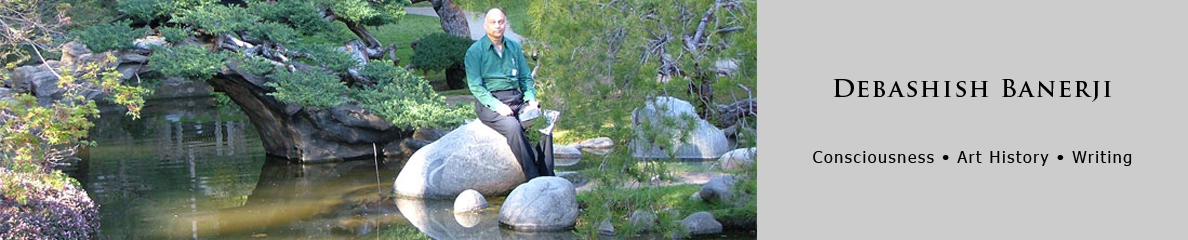





Author: Debashish Banerji
Bibek -Migration
A poem written and recited by Debashish Banerji on the artist Bibekananda Santra’s Migration series of paintings. Music excerpted from a live concert by the Art Ensemble of Chicago.
Half Aroma, Half Face
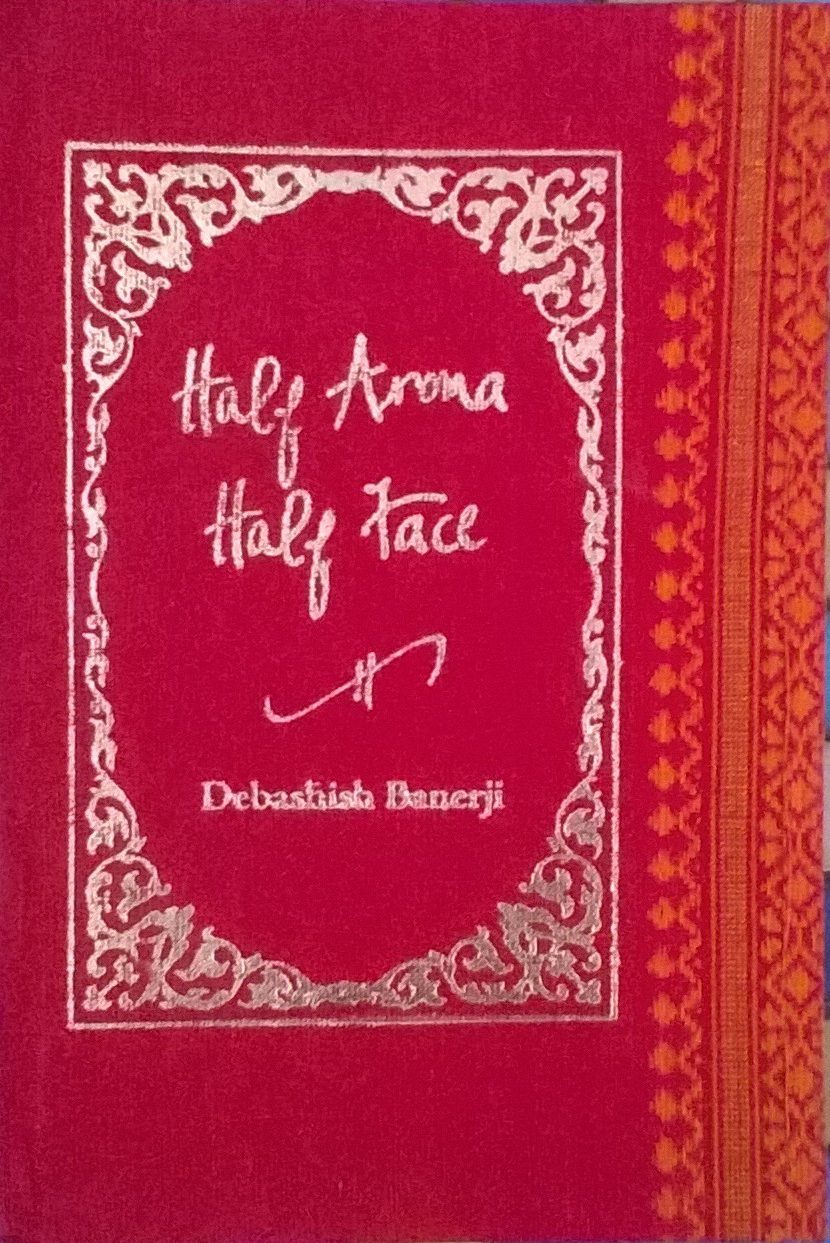 At the Edge of Memory: Debashish Banerji’s Delectable Silence
In the listening night, at the edge of memory, the wheel sleeps in the wheel, and only in mirrors life burns, and burning passes into Burning. To you I bring the herbs of lunar healing, through the jade branches of the moon, and you too will feel the snow of alienation on your wings.
The mystic nearness of Being, simultaneously sensual and austere, in the hidden core of consciousness where the voice of silence blossoms like a rose, where Debashish Banerji greets his poems, is the hallucinogenic ground of Banerji’s poems. They arise and slip away, get caught in the treacherous eddies of techno-capitalism, wrest themselves from language and concepts that had been appropriated by economic forces, only to slip into the melodic syncopation of voice and dream. The poet works to clear a space for a world history, a cross-cultural flow of ideas, images, and states of being.
Upheavals of consciousness, streams of dialogue, monologue, projected states of dream and being, all flow across and through Banerji’s texts. They lull, seduce, caress; they expose, attack, denounce. The reader is in the streets, traveling through time to witness and confront human corruption, oppression, spiritual degradation, and violence. The reader is lured, and then propelled into rapidly shifting cultural, economic, linguistic, and social landscapes. India has lived many lives and survived many assaults; from the white disaster of colonial racial violence to the hipcats [who] walk the Bombay streets, internationalizing the vernaculars. Banerji’s cultural landscapes are rich and detailed. His knowledge of art history adds texture and dimension to the denseness of his linear exegesis of spiritual beliefs and philosophy.
The poems act as spiritual “break-outs,” sudden manifestations of what is unrevealed in the narrowly defined contexts of history, culture, and economics. His attention to sound clusters and modulations creates verbal sculptures, similar in tone to the brilliantly colored and sculpted facades of the Sarangapani Temple. Each poem evolves, presents a meditative moment or a call to action; a poem’s incandescence becomes its beacon, as it moves through time. Banerji’s poems are not fragile; they are, at times, rough-edged and caustic. The eye of Being often rests on the volatile. The kamikaze return, the costumed traditions burn in protest or bare their fangs and burn whatever escapes comprehension. But the reader should always return to the flight of white birds and to the raga of human aspiring for the divine. Enter Banerji’s poems with a pure heart, a lucid mind, and the courage to wrestle with what cannot always be immediately perceived.
Andrea Moorhead
Greenfield, Massachusetts
December 2016
Sajag Sadhana/Waking Meditation: Darshan and Yoga in the Writings of Abanindranath Tagore
Debashish Banerji
This is a series of reflections on some ideas of darshan and yoga in the writings of Abanindranath Tagore. These reflections aim at extracting from the writings something that can be of use to sadhana — sadhana in general, the integral sadhana of Sri Aurobindo and The Mother and a kind of sadhana that one might call the sadhana of Art. Abanindranath has aimed his writings at what he called the ‘roop-dokkho’ [rupa daksa]. It is difficult to translate this term; loosely it may be thought of as one who has achieved proficiency in the seeing of forms. It applies to both the artist and the perceiver of art. It implies that there is a culture of seeing, a yoga of seeing. Hence these reflections form a certain process towards the yoga of seeing, darshan yoga one might call it. I have titled the talk sajaag sadhana.
Sajaag sadhana is a term used by Abanindranath. One comes across it in several of his writings in different contexts. A context that it arises in concerns, in fact, Sri Aurobindo’s brother, Barin Ghosh. Barin went to learn art from Abanindra¬nath. His attempt was to meditate, close his eyes and see in his inner vision an image, see it in clear detail and then express it. Now this method is not new, it is not original to Barin. It is a traditional method in Indian Art.
Canonically we have writings prescribing that this is the method to be followed for painting deities, images of the deities. It is also the form of meditation to be followed even today, for example in Tibetan Yoga, where every detail of the deity is to be very clearly perceived in the mind’s eye and then an attempt at unification with the deity attempted through that process. But Abanindranath discouraged this practice particularly from the viewpoint of what he was trying to teach as the sadhana of Art. And in his comment on this practice, he says “the sadhana of the artist is not the sadhana with eyes shut, but with eyes wide open, sajaag sadhana.”
So what is this sajaag sadhanal Our reflections today revolve around this idea. I hope that they will arouse in you also, reflections as to what this is, so that we may possibly have a dialogue regarding this way of seeing, this yoga of seeing as I proceed with my exposition of some ideas related to this notion of sajaag sadhana. First I would like to start with two quotations from the Mother. These quotations we can keep in the back of our mind as we proceed to try and understand what Abanindranath is saying, since they give in essence some of the major ideas which arise in the yoga of seeing, or the yoga of art.
The first quotation: The Discipline of Art has at its centre the same principle as is in the discipline of yoga. In both the aim is to become more and more conscious. In both you have to learn to see and feel something which is beyond the ordinary vision and feeling, to go within and bring out from there deeper things. Painters have to follow a discipline for the growth of the consciousness of their eyes, which in itself is almost yoga. If they are true artists and try and see beyond and use this art for the expression of their inner world, they will grow in consciousness by this concentration which is not other than the consciousness given by Yoga.
The second quotation: There is a considerable difference between the vision of an ordinary person and the vision of artists. Their way of seeing things is much more completely conscious than that of ordinary people. When one has not trained one’s vision one sees imprecisely and has impressions rather than an exact vision. An artist when he sees something and has learnt to use his eyes sees, for instance when he sees a face, instead of seeing just a form like that you know, he sees the exact structure of the face, the proportion of the different parts, whether the face is harmonious or not and why; all sorts of things in one glance you understand in single vision as one sees the relation between different forms.
So from these quotations it is clear that there is something to the sight, to seeing, to the drishti of the artist which has been developed in a special way. The Mother speaks of the artist but one can apply this also to what Abanindranath calls roop-dokkho, the art lover, the seer of art — art not only as one sees it on paper or in sculpture but as a method of seehg, a form of seeing in the world. Now let us remember that in some ways in our yoga, in the integral yoga, among the various kinds of inner development we are called upon to open up, one of them can be and is the yoga of right seeing, seeing properly. Let us move then to Abanindranath’s ideas of darshan and yoga and see h> iw they relate to this.
Firstly darshan. The word darshan itself we use commonly to mean seeing. But then we find a deeper kind of-usage made of the word darshan. Darshan as all people here know — perhaps this is the occasion that has brought some of us to the ashram — is a certain kind of seeing, viewing, looking at, a spiritually enlightened person or a deity, a god. You go to the temple for darshan, go to an ashram to have darshan of the guru. But if you think of it slightly more, you realize that it is not just the viewing of or looking at a person however great that is involved in darshan. It is also a being looked at. It is a relational seeing. A seeing in which one loses oneself. There is a form of sight in darshan, taken in its highest sense, where one rises out of oneself and is for a moment pure sight itself. It is not you who see the guru; it is a moment of seeing that occurs. In that moment of seeing the guru’s sight and your sight become one. This is darshan.
The word darshan is also used in a more technical sense in Indian thinking to mean philosophy: the darshan of Shankara, we may say the darshan of Sri Aurobindo. How does this darshan relate to seeing as we have spoken about so far? Well, we first need to realize that Indian philosophy is not the same as what we understand in the West by philosophy. Philosophy in India is a framework expounded to outline the details of a form of seeing. This form of seeing arises from spiritual realization.
The seer, the yogi arriving at a realization which is total, a realization which encom¬passes all of reality, is in a position to give the answer to the question: what is reality? This answer is a darshan and it is a darshan as in this statement the seer or the yogi is not just giving what is that person’s own subjective understanding or speculation on reality but a seeing of reality at a level where the seer and the seen are one. There has been an ascent to a point where there is pure sight and that sight is not yours or mine or that of the object. It is a sight that has lost its name, its authorship. Out of that purity of sight a certain enunciation of reality occurs which one calls darshan. This is what Indian philosophy is all about.
Now in the writings of Abanindranath one comes across a darshan of this kind as well. Answering the question ‘what is reality?’ occurs particularly in his Bageshwari lectures in an essay called “Aroop O Roop”, the formless and form. Herein, without being very aggressive or assertive, he contests the ‘mayavadin’ view of Reality. He says essentially that many people think that the world of forms is something we need to transcend to arrive at the formless. The world of forms is a world of illusion and we need to erase it and once we are able to do this we will be able to see the reality behind the world of forms — a formless reality. All forms sink in that sea. But he contests this view. He says “I have heard this, I have read this and I have tried a few times to think about, meditate, internalize this teaching. But whenever I have tried to do this, the world of forms reveals itself as innumerable masks of the All-Beautiful. Maadhurjo, he says, drips from all forms and I realize that — that Being. The forms refuse to disappear; the Being of Delight speaks to us through the world of forms.”
Now, what is being said here already contains in it the seeds of a yoga. Evidently to all our seeing the world does not present the innumerable faces of the All-Beautiful. There is much ugliness in the world; there is much that jars our sensibilities. To escape from these we would like to escape into ourselves, to close our eyes. It is exactly here that he is telling us, “Let us return to sajaag sadhana, sadhana with eyes wide open.” So how with our eyes wide open are we to see this world of ‘maadhurjo’, this world of bliss where every form is a face and aspect of all the All-Blissful, the All-Beautiful Being?
In brief he gives us two terms and then he elaborates on various aspects of seeing ‘roop’ or form. We will explore these terms in Abanindranath’s specialized vocabulary and try to arrive at an understanding of the ‘yoga of seeing’ implicit in them. The most broad or general first term which we will look at is ‘nishkaam drishti’. Nishkaam drishti, the word is very inviting. Out of it comes a certain understanding and insight of how we see things. We are retuned again to the Mother’s quotation where she says the ordinary person sees a world imprecisely. Where is the imprecision? What do we see? If we look into ourselves we realize that we see unconsciously. Our eyes are attracted by certain things, our sight is conditioned. This conditioning is initiated from within us and without us. It is the conditioning of desire — the conditioning of inner vital desire, which is also exploited by society to attract us from the outside. We are being attracted by the world of commerce, by advertisement and propaganda, by the world of various forms of social norms that want us to conform to certain ways of being. And without knowing we are attracted to these things. Our desire selects our seeing so that these are the things we see spontaneously when we look around us — a utilitarian seeing, a seeing full of desire. Most things we miss in a room, only the things which are of use to us or which stimulate our desire, attract our gaze. The first step in the yoga of sight is to break the backbone of this seeing, the conditioned seeing of desire. We have to move to nishkaam drishti, a seeing which is desireless.
Now we are reminded that in the Western philosophical tradition too, Kant talks about the aesthetic experience in the same terms. The aesthetic experience is different from ordinary experience because it is constituted of a disinterested seeing. One appreciates, enjoys an aesthetic object not because one wants it out of self-interest but because it is beautiful in and by itself. In our lives whenever we have such an experience — and I am sure most of us have had moments of true aesthetic experience, where beauty speaks to us — there is a coming to rest, it is as if one is put at rest, one’s desire falls off, one sees and as one sees, it is exactly as the Mother says, in an instant, at one go, all the various elements, their relation and proportions, the perfection of form appears to us and gives us enjoyment. This is the automatic legacy of an aesthetic experience. But we can turn rare sporadic experience inside out and make that our everyday experience if we follow the yoga of nishkaam drishti. If we can make our seeing desireless then things appear to us different from what they usually do, they appear to us as they truly are with the radiance and perfection that is within them.
The next thing Abanindranath talks about is ‘modhur shamparko’. Modhur shamparko literally means ‘honeyed relationship’. He doesn’t elaborate this very much. But with the backdrop of nishk tarn drishti we can see that merely impersonal, impartial desireless seeing may not i;ecessarily give us depth of enjoyment. The Zen artist sees with the nishkaam “dn.shti. But Abanindranath goes one step further in keeping with his darshan. As I have said, to Abanindranath the world gives us innumerable masks of the One Bein;. who is All-Beautiful. So we are called upon to enter into relationship with that Oni B.eing — a relationship of love, a relationship full of honey, of bliss. In that relationship we find that what comes to us through the world of forms is now something which drips honey, ‘maad/mrjo’. After having divested ourselves from our normal desire-based relationship with things through the practice of nishkaam drishti, we are now called upon to re-establish personal relationships with the objects of sight not in and for themselves, but in and for the One Blissful Being whose forms the are. This reminds us of Yajnavalkya’s famous statement to his wife Maitreyi in the Brihadaranyaka Upanishad — “It is not for the wife but for the sake of the Self thai the wife is dear to us.” From a basis of impersonality, one enters into a honeyed relationship, modhur shamparko, with the One Being, impartial in essence, rich with specified particularity in each instance. The world of forms refuses to disappear in the Formless here, each form revealing instead a special aspect of the Beauty and Bliss intrinsic to Being, to be enjoyed through modhur shamparko, blissful relation. These are the broad dimensions of seeing given to us by Abanindranath through the use of his specialized vocabulary, and the darshan pointed to here is reminiscent of the Visishtadvaita, Bhedaabheda or such Vaishnav schools.
Now we get to certain more specific forms of wop and seeing.
Abanindranath talks about two types of wop or form. One he calls swaaropak roop and to contrast with it he defines another kind of wop, swaroopak roop. Now what swaaropak roop means should be quite clear to most of us here. Aarop is projection, so swaaropak roop, self projected form. What is being talked about here? We return again to our understanding of reality as an ordinary person sees it — a kind of selected attractive reality, selected and attractive because it attracts us through our vital, through our desires. We look at things not as they are themselves but as we project upon them. Whatever we see, we see in a distorted form. Now this aarop swaaropak roop has a range of connotations. The most common is that of the distortion we are bringing upon reality all the time due to our own subjective distortions, our own desires. But this itself at a certain point can assume depth and profundity. There is a depth of projection, which can be an intimacy of relationship. We find in post-modern art, expressionism attempting to distort reality deliberately and consciously. Without elaborating further for the present, I yet invite reflection on expressionism as a form of swaaropak drishti.
Now contrasting with this is swaroopak wop. Swaroopak roop is essentially swaroop. Swaroop or essential form, inner form of self, something’s own form, innate form. Swaroop is something which reveals itself when we allow it to reveal itself. An object or form can speak to us if we can listen. To listen to it, we have to make ourselves desireless. Again nishkaam drishti is the basic condition of seeing swaroopak roop. However there is a range of ways through which we can understand swaroopak roop. How about academic naturalism where the artist tried to capture seen reality in terms of its photographic image? Is that not swaroopak roopl We know that Abanindranath himself broke away from that very kind of art. So evidently that cannot be what he is recommending as swaroopak roop, in and by itself. It could be a form of swaroopak roop, but the term must have another or other meaning(s). Upon consideration, we realize what Abanindranath is talking about through these two kinds of forms is not either/or, one or the other. He says at a certain point that we have to arrive ouselves in our yoga of darshan or of drishti to a kind of seeing at a greater depth where there is a union of these two. The term he uses for this is antar-baahir jog, the union of the inner and the outer. And this, essentially, is sajaag sadhana.
In this union one sees things as they are, at first emptied of all relationship. But out of this seeing arises a certain call, an invitation to relate to the Being behind the form. And in that relating there is another kind of aarop or projection, the projection of intimate relationship born in the mutuality of identity with Being. Is this not modhur shamparkol Once again we have risen’beyond the subject and object, beyond the seer and the seen, through the intimate honeyed relational union of love. In the mystic relationship between the seer and the Being behind the seen, there is a rising to a level where there is pure sight, incandescent with the bliss of union. Swaawpak wop and swawopak wop become one. This is another way that Abanindranath explores the drishtiyoga of a darshana which rests on a Vaishnav-like realization.
Now we come to another set of terms that Abanindranath introduces. These he borrows from the shadanga or six limb.’ of Indian painting. Abanindranath wrote an article on a sloka dealing with the shadanga, which he extracted from a medieval commentary. The idea of the shadanga in Indian aesthetic thought is known to be at least as old as the classical Gupta period (c. 4th c. CE). Without enumerating all the six limbs, I would like here to draw attention to two terms from the shadanga, which become very important and invite our attention from the viewpoint of wop, form. These are roophheda and saadrishya. First let us consider saadrishya because it brings us back to Barin’s story. Saadrishya means likeness or similitude. How are we to understand saadrishyal If we read rhe texts we find that saadrishya as the classical canonical writers wrote it, means to see in objects the archetypal form that lies behind them, the resemblance to an ideal form. Now ideal form also varies. There are various kinds of ideal forms. The human being itself may be ideal in a variety of ways. You can have the ideal of the physical human being — ads for gymnasiums will show you this ideal — f.s. with bulging muscles, etc. Likewise, you may have the ideal or typal form for a variety of human beings — you could see the image of the barbarian, bearded, wi’h a club in hand — i.e. animal man. You can have the ideal of mental human being, arjd this is what the Greek ideal of the human image attempted to convey. Finaliy YOU can have the ideal of the spiritual human being, the god. And this is what Indian Art of the classical tradition tried to convey. Here we have the archetype of a spiritual humanity — the gods wear the human form in its spiritual archetype. So w^ can have a whole range of typal forms. If we look at the Ajanta paintings we firm that the gods there are depicted in a spiritual ideal. But Ajanta paintings don’t just show gods, they show us the gamut of secular life as well. They show animals, nature, plants, robbers, thieves, kings, lovers, all kinds of ordinary human life. When we try and see how these are represented, we see again certain typalisms being used. But the typalism which is appropriate is what is depicted. It is not the god that we see even in Buddha when shown in his past life as a monkey — it s ihe ideal monkey that we see there. So there is a kind of understanding of what is typal reality in saadrishya, which was expressed by the Indian classical painters. But over time this typalism tended to fossilize itself into formulae and we started having the Gods defined in terms of proportions and attributes. Even within that, much flexibility of interpretation and depiction exists if we look at the gamut of Indian Art. But still a certain kind of range, a narrower range of types becomes the domain of Indian Painting in medieval times. And the prescribed way of arriving at these becomes meditation with eyes closed. You close your eyes, you look at the dhyana mantra of the devataa and you keep in mind the proportions that need to be kept in mind according to the canonical writings and as you practice this, there arises in your mind’s eye the image of a god. This you see with great clarity and then out of that meditation you paint or sculpt your image.
But Abanindranath’s understanding of saadrishya took a more personal turn due to his emotional mysticism. What I have expressed of saadrishya is in fact described more appropriately by Coomaraswamy. And Coomaraswamy points out that Abanindranath’s understanding of saadrishya was erroneous. I wouldn’t say it was wrong, I would say it was his interpretation, an interpretation inflected by his darshan. To Abanindranath saadrishya, likeness, similitude, metaphoricity dwells in poetry, dwells in our ability to see the correspondences which give us the secret unity behind this world of forms. The face of ‘Gouranga’ looks like the moon. We paint Gouranga in such a way as to bring out this resemblance. The face of the Buddha resembles the lotus. That resemblance is brought out in our depiction of Buddha’s face. It is this realm of psychic poetry that Abanindranath points to when he explains saadrishya. Saadrishya for him puts us once more in the realm of maadhurjo, the world of bliss and its innumerable forms of similitude, of metaphor.
But what of roopa bheda? Roopa hheda literally means the distinction between forms, roopa, bheda between forms. How are we to understand this? A cat is not a dog, a dog is not a human being. There is a distinction between forms here. So we have to learn how to paint a dog like a dog and not like a human being. Furthermore an Indian is not like an African, a Chinese is not like an American Indian. We have to learn to paint distinctions, learn distinctions about forms within species itself. We can go further and say no two individual objects are alike. Now what is happening here? Let us relate this to saadrishya. Saadrishya relates an individual form to an archetype. An archetype is a general or a universal form. Universal forms become more and more universal and hint at the one universal Being. Roopabheda takes us in the opposite direction. It splits the one into its infinite distinct personalities. Between the two what we see is a definition in terms of sight of the reality — the Being who is at once one and infinite. Can we unite these two in one single gaze, into one single sight? This becomes part of the yoga of drishti, the yoga of darshan. Can we see the one in the many and not lose their individual distinctiveness? This invites us in a way to make a comparison with our own yoga, Sri Aurobindo’s yoga, where the individual,, the universal and the transcendent have to be seen in single gaze. We have to see the divine in form, but not only in the psychic individuality, not only in the universality of the type but in the transcendental reality of the single being who expresses in all these and iffiiis particular expression in each object.
So this is where roopabheda and saadrishya come together and in this coming together we are reminded again of Mother’s saying about the instantaneous vision of the one in the many, of the perfection of form, of perfect proportions. I may also touch upon the idea of proportion which £bifstitutes one of the terms in the shadanga. It is pramaanaani. Pramaanaani literally means evidences or proofs and it has been taken to mean the formulae by which we can understand a devataa. It refers to the various ways by which parts are divided, the proportions which are written down in the canonical text. But here again Abanindranath provides a subjective explanation. He says pramaanaani are proportions but these are those perfect proportions that the eye sees all at once when roopabheda and saadrishya are united in one’s gaze. One sees the individual and the archetype at once and in so seeing one sees the perfection of proportions.
Finally, I would like to touch upon the distinction between four kinds of seeing that Abanindranath makes which gives us a progression for what we might define as drishti yoga or darshan yoga. These four types of seeing also have their correlates in Sri Aurobindo’s yoga and invite a ^;;tjparison. They are: 1) baahya drishti 2) tikshna drishti 3) antar drishti and 4) divya drishti. In these four types of seeing or drishti one can immediately perceive a progression. Baahya drishti is normal external sight. We are brought back again to the imprecision of ordinary seeing. We see the world as it is, we see it through our conditioning, through our subjective wants and desires, what the world wants us to see. However as we allow this conditioning to drop, as our drishti becomes more and more nishkaam, we start seeing the world with greater precision, as the Mother points out. This greater precision in seeing is tikshna drishti. A story is told of Abanindranath’s own childhood, when he with his two brothers went for a car drive to a ctn^np part of Calcutta, Chowringhee. When they returned, their father asked them what they saw. The two elder brothers said a few things, maybe two or three sentences. But Abanindranath’s description went on and on. He saw every blade of grass on the way and he described everything that he saw. This is the precision of the artist’s sight and this shows how the artist’s sight differs from the ordinary seeing. Mind you, the two elder brothers of Abanindranath were no novices to art. Gaganendranath and Samarendranath were both great artists. But from childhood in Abanindranath, we have this precision of seeing. We may say he was a born artist. So the precision of tikshna drishti arises out of the falling off of our conditionings of sight.
But it can’t stop here. Out of precision in seeing we have to go deeper to a relational seeing. Here we enter into antar drishti. Antar drishti or inner sight is not only inner in the sense of looking within the artist himself or herself, but penetrating into the insides of things, being able to simultaneously look within oneself and to look within other things, outside things. It arrives at the intimate image, the image closely known because based on familiarity of inner identity. This relational sight is antar drishti. But one would still say this kind of drishti belongs to the world of mysticism, the world of psychic relationship. There is a stage beyond this and that is the stage we have started our talk with. The stage of pure sight, darshan, where the seer and the seen disappear into pure Seeing. This is divya drishti. In divya drishti the play of relationship is transcended suddenly and one becomes one with that which is seen. An epiphanic flash occurs and there is no longer seer and seen, there is only Seeing.
So these are the four stages of seeing in the yoga of sight. I had said early in my talk that in Indian Philosophy, knowledge is equivalent to sight, darshan. It is not speculative knowledge but a seeing of reality, pratyaksha. So let us conclude by considering how Abanindranath’s four stages of sight may correspond to knowledge, seen in this way. We may relate our four stages of sight to three types of knowing in Sri Aurobindo’s yoga. You have knowledge through the senses and through inference or deduction through the use of the mind. This is outer knowledge. It relates to bahya drishti, the outward seeing. But going further inward through concentration on objects, we begin to enter into relationship with their inner reality. Our own inwardness makes us aware of the inwardness of others and we have entered into “knowledge through inner contact”. This is a phrase Sri Aurobindo uses. Knowledge through inner contact relates to antar drishti. Finally, there is “knowledge by identity”. The Upanishads speak of “that knowing which all else is known”. “That” is the Brahman, the One Being. Becoming That through union with it, one may enter into identity with all that is. One knows because one is. One is because there is nothing except that which is. This is divya drishti, the final stage culminating the yoga of darshan or drishti. This is the Seeing beyond seer and seen, the One Seeing, where saadrishya and roopahheda unite, where the consummating embrace of modhur shamparko unveils the Eye which simultaneously obliterates and preserves difference.
DEBASHISH BANERJI
(A talk given at Sri Aurobindo International Centre of Education, on 29 December, 2000)
* The author desires to keep the spelling of Bengali words as Abanindranath Tagore wrote and pronounced them. For example roop-dokkho is actually rupadaksha; aarop is aropa etc. — Editor
Matu
(from Pathey Bipathey by Abanindranath Tagore)
Translated by Debashish Banerji
Fog covers everything this morning. There hasn’t been a fog like this this winter. Water land and sky remain sunk in milky light; wherever I look, it feels as though an enormous pane of frosted glass hangs before me. All the ship’s benches are wet with dew; there is no place to sit. 7:50 is the departure time for the ship, but it is now 8:25, yet none of the fellow passengers can be seen. The boatswain, bundled up in an ear-concealing cap, motley woolen jacket and dirty stuffed wrap with Lucknow prints, is picking out fish for himself from a fisherwoman’s basket, storing them in his red bucket. The ship today is a sleeping duck, its head tucked under a wing, floating still by the waterside. My overcoat collar pulled well over my ears, I sit. As with sitting on a lone school bench on a rainy day, I am thinking I’d hurry home if I found a car. At such a time, I heard coming from the fog before me, someone call “ma” in a tender voice.
At this wharf at Barabazar – where from before dawn to well past sunset, there is no respite from the frantic din of work – all the ships stopping their horns stand silent today in the fog. You can imagine how silent it must be. Hence it goes without saying that in this silence that call “ma” in that tender voice penetrated deep within me. As if startled from sleep, looking ahead I saw – confronting our first class deck two large double storeyed ships with enormous bows have pushed through the fog and become half-visible. On the hull of one ship in large black letters is written “Matu” and on the other, ” Questan.” I see no people in the second ship; but in the one named “Matu,” below its balcony near the kitchen, I see sitting close to some shining copper vessels a ship-boy in blue pajamas washing a painted birdcage vigorously with water. With every splash of cold water the bird in the cage screams “ma ma” and that boy looses a continuous stream of speakable and unspeakable abuse at it.
I have always liked birds for pets and what is more, here’s a talking bird! Bringing myself right to the nose of the bow, I was studying the play of boy and bird, when Obin sneaking up from behind, said – “If you wish to get a good look at the bird, come with me.”
Seeing me hesitate, Obin repeated – “Why are you troubling yourself in this cold? Our ship will not stir before 9:30. Come, I know well the old proprietor of that ship, we can spend some leisurely time with him, smoking his pipe and sharing yarns. Mirsahib is a fine fellow. You’ll enjoy knowing him. And there isn’t another ship as showy as “Matu,” it’s wrapped all over in gilt and mirror. It’s cabins are worth seeing.”
Crossing, with Obin, another enormous jetty and a jute storage godown, I entered the ship Matu. It seemed hardly a ship, more like a mansion floating on water! Each deck stretched like a congress pandal, the eye failed to cover its extent. Having climbed up the double storeyed stairs dressed in brass and rubber, we were looking through the gigantic rooms full of gold and crystal, when a deck hand appeared and announced, “Mir saheb sends you his regards.”
Entering Mir saheb’s private cabin with Obin I found an old captain seated on a fabric bed pulling on a hookah, a box of paan beside him. Behind him through the glass of an open window a hazy impression of the jute godown’s tin roof was visible. After the customary pleasantries, Mir saheb turned to Obin and said with a smile, “I’m back in these regions after a long gap. It has been two years since I saw you last and here we are again.”
Presenting me, Obin said, “I brought this friend to meet you. He is very fond of birds; next time you must get him a cockatoo from Singapore. Anyways, tell us now the tale of your voyage.”
Saying this Obin, without pause for permission, picked up a bundle of paan from the box, stuffed two in his mouth and four in my hand, closed his eyes and sat erect, making himself comfortable. Seeing me hesitate, Mir saheb interjected, “Chew the paan, enjoy the story.”
So saying, he began –
“On one side Singapore-Hongkong, on the other, Alexandria and Constantinople, between these my ship docked in uncounted ports. Through day and night, good luck and misfortune, light and shade, in these eighty five years how many a river I have ferried, how many oceans crossed! But this Bhagirathi pulls my heart in a way I can’t explain. Here, on the banks of this Ganga I was born, and in this soil of Bengal I was nurtured. Whether on this land or in the immeasurable depths of the ocean my grave has been fixed, only Allah knows. But my heart wishes that the ship of my last journey sets anchor by the bank of this river. Driven against huge cyclonic storms, wherever whenever I have steered my ship, the image of this riverbank with an enormous banyan and my moss-covered grave below it, has arisen in my mind. The image of home however is not rooted for me in Bengal. My home was here, but what it was like and where, on this or that bank of the river, I have forgotten. Who else lived in that home, brother, sister, no memory remains. Only I remember my mother. Luminous her form in the darkness, nothing else. This is all that remains of my childhood, of when I was a child being raised by my mother.
Subsequently, my memories are clearer. I can’t say what my age was, a number of black boats scattered on the Ganga and myself seated on the bank wailing “ma, ma.” There wasn’t a stitch on my body; and two rupees clutched in my fist. The two rupees were for buying a train ticket – this I remember clearly. Then a sannyasi – with coiled topknot, ash-smeared body, brownish face hair – came up to me and asked, “Beta, why do you cry?” I said, “Take me to my mother, I want to go to Delhi.” The sannyasi laughed and asked if I had any money. I gave him my two rupees and holding his hand, entered a dark narrow street. What happened next escapes me. It is the only hole in the otherwise continuous chain of events in my life.
After this I remember a day waiting to go to Delhi in a wooden enclosure under a tin roof with the sannyasi and our bowls blankets and bundles. All around women and men, young and old, and so many people; some seated, some lying wrapped in blankets. Between two iron columns in the room the water of the Ganga could be seen. Then a great ship like this one appeared and stood right alongside that room. It was so large it didn’t seem to be on water. One saheb appeared and inspecting each of us by pressing our arms legs chests and backs, wrote something in a large register, after which all the people rushed like a herd of cows through the gate and entered the ship. The sannyasi slapped my back and said, “Go, boy! Dilli!” So saying he held my hand and helped me into the ship. Once in the ship, I turned around and saw the sannyasi disappear into the human ocean outside. In joyful expectation of going to Delhi, so long my heart was exulting, but seeing the sannyasi disappear, it’s as if everything stood still inside me. I can’t say how long I was in this state, suddenly hearing the sound of rushing water I noticed that the ship was moving. In the play of light and dark, the rippling water surface looked like the back of a striated snake. A black saheb wearing a white cap and a tan coat appeared and dragging me to a corner of the ship, made me sit. There a group of women seeing me, beat their chests and wailed, some calling their son’s names, some crying “father,” and some “o brother!” After barking a reprimand at them, the saheb left. From the conversations of these fellow passengers I gathered that this was a coolie ship. But I was too young then to know what coolie meant. Watching the water of the river, the light in the sky, the distant forested banks, the effects of dawn and dusk on sand banks my days passed happily.
Then the history of the tea garden. I have seen there how a human can break the backbone of another human by twisting it in slow degrees. How the hot blood of a human turned gradually cold under the whip, he pulls the load of others like a beast of burden body bent to the ground till one day he falls and dies, burying his head and bursting his heart in the hot sand – this too I’ve seen. Yet if I think of home, it is the image of this tea garden that rises in my mind. Here there was much suffering but also unlimited joy. Having come here seeking my mother after losing her in childhood, the sorrow that racked my insides cannot be expressed in words. But then again when some child-bereft mother behind a thorny pineapple bush gathered me to her breast with thin mud-caked hands, shedding her tears on the sun-scorched afternoon earth; when some little black girl wearing red saree and red lacquer bangles would leap on my back while picking tea leaves and embrace me crying “brother!” that sense of joy was indescribable. Then in spring, when all the forests were filled with flowers, songs of birds, golden sunlight, young green leaves, in moments of respite when I looked around I couldn’t bear the loss of my mother. In sixty years I didn’t let my mind or body show any fatigue. This strength came not from me, but was given to me by the one who is my true mother. This is why the saheb owner of the tea garden felt affection for me and wrote the garden in my name after his death. He had no relatives. All his affect was reserved for his tea garden and due to his confidence in my ability to run the garden, for me. But he was mistaken. I did love that plantation – not for its manicured terraced tea shrubs – but for the creepers of human affection that wove themselves around their thorny edges. Where the trees of the forest bent low like a mother to kiss the dust of stones, for those cool shaded forest paths I had secretly stored all my love for those sixty years. At the center of the tea garden, the owner of the plantation had built his own grave – a pointed column of polished black stone, with his name and date of birth in large gold letters. Inscribing his death date on it, I put an end to my tea garden chapter.
The last band of coolies, playing their drums, had left for the docks, to board the ship headed homewards. The evening moon cast its magical light on the silent garden, the motionless forest. Turning out the light in the house I was gazing ahead, when above my head someone or something passed by calling in a tender voice, “ma, ma, ma.” Then like a shadow someone ran past my door towards the forest, it seemed a small boy. I set out stick in hand. Near a cave by the forest, where the darkness stood with its mouth agape, I found the boy. He was a coolie.
I said to him, “All have left, and you’re still here?’
He replied, “Ma has escaped, how can I leave without her?”
I looked this way and that if I could find his mother; the boy suddenly shouted, “Mir saheb, there, see ma!”
In the dark, a flowering branch bent over the opening of the cave, I saw nothing else. Then, as I stood startled by the unspeakable abuse the boy was hurling at his mother, a black bird flew by and sat on his shoulder -.
Interrupting Mir saheb’s story I said, “Below the upper balcony of your ship this morning I have seen just such a boy.”
Laughing, Mir saheb said, “Indeed, he is here with me. I saw the boy clasping the bird with both hands and kissing it repeatedly while letting out an interminable stream of abuse; while the bird repeated, “ma, ma, ma!” Then I heard the coolie ship sound its horn and leave the dock. I said to the boy, “The ship has left, how will you go to your homeland now?”
Staring blankly at me he said, “I have no homeland.”
“Then where were you headed?”
“Where everyone else was.”
I kept the boy with me. “Mir saheb, where is your homeland?” – when he asked me this, I replied, “I don’t know” He thus believes that he and I have set sail to find our homeland.
I said to Mir saheb, “That boy mouths such horrible abuses at the bird, why don’t you scold him and take the bird away? A bird that calls “ma” with such a sweet voice is such a rarity!”
Mir saheb said, “Babuji, it is that boy’s tender “ma” call that the bird has learned from among the old sadness and weeping of that tea garden – not all of that boy is made of abuse.”
At this time, that boy wearing a blue kurta ran in and said to us, “Your ship will now sail, hurry – the mists have lifted and the sun is out.”
Our ship departed sailing past “Matu.” I saw rising from the three chimneys of Mirsaheb’s ship faint white smoke like the down feathers of a bird’s breast. When our ship returned to the jetty, I saw the space where Mirsaheb’s ship had stood, empty. Through that gap was visible an unending line of coolies with loads of jute on their backs making their way to the godown; and gold hat on head, stick in hand, a sahib, supervising them.
Nishkromon – Exit
by Abanindranath Tagore (translation Debashish Banerji)
Mother’s touch! Through light and dust along the margin of the thickly populated city this immaculate touch wanders in the guise of a river breeze. For the journey from this shore to the next, from the borderland to the home, while crossing the bridge, this startling touch, washed in Ganga water this touch.
On this bank of the serene soft caress I see a familiar ancient land, on the other bank the lion-gate to the beyond is visible, wrapped in dew-drenched wintry darkness.
Merged in the vast tide of the crowd I am hurried along, pushed along, soundlessly, silently; and from across the river, laden with all the tenderness of the collyrium sky, the black water, tirelessly wafts mother’s touch.
From the center of the darkness a shrill note screamed tearing suddenly the blue expanse. Light again, dust again, again the hubbub of humanity. Leaving all this aside as I pass, cleaving through the world-occupying enormous night, I hear only a clattering as of a fountain of iron rolling continuously underfoot.
From the double row of windows within the conveyance can only be seen two strips of sky curtain, and an occasional twinkling star or two.
Hour after hour between these two curtains of blue I travel. I see nothing to left or right; only from ahead, there come one clanging blow after another, and occasionally a sudden amorphous tree-form smites the eyes and races away.
To say I am flying through the enormous formlessness of the vast night would be incorrect. This is not a passage like that of the night birds who spread their still wings in the silent blue of the night and glide along soundlessly. This is as if a delirious demon, after shutting me in an iron cage with wheels is rushing across the earth. In the hurtling speed of his movement the cage, gashing the heart of the earth, scattering fire in all directions, proceeds ceaselessly through a black gulf.
Deep insomnia, unceasing restlessness, and after that enormous fatigue. Mute inert life lies prostrate like a helpless dumb animal staring into the shoreless darkness.
A little shock of light, the slightest aching tremor in the golden wire of night’s string instrument. In the midst of dawn’s quiet dew, I stand stationary, facing the new day. Ahead, to earth’s horizon, a large extent of massed darkness is still visible. A tender darkness like the skin of a black buck; upon it, footfalls of light softly descend. In front a single lotus bud can be seen standing still in water; as if the earth goddess folding her palms to the cosmic divine.
Like a traveler who stops for an instant to offer his respects at a wayside temple and continues walking, we make our salutations to this dawn juncture and advance forward.
Just ahead of an endless sand stretch the night has turned to dawn. The color of the sky makes the distant trickling streams of river-water glint like knife edges. To the ends of the earth spreads a single wash of pure turquoise. Against it a stand of tall rushes. Fresh light of day sprinkling on the white flower-whisks its powder in the color-play of Holi, has reddened the canvas. Solitary this river bank, soundless immobile the sand stretch of this shore, cutting through this the narrow stream moves; like us, slowly.
Far above the river we traverse the bridge. A gentle rocking, merely the shiver of a movement, beside this nothing else is felt. We move on and on, through the forgetful green of the day to the sleep-inducing blue of the night.
Unending path, moving ceaselessly through this deep time-quantum. Day and night, manifesting repeatedly on the two sides of this path the phenomenal magic of revelation and concealment, accompany us in our movement.
Varanasi – a vast forest of temples and monasteries. In the noonday sun, all its details are starkly visible – from the glint of lightning playing in the river-water lapping the steps of the desolate bathing ghats down to the dense shadows of pilgrims walking soundlessly on the hot scorching road. As if I am staring at an illusory city. From the stone walls a hot breath strikes the face. All the movements and activities of the townsfolk appear to the eyes in sharp relief; but no sound can reach our ears. Its as if we’re crossing a kingdom of the dumb. And beyond the boundary of sound, this their enormous city, lifting two pale stone arms high into the sky gazes into the distant horizon, like an inarticulate negation, etched against the soundless light of noontime.
On sunscorched fields falls copper glow of day’s end. In the shadows of the mango forest, night with its dread approaches. Against the tree-line a ruined fragment of the long-discarded palace of the last nawab of Ayodhya has left a deep melancholy stain of dried blood on the pristine blue of the sky. The dam-breached flood waters of the Gomti have spread across the earth like a vast tattered patchwork sheet, covering all the green for afar.
Across the western horizon a soundless cataract has descended from the sky to the earth; upon this, the bird of Night, its black wings outspread comes floating.
In the third quarter of the night, it is raining. Mountain wind coming through the darkness is like a touch of ice on the face. A single cricket opening up a fountainhead of sound sings interminably filling the distance. The oil-lamp of an inn reaching its light into depths across the rain-washed smooth softness of the earth stares unblinking towards the night.
Knocking against the impenetrable darkness the train advances, climbing the side of the Himalaya where the Ganga descends.
Here, breaking through clouds, the moon has appeared on the crest of a line of black peaks. Nearby the bathing ghat, the music pavilion, the temple tower lie asleep in the moonlight; the Ganga breeze has poured over all its soft tenderness. At the end of our journey, in the last quarter of the deep night, this gate to the Ganga. On the other side, the green horses of the Sun god are in waiting, to bear here the New, the Invisible in-front.
A spiritual quest and wellness in a Covid-19 world. Fireside chat with Rishi Kumar and friends
Rishi Kumar is an Indian American councilman from Saratoga, California, and a congressional candidate. He and a couple of friends conversed with me about spirituality and worldly life in a Covid-19 world.
Integration and Embodiment in Sri Aurobindo and Jean Gebser
Keynote Address for the 43rd Annual Jean Gebser Society, “Embodying Integral Consciousness,” University of Philosophical Research, Los Angeles, 2013
New Thinking Allowed: Reincarnation in the Indian Tradition
“Reincarnation in the Indian Tradition”
An interview from Jeffrey Mishlove’s New Thinking Allowed program
New Thinking Allowed Interviews: The Integral Yoga of Sri Aurobindo
“The Integral Yoga of Sri Aurobindo”
A 3-part interview as part of Jeffrey Mishlove’s New Thinking Allowed program
1
2
3