




Sri Aurobindo and the Future of India

(Based on a talk given at the Sri Aurobindo Ashram, Delhi on August 15, 2008)

Five Dreams

Sri Aurobindo was born on August 15, 1872 and on the same day in 1947 India achieved her freedom from British rule. On that occasion Sri Aurobindo wrote out a message to the new nation which was read out over the radio. This message outlined five dreams of Sri Aurobindo, in each of which India featured prominently. We find from a perusal of these dreams how significant a part India played in Sri Aurobindo’s vision for the future of humanity and of the world.

The first of these dreams was the attainment of freedom for India. Sri Aurobindo announced this dream in the most profound sense, so that the newly acquired political freedom of India was acknowledged but the much that was left unaccomplished was also made clear. The scope of a national freedom for Sri Aurobindo was not merely freedom from colonial rule, but a true independence of the subjective life of the nation, a freedom within; and he linked this notion of freedom with the idea of national unity. He said that India was free but she was not united and he touched on a major source of disunity in the nation in Hindu-Muslim relations which manifested in the partition of the subcontinent into India and Pakistan.

The second dream announced by Sri Aurobindo was the rise of Asia in the comity of nations, so as to balance the Eurocentric inequality of the modern age and to regain the place of vital significance that she held in the pre-modern past. Sri Aurobindo shared his perception that this was beginning to happen and that India had an important role to play here.

The third dream of Sri Aurobindo was world union – a global polity in which the security of the world was assured and a sense of harmony and concord developed among the peoples of the world.

The fourth dream was the spiritual gift of India to the world. Here he pointed to the fact that under present circumstances, with the various kinds of difficulties and cataclysms that mankind had created for itself and was forced to endure, increasing attention would turn to the spirituality of India, a process which had already substantially begun in his time.

The fifth dream of Sri Aurobindo was humanity’s rise to a new stage of being, a new kind of life or a new species which overcame the limitations of the present human constitution; and he placed this in the future.

Overall, Sri Aurobindo’s five dreams announce a magnificently hopeful and optimistic vision for India and the future of the world. At the same time, this is not a naïve optimism. We find him as one of the clearest observers and analysts of the difficulties and problems of modernity and yet, beyond these dangers, he holds out the light of optimism for the human future.

The Question of Unity

It is instructive for us to pay close attention to these five dreams of Sri Aurobindo today, so that we may assess where we stand with respect to them in our present time; and discover messages there which we may hold close to our hearts and turn into aspirations, and convert into will so as to fashion our national and international destiny. It is important to realize that to orient ourselves properly to Sri Aurobindo’s dreams, it is necessary to divest ourselves of the inertia which treats them as prophecies written into some divine calendar. They are invitations to participation, dreams that seek our adherence to turn them into realities.

When we look at these dreams as a whole, we find that a major thread running through them all is the question of unity – national or subcontinental unity, continental unity and global unity. We may start by asking ourselves where we stand with respect to these unities in today’s world. From the superficial point of view, we may say that we are more united today than ever before in history. The world has shrunk today in our minds. We travel large distances very quickly, we enjoy routinely goods and services available at great distances; we mingle with people from cultures spread across the planet, working in multicultural projects of unheard of complexity. So when we contemplate these facts, it seems that a much greater global unity has developed since the time of Sri Aurobindo’s announcement of his five dreams in 1947.

But when we contemplate more deeply the locus of unity which Sri Aurobindo intends in his five dreams, we realize that there is a big gulf separating us from his dreams of unity at a variety of levels. The unity we have achieved is only a materialistic unity – a unity driven by material and commercial forces. We seem to be closer to one another than before but that is because our subjectivity has been tailored into uniformity by the techno-commercial forces of the modern world. Common lifestyles have become normalized across the world due to the determining regime of a world market. On the face of it, this is not apparent, since there seems to be so much choice we find ourselves faced with at every moment, we have even coined the term overchoice to describe this peculiarly contemporary phenomenon. But if we look closer at these choices, they turn out to be merely choices of consumption with cosmetic differences – flavors, tastes, hardly choices of alternate destiny arising from the human depths. We as a world humanity today lead lives in which everything is packaged into commodities – our work and leisure – so that every aspect of our time is conditioned and made demands on. This makes our subjectivity determined and dwarfed, we are left with little or no time, space or energy for a growth of consciousness in our lives. We have little creativity left outside of the constraining boundaries of this determination to express new dimensions of existence.

It is this common condition of servitude that constitutes our unity today. We are united in our bondage to the global world Market. Is this the unity Sri Aurobindo had in mind when he announced his five dreams?

Colonialism and Globalization

Sri Aurobindo begins his address by saying: “August 15 is my own birthday and it is naturally gratifying to me that it should have assumed this vast significance. I take this coincidence not as a fortuitous accident, but as the sanction and seal of the divine force that guides my steps on the work with which I began life and the beginning of its full fruition.” Let us contemplate this work with which as he says, he began his life, and the beginning of whose full fruition he observes on August 15, 1947. The steps that he is referring to here take us back a hundred years to India’s struggle for independence from colonial rule. India was occupied by the British at that time, but this was not a privilege granted only to India. Colonialism was an endemic condition that pervaded most of the non-western world, what is largely called today the developing nations. We may say that all of Asia was colonized, if not politically, then culturally and mentally. India was part of this condition of colonization. Colonization meant racial and civilizational subjugation, economic exploitation, political domination, oppression of many kinds. Now, it is natural that sooner or later, an oppressed people would want freedom. And so, in India, there was a movement for freedom. But colonization itself was an epiphenomenon, a symptom of a much larger ideological movement of European intellectual history, that continues to work its way in the present. This is what took its roots in the 18th c. and is known as the European Enlightenment.

This term “Enlightenment,” as we know it today, has a variety of connotations. It is a term used to describe, rather vaguely, the Buddha’s spiritual attainment, for example. But it is more commonly a term which is used to describe a condition of freedom and expression of the mind as a common property of all humanity, an ideal which developed in 18th c. Europe. On the face of it, this sounds like a noble ideal and we would be hard put to see any connection between this and colonialism or to relate it to a study of what Sri Aurobindo meant by the term “unity” when he began his life in Indian politics. The Enlightenment is an intellectual revolution in which the sense of the divinity of man as a rational being is brought to the front as the definition of humanity. It asserts the intuition of a world which can be understood by the mind in terms of laws. Historically, it arises as a reaction to the religious excesses of the Dark Ages with the revolutionary idea that human individuals do not need any intermediaries between themselves and God, because God is Reason and man possesses a faculty of reasoning. The exercise of the Mind to arrive at the full “Reason” of the world and its expressions would constitute the godhood of man, since by knowing the laws by which the universe is run, he would be in possession of God’s organ of Knowledge. He would thus be an equal of God. This would be the true freedom of the Mind, and this is what would constitute Enlightenment.

What this rational Enlightenment proposes thus, is nothing short of a seeking for omniscience. This becomes the entire project of Modernity, spawning a systematic development of rational knowledge, the birth of the modern Academy and its organization of the world, a process continuing to this day. The utilization of Knowledge for expressing fully the potential of the world, for bettering the world we live in sounds like a most noble ideal, but what stamps it with defect is the Will to Power which it inevitably expresses. This hinges on the question of the limits of human or rational knowledge but more so, on the misuse of the will which is natural to humankind. The Will to Power subjects the Will to Knowledge to its own desire to possess, exploit and enjoy the world and its resources and creatures. The essential experience of separateness endemic to humanity makes each individual person or group treat itself as the center of the universe and all “others” as either a threat or an element for assimilation, possession and enjoyment. The goals of bettering the world slip easily into the goals of utilizing knowledge for accumulating more and more profit, developing huge machineries for creating more and more surplus for the accumulation of profit and expanding techniques for creating desire for the consumption of the surplus produced.

Western man’s religious life has also been exploited to make this possible. As analyzed by Max Weber, the guilt associated with Original Sin in Christianity has been displaced onto a “Protestant work ethic” so as to exploit labor for the accumulation of capital. Similarly, as per thinkers like R.H. Toni, the Old Testament injunction to build perfection on earth has equally been grist to this mill. Thus, this capital accumulation has been a necessary accompaniment of the Enlightenment and, along with the need to convert the whole world to the civilizational ideology of the Enlightenment (what was known as “the white man’s burden), it was as part of this drive for material and subjective exploitation that colonialism arose as a direct consequence of the Enlightenment. Today, the world is no longer politically colonized, but the forces of capital accumulation and the society it produces is no less with us today in and as our era of globalization.

Nation Soul

Thus we can see how critical an understanding of this trajectory of modernity is to the notion of national independence. When Sri Aurobindo entered the field of national politics, there were two kinds of approaches to colonialism. The parties who represented these two approaches were the Moderates and the Extremists. The moderate approach was not primarily interested in independence from colonial rule. It called for an end to oppressive policies. It considered the injustices and evils of colonial rule to be what needed overcoming and sought to remedy this through pressing for constitutional change. In other words, its approach was an appeal to the conscience of the colonizer while accepting the superiority of its progressive drive and its right to rule over the nation. Thus, for the Moderates, what the British brought to India were the noble goals of the Enlightenment, which India sorely needed. Humanism, Science and a rational organization of life were seen by them as the great gifts of the west to India and what they pressed for was what they felt to be consonant with the “enlightened” goals of government, a removal of oppressive policies to become true benefactors of India.

What Sri Aurobindo represented was another mode of thinking belonging politically to the group called the Extremists. The Extremists held complete independence from the British to be their political goal and they justified this stand by claiming an alternate civilizational trajectory from that of the west. We find this line of argument consistently for example in the political writings of Sri Aurobindo which emerged in the journal of the Extremists, Bande Mataram. Here we find the call for national independence being issued in the name of a national law of becoming or “dharma.” The use of this term is related to the Gita’s idea of a distinct law of being, swabhava and becoming, swadharma for each individual. Sri Aurobindo adapted this idea for the collective entity of the nation and thus asserted a psychic reality uniting the people of India. By this argument, it is not just to be free of oppression that India needed to be free, but for her people to express what lay latent in the depths of national self-becoming, the swadharma or rashtra-dharma of the nation.

The idea of a national law of self-becoming was never articulated distinctly before this in India and is also an adaptation of the idea of the nation soul which was developed in late 18th c. Germany by thinkers like Johann Herder and G.W.F. Hegel. Looked at from a contemporary historical vantage, this idea of a nation soul is very controversial. This is because we live in the wake of World War II, in which this idea was very drastically and dangerously abused. A national soul, as an ahistorical essence, gives rise easily to the idea of racism and radical cultural relativism. All nations, by this idea, would be seen as eternally distinct with its people making competitive claims on the earth. From this problem of relativism, also arises the question of hierarchy. How are these distinct entities to be ordered in relation to one another and the totality of the world? What is to be at the center and what at the periphery? It is clear that such ideas can easily be abused to justify Apartheid and racial or cultural expansionism. These are also the kinds of problems that led to the second World War, whose disastrous effects brought humanity close to extinction and whose aftermath smoulders all around us. In occult terms, Sri Aurobindo and the Mother referred to the power behind this war as “the Lord of the Nations,” which goes to show how the nation idea can be distorted into something very dangerous, with a possibility of falsehood which can abuse it hugely if one is not careful.

Apart from this, the idea of a nation soul can raise serious problems of an internal nature, if not properly understood. A nation tries to define its identity through the writing of its history. A variety of ideologies can become the bases for contested histories, each of which claim to give voice to the “true” soul of the nation. We see this all around us as a real problem of nationalism, a factor of fratricidal struggle, seeking to determine the destiny of the nation. In India, there are those, for example, who have built a history around the idea of a Hindu nation. Equally ideological and contestational, may be the idea of a “secular nation.” This, for example, was the entire idea behind Nehru’s work on Indian history, to show that the Indian people have accepted a wide variety of ideologies, religious and otherwise, with no priority given to any one. This allows him to posit a socialistic democracy as the form of polity suited to India’s future.

All these ideas, based on the notion of an unchanging essence defining the nation, hold great dangers, which is why contemporary thinkers have chosen to discard this idea of a nation soul. But Sri Aurobindo and others who utilized this idea to speak of a national soul and law of national becoming, did not see this as the basis of a static racist or culturally essentialistic ideology but as an evolving entity with a cultural history moving towards universality. Sri Aurobindo anticipated these dangers in the nation soul idea and made it very clear in his work on social and political philosophy, The Human Cycle, that the entry into a subjective age, one which opens itself to the subjectivity of a nation soul, is fraught with dangers. He writes here of true and false subjectivisms. But he does not discard the idea of a nation-soul. The truth of the nation soul, according to Sri Aurobindo, is the same as the truth of the individual soul as Sri Aurobindo develops it from the tradition of Indian spiritual philosophy. That is, it is a self-concentration of the one Divine Being, one way of self-understanding of the One Being there is. In other words, nation souls are the same in essence, but different in form of perception and form of expression. This is what allows the soul, whether in an individual or a nation, to see itself as the same in all beings. It is the realization of the One Being in many forms, arising from what Sri Aurobindo calls “the multiple self-concentration of the One.” This is what forms the essence of the nation soul for Sri Aurobindo.

These nation souls are differentiated because the Divine Reality, which represents itself in all these souls, is the Infinite One. While being the Same, it is the aspect of its infinite possibilities which finds differentiated manifestation in the perception and expression of souls. This is what provides a radical uniqueness to each soul’s expression, while basing it in Oneness. The realization of such a subjective truth evades the dangers which arise from an essentialistic psychic ontology, a static monadology without any basis in unity. Sri Aurobindo sees the espousal of such a radical essentialism without unity as a false subjectivism, which seeks to assert its “truth” against all others or dominate the others through a world ordering mythology in which it assumes the position of centrality. On the other hand, the realization of a differentiation based on an expression of the Infinite One would move towards an acceptance of plurality based in the wonder of difference-in-unity, a Being-in-Becoming of the Infinite One. This Sri Aurobindo sees as a “true subjectivism.”

The Five Dreams and the Triple Transformation

Such a “true subjectivism” is better understood in terms of cultural history, as a process of continuities and disjunctions. The evolving nation soul develops its forms through its cultural body. It makes its appearance as a self-identifying concept among the people of a region at a certain point in time and develops along certain lines of preserved preference due to cultural momentum, but is not restricted to them. To understand better the trajectory of evolution of a nation soul, we may compare its movements to those in the development of the individual soul. Here we may see three major movements, which could be related to the idea of Triple Transformation introduced by Sri Aurobindo in The Life Divine and elsewhere. The first of these movements of history is the creation and proper unification of its instrumental body. This relates at once to the first of Sri Aurobindo’s five dreams and the first of the three transformations which he sets up as the trajectory of human evolution in the individual. The first of the three transformations is the development of a nature body adapted to the use of the psychic being and the emergence of the psychic being as the controller and leader of this expressive nature. Similarly, the first of Sri Aurobindo’s dreams is the freedom and integration of the nation, the preparation and integration of the instrumentality for the use of the nation soul. Sri Aurobindo sees the swadharma of the Indian nation as one which seeks the realization of the Divine in innumerable ways. Each constituent of the national body has its own approach to that Infinite One which attracts it and the nation soul is empowered in the fostering of cultural plurality and syntheses which allow all these myriad lines of seeking their full power of development.

The second movement in the evolution of the nation soul can be seen as its growth towards universality. This is also related to the second transformation in Sri Aurobindo’s formulation of the triple transformation. This is the realization of the Cosmic Consciousness, that which is all-inclusive and sees other forms of approaches as perspectives having differences which are related in a harmony based in an implied Oneness. For the nation soul, this means a growth in the power of relation with other ways of becoming, an expansion out of a narrow way of looking at reality. Such an expansion takes delight in other ways of becoming and forms relations of commonalty, hybridity or syncretism, leading eventually to an inclusion of all other ways as part of one’s own. However, such formulations would continue to respect other kinds of syntheses which may be developed by other ways of becoming. This provides the scope of the second and third dreams of Sri Aurobindo – the rise of Asia as a continental reality in which India plays its part, and the development of world union.

These movements are not temporally exclusive, that is they do not form phases of development which wait for completion before moving to the next. However, for the success of India’s part in the rise to prominence of Asia and for its part in world union, it is important for the development of subjective unity based on an interchange of spiritual plurality in the nation. In fact, one may say that universality is part of the articulated essence of India’s soul, in its espousal of “the world family,” basudhaiva kutumbakam. To realize this, to make it concrete and manifest in the nature body that we call India, is part of its movement towards the goals of the second and third dreams of Sri Aurobindo. Sri Aurobindo brings together the drift of these three dreams in his fourth dream – the gift of India’s spirituality to the world. This, indeed, is how Sri Aurobindo sees India’s swadharma. But this is not a static spirituality based on a monocultural reading of history – as for example in the idea of a Hindu nation. India’s spirituality is not merely a repetition of its past, it consists in the lived adaptations of the present. This is what Sri Aurobindo makes very clear in his statement: “We belong not to the dawns of the past but to the noons of the future.”

What may be seen as the third movement of the nation soul relates to the fifth of Sri Aurobindo’s dreams. This is the most profound movement and is also identical with the third of the three transformations in Sri Aurobindo’s yoga. This is the further journey of the soul out of its cosmic context into a transcendental dimension, from where it may create a new humanity or rather a superhumanity. This is the dream of a new species, where human souls, prepared through a cosmic unity, rise in consciousness to a higher level of being not yet manifest in the race, and from this vantage, can reformulate the expression of humanity. This goal, perhaps even in its beginnings, belongs to the future, as he says. For this, we need to have some sufficient realization of the first four dreams and we are still very far from that.

The One Nation and the Two Nations

Now, the question to ask is what do these dreams have to do with us? The easiest answer is to say that these are predictions of an avatar and all we need to do is to wait for their achievement. Unfortunately, as the Mother says somewhere, Nature is in no hurry, and predictions or not, these dreams will remain dreams were we not to participate in making them realities. So, let us consider these dreams in terms of their contemporary realization. Where are these dreams today and what is needed to move towards them? The first dream concerns itself with the unity of the nation, not merely political unity but cultural unity, a unity in cultural psychology. One may even say, that for Sri Aurobindo this psychological unity comes before political unity. Political unity can hardly be secure if there isn’t a psychological unity among the peoples of the nation. As a nation, India has experienced various forms of cultural unity in the past. Sri Aurobindo raises here one of the most difficult problems of unity we are faced with today – the Hindu-Muslim question and politically related to this, the India-Pakistan question. Sri Aurobindo says that the political division into India and Pakistan should not be treated as a settled fact. What he is saying here, has its roots in cultural history in the debate between what is known as the one nation and the two nation theory. The one nation theory is based on the idea that Hindus and Muslims in India share a cultural psychology, that in some way, Indian Islam has developed into a synthetic form which shares an acceptance in difference with Hindu forms and vice versa. The two nation theory implies that Hindus and Muslims in India live two completely different realities and are better parted into two nations. The two nation theory has made its appearance in relatively modern times and represents a politicization of religious identities, made to look like a historical fact. It is a rhetorical formulation. If we look back at India’s past, we find many synthetic formulations which have tried to bring Hindu and Muslim spiritual forms into relation or unity with one another. These attempts have become part of the cultural history of the peoples of India, irrespective of religion.

Creative spiritual personalities have arisen in Indian history, such as the Chisti saints, Sufis like Kabir and Nanak, in modern times, personalities such as Rabindranath Tagore and Kazi Nazrul Islam or the spiritual genius of Sri Ramakrishna, who united in his own life the various spiritual experiences of different religious traditions. It could be said that India had been under Islamic hegemony for four or five hundred years, but during this period, there were also signal achievements of synthesis and harmony. A great flowering of hybrid Indian culture, transcending religious differences, developed during the Mughal period and the history of India would have been very different had Dara Shikoh, the eldest son and rightful heir of Shah Jehan assumed the throne of Mughal India. The Mughal court was dominated by two Sufi denominations, the Chistis and the Naqshbandis. Of these, the Chistis created a synthetic spiritual culture through hybridization with Vaishnavism. The Mughal emperors who were under the influence of the Chistis, eschewed orthodoxy and promoted spiritual dialog and synthesis. Unfortunately, the Naqsbandhis were more orthodox and lent their support to the ulemas. The regime of Aurangzeb established an Islamic orthodoxy which could be said to lay the seeds for the modern idea of the two nation theory.

If we study the periods and personalities who helped in the manifestation of a cultural closeness among Hindus and Muslims, we find an embracement of the spiritual history of India beyond all orthodox formations. This is what brings us into contact with the nation soul, a culture of pure self-discovery, experience and manifestation of the spirit, however it may come. This implies spirituality in a creative vein, not a clinging to forms and a policing of boundaries. Spirituality stuck in the forms of the past is one thing, India has created many great forms of social practice leading to experiences of the spirit, but if these become exclusive or if they seek to erase the realities of other forms by co-optation, this leads only to internal strife and division, hardly the integration of the social body or the first step towards the manifestation of the nation soul as per Sri Aurobindo. What we call Hinduism has created such a form which tends to define it today, a form of Puranic religion, habits and customs of life and worship, to give body to spiritual experiences. If we follow these forms with a spiritual aim, we may have high realizations of the spirit, as innumerable saints and yogis have affirmed. But let us not forget that these forms also have a historicity, they were created at a certain point in time and answer to certain social conditions. Can we dare to modify or break them? Can we dare to create new forms? Do we have the power to create a new spirituality which will represent a greater cultural psychology of inclusion and realization for the nation? This is the invitation of the first dream of Sri Aurobindo. It calls on the people of India attuned to its nation soul to allow the power of spirituality to become creative in themselves and embrace every form, all shades of realization which have left their mark in the history of the nation. All this history belongs to us and is not to be thrown aside. What we need to protect ourselves from is not this or that spiritual form but all orthodoxy. What we need to embrace instead is a creative and all-embracing spirituality.

Asia is One

Sri Aurobindo’s second dream concerns the rise of Asia. Today much is being said about Asia becoming a major player in the world market. India and China are often spoken of as holding the key to the economic future of the world. If this is all the destiny of India and of Asia, as an economic giant in the drive for a new developing globalization, then we have lost a great opportunity. The Asia that Sri Aurobindo is speaking of is an Asia fertilized by powerful rivers of spirituality, many emanating from India – the Asia that received Buddhism and Hinduism and made its own forms of these, the Asia through which Islam spread not as an orthodoxy but as Sufi mysticism, the Asia in which Confucianism, Taoism and Shinto mingled their rivers with Buddhism in new creative forms through many regional histories. This eclectic spiritual continent called Asia is what Sri Aurobindo is referring to. To approach this, we have to move our attention from the material and economic to the depths of the cultural and spiritual. Do we see any movements of this kind today? I don’t see any. Here again, is where our aspirations come in, we have to make these dreams into realities.

At the turn of the 19th/20th century, Sri Aurobindo started an anti-colonial revolutionary movement in Bengal with a few splinter groups which had already received some preparation towards revolutionary action, not by an Indian, but by a Japanese ideologue by name of Okakura Kakuzo. He had come from Japan to India in 1902 looking for a spiritual personality to take back so as to to re-enliven Japanese spiritual culture. The personality he wished to take back was Vivekananda. This did not happen, since Vivekananda died that year, but Okakura also brought a message to India. This was the message of Pan-Asianism, which he expressed in his famous book, The Ideals of the East. Okakura began this book with the line “Asia is one” and in its very first page, he referred to an all-embracing “Advaita” as the very soul of Asia, a spirit of non-dual spirituality which flowed into the whole of the continent from India. It is this spirit which needs to be kindled in dynamic and living forms today. This rekindling is necessary if Asia of the ages is to rise again into the comity of nations and realize the dream of Sri Aurobindo. This is hardly the Asia which is today playing out a derivative role furthering the commercial vision of the European Enlightenment through neo-liberal globalization.

The Religion of Humanity

Sri Aurobindo’s third dream concerns world unity. Given the forces of globalization weaving a single lifestyle across the world today, it would seem that this dream is close to fulfillment. But once again, this global reality is driven by forces of capital accumulation and economic inequality. Is this the confederation of nations which Sri Aurobindo had in mind? Or an international policy protecting the interests of all the peoples of the world? At the end of World War II, an organ was created for just such a purpose. This was the United Nations. But the United Nations is a highly compromised entity today. It is merely a political tool for certain world powers. Here again, we must realize that for the world union Sri Aurobindo had in mind, external mechanisms like economics and politics are not enough. We must find creative powers to build a global unity which discovers the commonalty of all human beings. Ideologically, this was attempted in Europe through international movements such as Marxism and Socialism. Such ideologies are with us even today. Internationalism as an attempt to define and solve human problems irrespective of cultural differences, problems of human rights, democracy, equality, basic needs continue to be attempted, as variations of the ideals of the Enlightenment, but these solutions don’t go deep enough in their dealings with the darkness that lurks in human hearts. Sri Aurobindo presents instead the ideal of the religion of humanity. This ‘religion of humanity’ is very different from any sectarian religion, just as it is very different from an internationalist Socialism. It is based on the discovery of the soul. The ideal of psychic self-discovery equally enables the discovery of the soul in all individuals. There is a line in Sri Aurobindo’s Synthesis of Yoga which opens up the kind of practice leading to such a goal. Here he says, “The realization of oneness and the practice of oneness in difference is the whole of the yoga.” This line returns us to the profound meaning of unity and difference in individual and national souls. It is a practice of this kind that constitutes the essence of realization of the nation soul and of world unity.

A Grass Roots Spirituality

Sri Aurobindo’s fourth dream is that of India’s spiritual gift to humanity. Sri Aurobindo points out that given the changing circumstances and anxieties of our times, people will turn more and more to spiritual solutions and look to India and her long history of spiritual experimentation for solutions. Here he warns that it would indeed be a pity if when the world most needs the benefit of India’s spiritual gift, the citizens of modern India, attracted by the glittering trinkets of global materialism, would themselves devalue or cast away the riches of the soul. In the burgeoning mega-cities of contemporary India, how much value do we give to spiritual solutions? Or has spirituality been reduced to a tool for stress-free and efficient business management? This is what contemporary thinkers such as Slavoj Zizek criticize when they talk of New Age Buddhism becoming the perfect and appropriate subjective counterpart of world capitalism. Yet, perhaps, beyond this easy co-optation, and under the surface of what seem to be comfortable neo-liberal lives, growing fears, anxieties and discontents stemming from nightmares of slippery terrorism, unpredictable financial collapse and/or ecological disaster also mark our age. It is here that people are left to seek for personal solutions which the hubris and self-confidence of the Enlightenment cannot provide. Perhaps somewhere in the occult range of human species consciousness, a shadowy seeking for a new synthesis of yoga is beginning to raise its lonely tongue of aspiration. But even as this need grows around us, how many among us are in a position to offer the help that is necessary? For the spiritual gift of India to answer to the need of the hour, new leaders are necessary – not only at official or institutional levels but at the grass-roots. Many times in India’s past, such waves of spiritual adaptation and experimentation have spread through the country from among the masses. In recent history, the Sufi, Bhakti and Sant movements of the 16th c. are cases in point. But in our present times, when the light of tradition either burns dimly or has been transformed to the lurid glow of fundamentalism, a new inspiration is necessary to kindle the flames of a postsecular world spirituality. Sri Aurobindo has provided a spiritual vision which can sustain and transport us through our contemporary global condition. Thus, it is those who have been touched by the light of Sri Aurobindo and the Mother who carry a special responsibility, to make available viable spiritual solutions beyond an exotic traditionalism or a sectarian narrowness. This again, is something of India’s future which needs to be built, a dream to be realized only through sincerity of practice. This too, is very far from being realized, unless enough individuals develop the will to accelerate and intensify its aspiration in their lives.

City States of the Future

Sri Aurobindo’s fifth dream, the transition of humanity (or at least a portion of it) to a new species, is still distant from us. But here, as in the case of his other dreams, it is Sri Aurobindo and the Mother who have left us their own examples towards this eventuality so that we may tune our aspirations towards it. Further, they have given us the beginnings of social formulations for preparing this transition, what Sri Aurobindo has termed “laboratories of the life divine.” These include the communities founded by them, such as the Sri Aurobindo Ashram and Auroville. To prepare ourselves for a change in consciousness leading to a new form of being and becoming, are we being told to gravitate to these places and swell their populations? There is much that we can learn from these places, but if we do not understand the forces with which they were constructed and the world forces they were put in dynamic relationship with, all we will see there are forms of shelter, locations of escape from the modern world. Or if we turn to the practices of the inner life that form the habitus of these places, we may easily lose our connection with the demands of modernity. But it is not for this that these locations were established by their founders. These environments were established to be sites of selective assimilation and engagement with all the forces of the world, so as to have a world transforming potential. In some way, this kind of response to modernity has also been approximated by a number of other social experiments that arose during the period of India’s national struggle for independence. We may think of Rabindranath Tagore’s Shantiniketan – Visvabharati, the educational center for the making of the Universal Man, Visva Manav, or even Gandhi’s ashram at Sabarmati. These are all attempts at consolidating the inner life against the fragmenting sway of the global techno-commercial forces of modernity, the overwhelming flood which is occupying the world and fashioning human subjectivity today. If humanity is to have a chance at opening up the possibility for Sri Aurobindo’s fifth dream, it can only be through the creation of social conditions where the expressions of a collective spiritual life can take precedence over the ever-accelerating determinisms of production and consumption of a global world market. These are the sites of soul building, not ashrams in the sense of shelters but the autonomous intentional communities and city states of the future that we need to conceptualize and build collectively. So long as the privileging of our national target remains economic success in the world market, this dream of the future will elude us. We have to think and act differently, as individuals and as collectives.

Thus, to contemplate India’s future, as extended in the vision of Sri Aurobindo, it is of paramount importance that we cease from a passive acquiescence to the forces of the world or treat Sr Aurobindo’s dreams as inevitable prophecies. We must hold these dreams near to our hearts and make them our own. To sustain a dream in one’s attention is the very essence of meditation. The Mother makes this need of the hour very clear to us. She asks us never to forget that we are participating in the birth of a new world – to keep this idea in the forefront of our consciousness, to wake with it and go to sleep with it. The Mother says about the supramental manifestation that it may be achieved in a thousand years or it may be achieved in a few hundred years. It depends on human aspiration and practice. The same can be said about Sri Aurobindo’s dreams for the destiny of India. We are not called upon by Sri Aurobindo to be astrologers; we are called upon to be people of aspiration and will. Of course, it is not all in our hands, there are cosmic powers much greater than us as we are presently constituted that have a stake in the future. But unless we become active participants in the process, be able to interpret our times and intensify the movement towards the fulfillment of these dreams, they will remain deferred or even defeated.
Spirituality Beyond Religions: Integral Anthropology and World Religions

The term Integral Anthropology is my own coinage.  I introduce this term so that we may contemplate the idea of an integral definition of the Human, an all-round locus of the Human which is integral.  But in introducing this term I would also like to foreground from the very beginning human helplessness at grasping the dimensions of the integral.  An integral anthropology is something  very inviting, indeed  something that we’ve been invited to in our modern age. From a certain viewpoint, it is, perhaps, the very meaning of the Modern Age. But it is also something paradoxical, something aporetic, that brings us face to face with our helplessness.  So, to initiate our contemplation, I’d like to invoke two images . The first one is related to what has been called the Sacrifice of Purusha.  The Sacrifice of Purusha is an idea that comes to us from the Veda, from the Indian tradition, but it is not restricted to the Indian tradition.  It may be thought of as an anthropological deep structure.  We encounter it, for example, in Greek mythology as the dismemberment of Poseidon and the dismemberment of Dionysius.  This idea of something whole, something complete, something integral, which subjects itself to limitation, to fragmentation, to its opposite, subjects itself completely so that it becomes that :  this is the notion of the Sacrifice of Purusha.  I’d like to introduce this through an image which might seem facetious, but I found it to be very profound.  It is the old Nursery Rhyme :

“Humpty-Dumpty sat on a wall,

Humpty-Dumpty had a great fall.

All the King’s horses and all the King’s men

Could not put Humpty-Dumpty together again.”

The second image I’d like to invoke also relates to Integral Anthropology.  It is taken from the Gita.  This is what is known as the Vishwarupa Darshan.  The Gita synthesises all that has gone before in Indian spiritual thought, and it weaves these ideas around two conceptual categories through much of its discourse. These are Sankhya and Yoga.  These two categories are repeatedly referenced, and the Gita builds its own  integration around the ideas of Sankhya and Yoga, showing them both to  belong to one spiritual realisation. Yet there is a profound chasm between these two.  One, Sankhya, pushes in the direction of Knowledge, in the direction of the Static, of the Akshara Brahman, the Immutable Purusha ;  the other, Yoga, pushes towards the Way of Works, towards the knowledge of will, of right and  wrong, of the thing to be done – kartavyam karma – and the Purusha that is dynamic in time, that is mutable – Kshara Purusha.  The Gita integrates these, ultimately, through something that has not been introduced before in Indian spiritual thought:  the idea of the Avatar, the Divine embodied in human form. 

In its climactic episode, when Arjuna says to Krishna, “Show me who you are”, he bestows upon him a special faculty of vision which he calls the Divine Sight.  This bestowal enables Arjuna to see what no human being can see, and what he sees is paradoxical beyond his power of envisioning.  He is bewildered.  He sees that which has no beginning and no end, that which encompasses all time – past, present and future – that  which is formless, and yet that which has assumed all forms. Every form that has ever been taken in the past, that exists in the present and that may be imagined in the future – stands out in front of Arjuna in the body of this one person.  This paradoxical image is something that Arjuna cannot bear.  It makes him plead with Krishna and say, “Revert back to your four-handed cosmic form for I cannot behold you like this.  It is beyond my capacity.”  And the vision is withdrawn from him.

These are the two images that we would do well to contemplate if we are to think  Integral Anthropology.  Now to return to the other term:  World Religions. 

Before there was World Religions, there were religions and there were worlds. Each religion had its own world.  Religions were formed, due to some divine revelation or divine realisation, experience, something from beyond, received by someone or some few and then propagated in terms of wholeness, completeness, in the name of integrality.  Each of these religions provided a cosmos, a cosmos made up of many worlds, not only visible worlds, but invisible worlds, organised hierarchically with some core foundations of what Reality is, with some image of the human and his place in this cosmos, and with a trajectory which that cosmos and / or that human followed as a path towards some end.  Now, these religions spoke in the name of the Whole, the Truth, the Absolute.  But as a matter of fact they arose out of the fragmentary, they caught a partial glimpse, some a little bigger and some a little smaller, and they tried to capture their reality along what I think of as three axes, or three varieties of the life of religion. 

I would like to enumerate these lives of Religion. First comes the life of thought in religion, what is called Theology.  The life of thought in religion proceeds to state what Reality is, based on what has been experienced by somebody but often expressed by a variety of people who are not that somebody who had that experience.  Therefore to the life of thought in religion, there is a double vacuum at the centre :  first a vacuum of partiality, and second, a vacuum of inexperience.  This results in what some post-modern thinkers, such as  Jacques Derida, have called Supplementarity :  the teaching has a hole which calls for supplementation.  An incessant flow of words, of commentaries, of apologetics, of various kinds of justifications for the central tenets of the religion issue forth of necessity, so that what was postulated as the core of the religion   becomes completely obscured over time, so that one forgets to ask what were the causes, what is the scope, what constitutes the integrality of that religion.  It continues to build.  Part of this supplementality is beyond thought – it goes into the need for a following.  To hide its vacuum it needs to gather more and more people to bolster its image of being the Truth. Of course, one may say, from a certain viewpoint, that all religious teachings may be subject to this effect of supplementarity. Theology, in its statement of a central dogma, at best subjects the infinite to a perspectival distortion, which is the trap of language, coin of the mind. This is why Martin Heidegger, who coined the term onto-theology, which means the philosophy of being, ontology, treated as a theology or religion, cautioned about the problem of “naming” God, and sought a language where Being would be presented “under erasure.” There may be other solutions to this problem of Theology. If Theology could be taken as figure only, as an aid to mystical experience, perhaps the need for supplementation can be avoided. Instead of searching for justification, it then becomes secret doctrine, flexibly available to a community of mystics. But this solution is an esoteric one and suffers from the problem of all secret societies in pre-modern times, the maintenance of secrecy through power, the formation of a cultic order.

The second such life is the life of feelings in religion.  Religions make themselves accessible to human beings through mythologies.  Mythologies are of various kinds, and I won’t go into a detailed description of how mythologies work, in what various ways they proceed – a little contemplation will show us how mythologies bring  religion close to our feelings so that we are willing to live for it and die for it.  Mythologies create conscience in the follower, a symbol system which subsumes the human in a virtual reality. The human then lives this reality as integral truth. We are willing to take up arms for it and kill for it, to withhold life and give life.

The third form of life in religion is the life of power in religions.  Religion attracts power.  The hunger for power in religion is much greater even than politics, because this is divine politics, the politics of the Infinite.  It attracts those who wish to lay claim on the invisible, in the lives of human beings, the “sacred darkness” which surrounds our existence.  If mythologies create conscience, Power is needed to keep conscience in place.  Human beings become inculcated into a certain belief, and there are official and unofficial priests around us to make sure that we don’t stray from those beliefs or from the flock of believers.  The excesses that have resulted from this condition are well known to us in the modern world.  In Europe this led to what is called the Dark Ages, a period of obscurantism and terror in the name of Religion. 

The story of World Religions begins only after we acknowledge the fact that the Dark Ages caused the Modern Age to spring forth in a way that wanted to exclude or, at least, marginalise the life of religion from the world.  Instead of religions with worlds it wanted us to realise that there is one world, the earth, and one people, the human race.  And as for its dealings with religion, it had little place for it and created its own dogma, refusing the  invisible, that which bounds our little moment on this earth, that which is hidden before our birth and after our death.  Hence, we proceeded into this modern secular world and created our academies that gave us knowledge of this world and, at the centre of this world, of the human being that occupies it.  This knowledge of the human being comes to us through what are called the Human Sciences.  Human sciences, psychology, sociology, history, culture studies, most of all, anthropology, give us the wide scope of the definition of the human.  Part of the drive of the Modern Age, based in the European Enlightenment, is to arrive at such a knowledge of what is the human, and we applied the universal method of modernity, Science, to study this question empirically through the manifestations of humanity wherever it is available on our planet. 

But, though religion was marginalised in the process, it did not die.  It didn’t die because to every religion there was a truth.  That truth was the truth of the experience that lay at its centre:  the spiritual realisation that somebody had, the intuitions that human beings carry within themselves that it is possible to know something outside of the bounding limits of the world as our senses perceive.  And so religions continued, though given a secondary place in our modern world.  Today we see modernity reaching its culminant phase in a global world that it has encompassed and made one in its own terms.  But along with that we find also the rise of religious fundamentalism in this world, – the religions that have asserted themselves, beyond the power of their previous scope, to exert their universality, their supposed integrality, their partialities turned into hegemonic world-dominating discourses in competition with the global world of modernity. 

This is the story of religion in the modern world.  But when we speak of world religions it is another possibility of modernity that meets our gaze.  Through the history of the modern academy, Religion has made its entry in other ways into the study of the human.  The human sciences have done something remarkable and unprecedented for human beings all over the world.  It has created the Idea of the Human.  This is the sense in which Michel Focault says that discourse is productive. Discourse produces ontologies, forms of being. Today, we have a sense of the human — almost a species sense — which we never had before the academy put forward the idea of the human sciences.  Perhaps one always had access to such an idea through inner contact with a universal consciousness. In this sense, “humanity” as a whole was seen as the children of immortality and announced as such by the Vedanta.  But in the mass, the idea of the human, the intuition of the human, is available to humanity in a more concrete way today than ever before.  Into this field, that which was excluded is seeking its return.  One may see that return always present through modernity as an undercurrent, the undercurrent of spirituality even in the modern academy.  Perhaps it begins in the post-Kantian phase with German Transcendentalism, followed by English Romanticism, French Symbolism, and American Transcendentalism of the late nineteenth century.  But it is only around the turn of the nineteenth and twentieth century that something emerges which we might call a Post-Secular Humanism, the beginning of a new definition of humanism, a spiritual humanism, the beginnings of what may be called an integral anthropology. 

We may speak of certain prominent names that have inaugurated this phase.  We may speak of Vivekananda, and the address he gave at the Parliament of World Religions in 1893.  There are other figures of this kind arising out of India in the early twentieth century that have spoken in the language of the West and have brought the message of an experience of the Spirit, not bounded by the lives of theology or mythology, or authority,  but available to all human beings as an unmediated reality.  Sri Aurobindo comes most prominently to mind as one of these figures, who has perhaps given us some of the clearest indicators to guide us to an integral anthropology. The same year that Vivekananda was giving his speech in 1893 in Chicago, Sri Aurobindo was returning from England to India.  We also have figures like Rabindranath Tagore and Ananda Coomaraswamy who have left their mark in making this subjective life of the spirit available to mankind as a whole.  But also, this turn of the century opens up to the modern academy the systematic study of world religion.  Two of the major figures I would like to refer to in this regard are both Americans.  One is Richard N Bucke, who wrote a book called Cosmic Consciousness in 1901. The book was inspired by an experience, on  which he wrote in the third person due to a sense of impersonality that had entered his consciousness.  He writes :

All at once, without warning of any kind, he found himself wrapped around, as it were, by a flame-coloured cloud.  For an instant he thought of fire, some sudden conflagration in the great city.  The next he knew that the light that the light was in himself.  Directly afterwards came upon him a sense of exultation, of immense joyousness, accompanied or immediately followed by an intellectual illumination quite impossible to describe.  Into his brain streamed one momentary lightning flash of the Brahmic splendour,  which has ever since lightened his life.  Upon his heart fell one drop of Bhrahmic bliss, leaving thenceforward for always an aftertaste of heaven.  Among other things he did not come to believe he saw and knew that the cosmos is not  dead matter but a living presence, that the soul of man is immortal, that the universe is so built and ordered that the foundation principle of the world is what we call Love, and that the happiness of everyone in the long run is absolutely certain.  He claims that he learned more within the few seconds during which the illumination lasted than in previous months, or even years of study, and that he learned much that no study could ever have taught.

This quote is interesting in that the author uses the term “Brahmic” to mediate his experience, giving evidence to the transmission of Vedantic knowledge to the American mind by this time.   It also gives the gist of Bucke’s vision of Cosmic Consciousness as an emergent property for a humanity of the future.  He says, “The human race is in the process of developing a new kind of consciousness, far in advance of ordinary human self-consciousness which will eventually lift the race above and beyond all fears and ignorances, the brutalities and bestialities which beset it today.”

1901-1902 is also the year of the publication of a major work, one may say, the foundational text of world religions, of comparative mysticism, and of one might call the subjective science of the future.  This is William James’ Varieties of Religious Experience.  In this work, James characterizes all mystical experiences by four features. It’s interesting that James  first characteristic of mystic experience is stated in terms that may almost be taken out of the description of his experience by  Richard Bucke Bucke says of his experience that he had an exaltation “followed by an intellectual illumination quite impossible to describe.”    The first of James’ characteristics is ineffability.  Ineffability refers to an excess beyond any possibility of description.  There is always more to it than can be described. This excess is another aspect of the supplementarity we find with onto-theology, but for an inverse reason.  Here we find that supplementarity can result, not merely from a vacuum of experience, but from an overwhelming excess of experience. The experience has  so much to it,  that one may  describe it without ever exhausting it.  This distinction leads to an important difference in the quality of supplementarity between onto-theology and the expression proper to the ineffability of mystical experience. The first exists to increasingly hide the hollowness at its center; the latter to increasingly reveal the inexhaustible plenitude at its center. These lead, naturally, to two very different kinds of language practices.

The second factor is enumerated by James is Noeticism.  This term has risen to popularity in more recent  times through Edgar Mitchell’s founding of the Institute of Noetic Sciences.  Noeticism, as James describes it, is the sense of significance, the profound sense of meaning which is self-evident.  This is the key part to the idea of Noeticism, that it does not look for evidence to prove it.  One who has the experience bears the burden of self-evidence.  This is its noetic aspect. 

The third characteristic James gave to mystical experience is Transience, that  it is not permanent, it occupies a period of time.  Now, this characteristic has been contested in later literature by people who have written about  transformation of consciousness. This implies the possibility of  moving from temporary altered states of consciousness to transformed ontologies, changes of being which are permanent.  As a more recent yet seminal contributor to the idea of world religions, Huston Smith has put it, what we seek are not altered states but altered traits. Hence, transiency refers to the sporadic nature of mystical experiences, but this need not encompass the totality of mystical realisation. 

The fourth factor that James introduces is Passivity. By this he means that mystical experience comes unexpectedly, though one may prepare for it through a sustained discipline.  This is related to an old debate between “gradualism and sudden enlightenment.”  The conclusion here  is that mystical experiences can be prepared through gradual discipline, disciplinary preparation, but they come unbidden, suddenly, unpredictably, in that way. 

To these categories by William James, modern thinkers of what is called the Perennial Philosophy School, have added one more. This is Non-dualism.  They say that mystical experience is characterized by a loss of distinction between subject and object.  Even if there is some continuity or persistence of that distinction, there is simultaneously an  overcoming of that distinction. 

This Perennial Philosophy school is itself part of a long historical lineage which can be traced to these developments at the turn of the 19th/20th century in America.  These turn-of-the-century intellectual movements could be considered as marking the moment for the introduction of mystic studies into humanism in the modern academy, and leading to what we call religious studies today.  Religious studies is not really a study of religions but an appropriation of religions into the field of comparative mysticism as part of a humanistic discipline, leading to an integral anthropology.  The figures that I’d like to name in this regard are of course very well known :  Aldous Huxley marks a very important punctuation mark in this lineage, and I’d like to present a quotation from Huxley which relates centrally to our contemplation.  Huxley’s book Perennial Philosophy was, of course, deeply influenced by Vedantic thought, – perhaps it is the term Sanatan Dharma that he is translating as Perennial Philosophy though the latter term comes to us from Liebniz.  Huxley writes,

“The last end of man, the ultimate reason for human existence is unitive knowledge of the Divine ground, the knowledge that can come only to those who are prepared to die to self and so make room, as it were, for God.”

Other major figures in the lineage leading to world religions as an academic discipline in our time would include names such as Joseph Campbell, Mercia Eliade, Huston Smith – to whom the idea of world religions is most closely associated in its present form – and in contemporary times, Robert Forman and Carol Armstrong. In effect, these figures have helped to bring the investigation of world religions or comparative mysticism into the academic mainstream as a legitimate extension of our ongoing attempt to define the human in its fullness, an endeavour that may be thought of as a goal of the modern Enlightenment and called by the name Integral Anthropology.

Now, a word of caution that relates to the two contemplations I began with.  And for this, I would like to introduce two considerations, a quotation from Aldous Huxley and a classification from Robert Forman.  In his book Perennial Philosophy, Huxley gives us a quotation from the thirteenth century Flemish mystic Ruysbroeck.  He says (Rruysbroeck says):

The image of God is found essentially and personally in all mankind.  Each possesses it whole, entire, and undivided, and all together not more than one alone.  In this way we are all one, intimately united in our eternal image which is the image of God and the source in us of all our life.

Forman is a contemporary religious study specialist of the Perennial Philosophy School.  He says mystical experiences revolve around a direct encounter with some fundamental underlying reality.  The differences between mystics’ accounts of their experiences are viewed in the Perennial model to be based on cultural interpretations that take place after the event.  They are only flavours of non-separateness, and he introduces three such flavours.  One is what he calls Theism, another is Monism, and the third is the Nothingness School.  Theism relates, as we may imagine, to all the devotional schools, Christianity, Vaishnavism, etc.  Monism relates to Advaita Vedanta, Neo-Platonism, Islam or Judaism. The best example of the Nothingness School is, of course,  Buddhism. 

The reason one needs to interject a caution here is that the Perennial Philosophy School, though it really gives us a new entry into a non-secular or post-secular spirituality, is also marked by a hierarchism.  This hierarchism places a formless Monism at the peak of all mystical realization. It bears the impress of the mental enterprise of system building, which is the very method of the Enlightenment.  Another well-known contemporary exponent of such a hierarchism in out times, in a related field, that of Transpersonal Psychology, is Ken Wilber, who could also be considered a Perrenialist. Such a hierarchism is not new.  It also belongs strongly to the history of Indian Spiritual Thought. 

Perhaps the father of this hierarchism is the 9th c. Indian spiritual philosopher, Shankara.  In modern times it has revived, and, been amplified, due to certain aspects of modernity, linked to the nation idea.  What is known as Hindutva today, which some people refer to as Neo-Vedanta arises from this very kind of hierarchising of the various spiritual realisations possible under a pyramid that ends with the experience of the Formless.  So it is that all the various schools of Vedanta, which, in fact, show the inexhaustibility of the Vedantic experience, — Dwaitadwaita Vedanta (dualistic non-dualism), for example, or Vishishtadwaita Vedanta (qualified non-dualism) – various subtleties of experience, are all given their place but ultimately clubbed as secondary stages in a succession that will end with Shankara’s Monism,  Kevaladvaita the realization of Formless Spirit, after which one can drop the ladder and forget about the “preceding stages” because they have no further meaning. 

This kind of hierarchism is dangerous.  Particularly connected with nationalism it leads to the notion of world hegemony in a new form, a form that portends not very good things for a spiritual future.  There is another kind of danger that has not yet arisen but whose stirrings are felt around us, particularly in circles related to Sri Aurobindo.  It’s the Religion of Integral Philosophy. This is not a hierarchism in which an inclusivistic structure established itself through stages. It is rather a horizontal inclusivism, an integral theory in which all mystical experiences, the bases of all religions are structured together and the whole, named or unnamed, is held up as the Integral Anthropology. In thinking of an Integral Anthropology, this caution is something we need to take to heart. To understand this,  I draw attention once more to the two images with which I started, the image of the Vishvarupa and that of the fallen Humpty Dumpty.  First, the Viswarupa: The fulfilment that Sri Aurobindo shows us in the Supermind is one in which the One and the Many co-exist.  Integrality means that the Many express the One and are the One.  If one creates a theory of stages that tries to encompass this idea, then we end up with a mental construct which loses the essential paradoxicality of integrality demonstrated so powerfully in the Viswarupa.  Integrality is paradoxical.  For the One and Many to co-exist in experience, a jump in human consciousness is necessary.  Integral Anthropology cannot be premised on a static structure of the human, because the integral escapes from the grasp of the human. If an Integral Anthropology is to take any inspiration from the paradigm of integrality envisioned by Sri Aurobindo, is must recognize too the essence of the human as an unfinished entity, a rope thrown between the beast and the superman, as per Nietzsche, “a transitional being” as per Sri Aurobindo.  The structures of integrality do not exist in the human being.  Or, if some hold to the faith that Sri Aurobindo and the Mother have already laid those unprecedented structures, they are far from human experience and have yet to be established in a generalized form in humanity. 

To create an integral theory that makes it appear as if such an eventuality exists at the top of the spiritual pyramid is even more dangerous than Neo-Vedanta.  Unfortunately, an integral religion, an integral theory, has its stirrings around us.  It is here that it is necessary for us to revisit the image of Humpty Dumpty, and the irreversible pathos of his Fall, which is the human condition.  This contemplation should lead us to humility, to helplessness, to aspiration and surrender, for the recognition of the fact that the goal towards an integral anthropology includes a discontinuity, which it is not within human hands to bridge.  It is through the Grace of a Higher Power that that bridge can be built.  And in the meantime post-secular spirituality must grow in its variety, in its multiplicity, in its comparative nature, through comparative studies, if through a structuralism, then even more through a post-structuralism, and out of that must arise a subjective science.

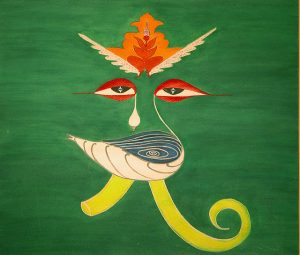
Amrita’s Ganesha

Are you composed or decomposed
In the undecidable of the in-between
Pulling towards and pulling against clicking into an archetype
But resisting that structuralist move with a dive into the plural symbol of the preindividual
As the ground of your interpretation as praxis
Playful as a Klee or a kite
In pop-op graphic art style.

The swan first comes to eye
– The Ramakrishna Mission having accustomed the eye to the sign of it –
With its black pool whirlpool –
Or is it a white shell
Or petal
Or leaf to the eye flower
Suddenly deliciously 3-D and tactile in a 2-D world
Its bud about to open
Which conforming to Einstein’s thought-experiment of nonlocality
Instantaneously though at a distance co-experiences the opening of corresponding
isolated eye-bud
From which drops –
A tear?
A small shell?
Into the ocean? A large shell?
Cup, leaf, receptacle?
The pearl in the oyster
The seed in the furrow
The jewel in the lotus?

Water to water, matter to matter
Or not quite any matter
But self-organized matter
Dry and durable
Carrying the seamarks of evolution
Only the flip side of the mutable medium
Its cooling or slowing (same thing) into a stable (though fragile) quasi-eternal medium
For archaeology of inscription, palimpsest, dense information archive
Techno-organic proto-individuals
Whose lord is the hybrid elephant-human splice, Ganesha
Claiming the shell-petal-cup-banana-rubberpipe-inside/out-twocolor-coil for its trunk
Or collapsing the elephant into its taxonomic ontology of animals including aves
The bird-flower-shell-water spliced with the divine-human eye
Observing but expressing compassion
In a mono-no-aware severe essentialism
Dried out to the bone
Of shell-tear.

Or the eye and the bird follow the image of the two birds of the Upanishads
One the witness bird, the eye
The other the bird of time, it’s matter-fluid inscribed with the spiral pattern of evolution
But the witness is not just sakshi
But the Mother expressing her descending compassion
In response to the evolving yet static ascent of the swan
Which, after all, is nothing but the fine twine of black and white threads
Spinning upwards like an oil wick with an eye-flame.

Yet the black pool refuses subsumpsion into universal frames
And pulls into the infinite (ananta) folds of involution-evolution
The tear of Tara-Kali, shell, liquid cocoon, multi-sheathed vessel
Not unlike the human material-vital-mental-psychic-supramental (and higher numinous) bodies
Or to get into the civitas dei a la Simondon, material-vital-psychic-transindividual body-in-the-making
Sutured through technology
Folded into the first evolutionary substrate as will to technology
Not for having but for becoming
Putting into relation in dynamic structures
Of inter-related complexity and baroque flexibility
The self-maintaining and self-perpetuating machines
Negotiated by the nameless will to individuation
Acting through each individual as agency.

The teardrop responds perennially to the aspiration behind the struggle for evolution
Fertilizing rain to the furrowing and seed-planting
Traveling the grades of consciousness without end
Though static as an Idea
Or what Deleuze would call a machinic portrait
Or Sri Aurobindo would call an event outside time
Or Tantra would call a yantra
An engine of perpetual becoming.

Tear of Green Tara
Mother of Compassion as Insight
Just as you are yourself the tear of Avalokiteshwara
The Compassionate Witness
Who looks at/after/into the locations of the lokas
And sees all that there is to be seen
Nothing is he allowed to close his eye from
So that to fertilize the needs of hunger and thirst
He produces you, body and soul, as a tear of Compassion-as-Insight-Idea
And you, O Mother Divine, allow to flow limpidly through you
Your self-replications as forms of compassion-insight becoming
Each a unique infinity of the Infinite
Outside a shell or liquid cocoon or multi-sheathed vessel
But inside, the Person, the One no other, You
Not a body-mind split but an added dimension
The center of the circumferenceless circle,
The jewel in the lotus,
Presence.

Compassion-as-Insight, Compassion
As Insight, Compassion-as-Insight
Can we like beads repeat
Hoping to arrive at Compassion-as-Insight
But without exercising compassion or insight
Compassion as insight implies understanding
The lightning bolt that illuminates Ignorance
Revealing the unity of things
Insight is searing, it is pitiless
It burns through the bone, leaving no residue
Unity as Idea is experienced as Insight
Not mental Idea, but Real-Idea
Experienced, in each sheath of consciousness in its own way,
At once as/by the In-dwelling Person.

Eye of Mother Kali, Eye of Mother Tara
Like the outspread wings of the silver eagle-bird of Vishnu
(Forming the orifice of exit of the tapas-Agni of your Third Eye,
Hot as turmeric, red as chili)
Are your eyebrows of massed Lightning
Supporting Indra who funnels his thunder-seed
As the Insight in your Compassion.

Like an exotic triple-petal-whorled fire-flower
On the summit of your archetype
Is this seat of Indra.
Above, and invisible, the solar Gnosis burns
Whose descent is Indra.
Below, at the other end
The playful swan has two dysfunctional legs
Or unstable props like long balloons
Spiralling to stability – kundalini paired with its bourgeoning complement
Reaching for balance –
The signs of the tusker.

you didn’t know did you – Joy Goswami

you didn’t know did you
that snighdhata, soft warm comfort
was a certain monsoon?
no one told you?
such a monsoon who by its free will
can wander all year long,
wanders,
in the sky:
a burst of rain today,
tomorrow, stormy cloud.
thence, from time to time there come instances of rainy breeze, cyclone.

whenever I close my eyes I can see
as soon as it rains the kids
dropping what they have run away to the fields and rivers;
and standing beside mud walls and tubewells village wives
call home their ducks from canals and ponds:
choi-choi, choi-choi, choi-choi.

About a hundred years back
A childhood friend teased you, calling you choi-choi,
do you remember?
today, in this life you are a swan of winter’s country
swimming from lake to lake
crossing oceans you wander to unknown distant lands.
but in this life too, someone
calls you by your pet-name from a hundred years –
calls you soundlessly, choi-choi, choi-choi.
and you, perhaps, hear nothing
isn’t it?

If I knew how to play sarod – Purnendu Pattrea

certain aches I have whose name is tilak-kamod
some such memories that are sindhu bhairavi
like jaijavanti many cracks remain in the interior walls
some hurting wounds in being one
yeman kalyan.
knowing to play sarod would have been very good.
how the purusha weeps only he knows.
in the carpet dressed beloved inner chamber water has entered.
shipwrecks at every instant, oppositional crafts afloat.
where drowns the septa-boat of all the earth’s loving
there blossoms a lotus like a woman.
water laughs on the bangled arm of waterness.
in the snake-bite of the ghagra, circling like a dancer,
all it snatches, all snatches then refills
with lotus fragrance, vast field, in the flute-hollowed reed of the heart.
this delectable destruction, this champa colored whitewash on the rusty door hinges,
Is this what is called darbari kanara?
knowing to play sarod would have been salutary.
how the purusha stays alive only he knows.

Lal Neel Sabuj/Red Blue Green – Purnendu Pattrea

I have many friends.
some red some blue some green.
red friends walk pushing boulders mountains of the ten horizons
crossing over all the bloodshed there will come a cloudless morning
the conch that will greet it, they seek out.
blue friends becoming naked enter the waters of the seven rivers
from the ocean’s womb to the docks of the constellations humans will voyage
the unworldly craft that will ferry them, they go in search of.
and green friends have lost themselves in the yellow forest.

Road-Walking

As though holding some gesture in my mind alone from city’s road to road
Much I have walked: much I have seen the correctness of moving trams and buses
Then leaving the road they know peace and withdraw into their worlds of sleep.

All night the gaslight knowing its duty burns in good conscience
No one errs – brick home signboard door window terrace
Becoming silent know the need for sleep under a sky.

Alone walking the road the deep peace of these in my heart I have known.
Was late at night: Many stars the heads of monuments and minarets
Have circled in silence. If anything more simple more perfect than this

I have seen I wonder: a sprinkling of stars and monument-peopled Calcutta?
My eyes are lowered – quietly burns my cigar – much dust and straw in the wind.
Shutting my eyes I step aside – from the tree many brown dry leaves

Have flown. In Babylon alone thus I have walked through night
For some reason. Why, today after a thousand thousand tired years I am yet to understand.

Vulture

From field to field and field – throughout the afternoon in sky and sky of Asia
Are grazing the vultures. Man sees market outpost settlement – soundless fields
Of the vulture. Where extreme silence of the field is standing next to the sky
As if another sky, – there the vultures descend once in succession
From the stern hard clouds: As if leaving their distant light the sleep-weary elephants of direction
Have fallen – Have fallen on earth in fields grounds wildernesses of Asia
All these discarded birds, but for a few moments: They then lift themselves to rise,
Huge wings of darkness on the palm tree. On the horns of the hills in sea’s margins
They momentarily survey the beauty of earth: When ships of the Sea of Bombay
In darkness of harbour dock, that they view : then to peaceful Malabar
They go flying: Passing round the sad corner of a minaret many vultures
Forgetting the birds of earth disappear to some kingdom beyond Death:
As if some Boitirini or desolated earthly lagoon of Separation
Is moved to weeping – strain your eyes to see where in the distant blue have merged all those Huns!

Gautam Ghosh / violet

Gautam Ghosh

Violet

I.
a color field of violet and on its fringes
two worlds, a copy in becoming and
a virtual ideal. The ideal first –

two registers: one showing four index birds
turned towards the color field like hieroglyphs of horus
though they could equally be a pack of parrots

and as with all foursomes, a dark outlier,
same but other and mysterious leader.

behind it looms a form, a formation of fire
spirit of the grey wolf guarding the ways, rearing like a predator,
though it could as well be a fairy princess.

This is the dynamic ideal, the other is the static:
the four birds separate and together with the fifth
harmonized around an idea, a fire-hieroglyph.

at the corner in an off-shade of the field
is the blown-up bindu, portal, yoni, worm-hole –
or seen objectively as idea, gnosis-fruit
carried on a duality-tray.

then the copy-in-becoming – the birds again,
in what seems three registers or two
and a transition station in-between.

these two registers of the actual
replicate the technical inscriptions of the virtual
in a dimension of becoming

in which each structure is rendered fuzzy
in a sumi-e of random ink,
meaning the plural becomings of the arche-ideas

(and there being no sign of it is not a proof of its absence:
an invisible stirring in each index of true freedom
freedom exceeding models).

beyond these registers is the signature of chaos
the fire of becoming not a replica but an equal of ideal being
and maybe prior, traveler of the worlds

II

swan of the supreme and spaceless ethers
wandering winged through the universe
spirit immortal

rose of ideal beauty, rose of god

free – perhaps the same freedom surmised above in each individual,
the fire of evolution alight in consciousness of becoming,
the negentropic dimension

uniting subject and object, the what and the who
a deferred difference a la derrida
which is becoming as play, in its own truth,

self-chosen by a player who wished to play with their plurality
along an evolutionary scale through an archeology of consciousness
built of fire, an alchemical cosmos of self-alchemists.

the self as alchemist in selves opens the discipline
of the relations of spirit and matter, or spirituality and magic,
the evolutionary self-becoming and person-making.

Hufreesh or Abstract Realism

by an art of abstract realism
is meant that the principle of abstraction
is not a medium for representation,
natural or technical.

a natural medium might be
a lens of natural or cultural forms
through which a movement of consciousness
expresses itself.

a technical medium might be
a theoretical form such as a color field,
once an innovation, now a tradition,
in transduction with a movement of consciousness.

Such media for transduction,
whether natural, cultural or theoretical,
have immense importance in themselves
as forms of collective individuation
carrying history as an evolving body

but that there can be an abstract realism
is a pointer in another direction, a signal
of an intensity equal spirit and matter,
hence arche-med(ium/a).

hufreesh’s abstracts are pointers
of this non-representational abstract realism
not to be mistaken either
with abstract materialism, where the principle(s)

whether color, texture or form
imprint themselves as movements directly
onto a physio-chemical or even biochemical substrate
a machinic geo-aesthetics or aesthetics of accident.

this, indeed, is the materiality
of the art object, but what it expresses
is a realism of pure becoming
matter of an intense relationality
phylogenetically coincident.

whether splintered mineral strata
suspensions of coagulating biota
vortices of chromatic circulation or
sizzling ascents of incandescent plasma –

the stacked fractal verticalities
are co-present in this concrescence
of transitions, thresholds, liminalities of passage –

color, texture, shape of psychic affect
captured in the process of becoming archetype
in the relative viscosity of consciousness-media.

in this way it is characteristic
of an artist resident of Auroville,
a city dedicated to spiritual experimentation
towards an earthly divine manifestation.

Note of course that terms such as “divine manifestation”
are not entirely open yet open
to plural understandings, tending towards
the formation of an utopian collective subjectivity

and individuation. at the same time,
the telos is an attractor and hence a reality-in-becoming,
that exerts its own influence from the future.

the images of artists
can give spiritual and cultural materiality
to such futures.
the abstract realism of hufreesh
exemplifies this expressive transindividuation.